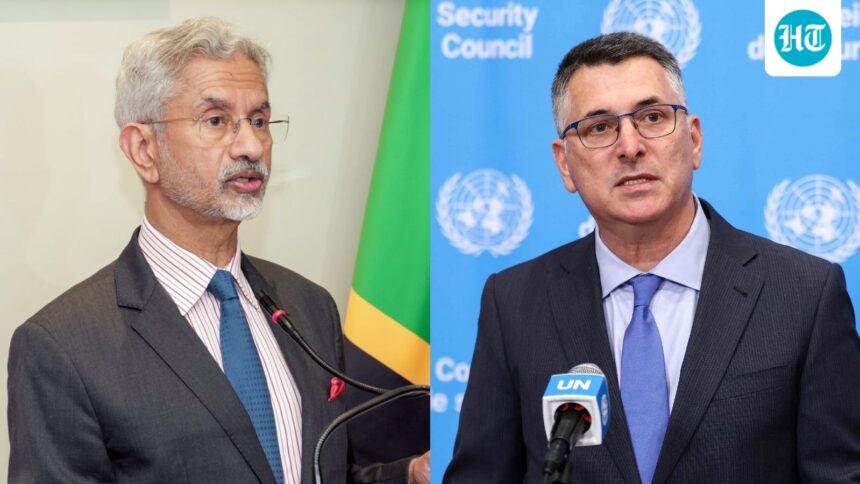
Indian External Affairs Minister S Jaishankar and Israeli Foreign Minister Gideon Saar on Tuesday discussed the West Asia crisis over a phone call, days after talks between the United States and Iran failed to reach a peaceful solution to the war that began with the Israeli-US attacks on Tehran about six weeks ago.

The Israeli minister said in a post on the X website that the conversation between Jaishankar and Sa’ar focused on the Iranian nuclear program and transit through the Strait of Hormuz, as well as the situation in Lebanon.
Meanwhile, Jaishankar also said that discussions took place on West Asia. He did not share further details. “I had a phone call this afternoon with Israeli Foreign Minister @gidonsaar. Our discussion covered various aspects of the situation in West Asia,” EAM said in a brief post.
Read also | Israel and Lebanon hold talks in US next week; The Israeli army continues to attack Hezbollah
The American position on the Iranian nuclear program is decisive: Saar
In the details of the conversations held with Jaishankar, Sa’ar confirmed that he informed Jaishankar that the American position during the negotiations regarding “the conditions that would prevent Iran from obtaining nuclear weapons (non-enrichment in Iran, and the removal of enriched materials from Iran) is critical to the entire international community.”
The Israeli Foreign Minister also alleged what he described as “economic terrorism” practiced by Iran in the Strait of Hormuz, saying it would harm “freedom of navigation and the global economy.”
He also said he had informed Jaishankar that this would require action from “all countries, including India and our friends in the Gulf.”
Read also | Will Iran impose duties on India due to its passage through the Strait of Hormuz? Tehran envoy answers
India raises its concerns about the situation in Lebanon
This comes even as India expressed concern over the increasing civilian casualties in Lebanon amid attacks launched by Israel.
Lebanon was one of the hotspots in the negotiations between the United States and Iran, as the latter said that the truce that was decided for two weeks included Lebanon. However, Israeli Prime Minister Benjamin Netanyahu had previously claimed that the ceasefire agreed upon by the US and Iran excuses Israeli action against Hezbollah in Lebanon.
Addressing a joint ministerial conference in New Delhi on recent developments in West Asia, Foreign Ministry spokesman Randhir Jaiswal described the situation in Lebanon as “deeply worrying”, given India’s long-standing commitment to peace and stability in the region. Jaiswal pointed out that about 1,000 Indian citizens live in Lebanon.
“We are deeply concerned by reports of a high number of civilian casualties in Lebanon. As a troop-contributing country to the United Nations Interim Force in Lebanon (UNIFIL) – which is invested in peace and security in Lebanon – the course of events is extremely worrying,” the State Department spokesperson said.