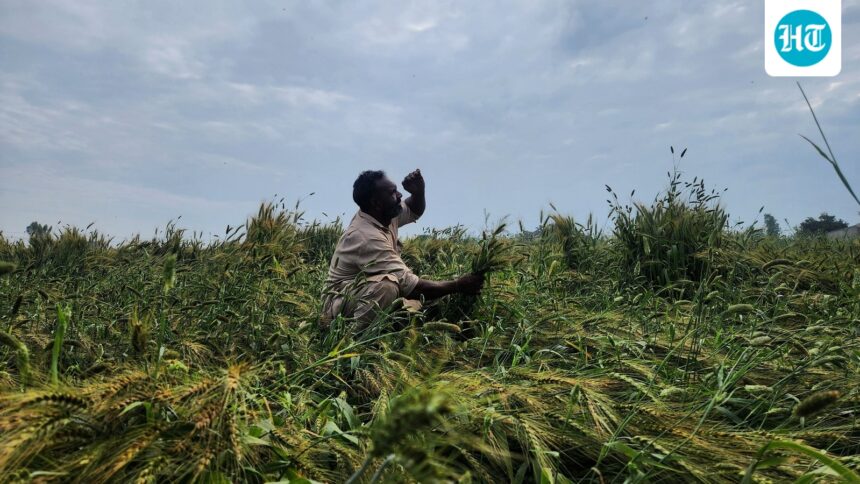
This year’s monsoon rainfall is likely to be below normal, the India Meteorological Office said on Monday, its first forecast of below-normal rainfall in 11 years, casting a dark shadow over an economy already worried about growth, agricultural production and inflation, all collateral damage of war in West Asia.

The last time India saw below-normal rainfall during the southwest monsoon was in 2023, although the Indian Meteorological Department forecast that year was for normal rainfall.
Read also:
The country’s monsoon rainfall is likely to reach 92% of the long-period average with a margin of error of +/- 5%, the IMD said in its first phase of its long-range forecast for the monsoon season on Monday, attributing it to the El Niño phenomenon.
The average LPA for the period 1971-2020 is 87 cm. IMD sets 96-104% of LPA as normal.
The spatial distribution indicates that below-normal monsoon rainfall is likely over many parts of the country except some areas in northeastern, northwestern and southern peninsular India, where normal to above-normal rainfall is likely.
The Met Office statistical model shows that there is a 35% chance of a ‘deficient’ monsoon (< 90%); 31% probability of a “below normal” monsoon (90 to 95%); 27% probability of a “normal” monsoon (96 -104%); 6% probability of an “above normal” monsoon (105-110%) and only 1% probability of “excess” rainfall (> 110%).
The projections carry significant economic implications. Monsoon is the lifeline of the Indian economy. According to the Ministry of Agriculture, 51% of the cultivated area in India, which represents 40% of production, depends on rain. With 47% of the country’s population dependent on agriculture for their livelihood, a lower-than-expected monsoon could dampen consumption in rural areas and push up food prices in a year when conflict in West Asia threatens to pose a greater threat to the availability of energy and fertilizer – critical agricultural inputs.
The last time India received “below normal” rainfall was in 2023, also an El Niño year, when rainfall over the country as a whole during the monsoon season was 94% of the long-period average.
El Niño conditions are likely to develop during the monsoon season especially during July, August and September, according to the Monsoon Mission Climate Forecast System (MMCFS). Currently, neutral Indian Ocean Dipole (IOD) conditions exist over the Indian Ocean and the latest climate models indicate that positive IOD conditions are likely to develop only at the end of the southwest monsoon season.
“In general, we can say that the onset of El Niño during the monsoon and neutral IOD conditions are likely to impact the monsoon. Hence we expect less than normal rainfall during the season,” said M Ravichandran, Secretary, Ministry of Earth Sciences.
He added, “But we expect the effect to be more noticeable during the second half of the monsoon. We do not expect much of the impact of the El Niño phenomenon during the months of June and July.”
El Niño and La Niña are two opposite phases of the natural climate cycle — called ENSO, or El Niño Southern Oscillation — driven by changes in sea surface temperature in the equatorial Pacific Ocean. El Niño, the warmest phase, usually suppresses the monsoon in India and leads to weaker rainfall. La Niña, its cooler counterpart, tends to enhance it.
El Niño “is likely to be strong,” said Mahesh Palawat, vice president of climate and meteorology at Skymet Weather. “Once it develops, it will likely gain strength at the end of July, August and September. Sea surface temperatures will rise rapidly over the eastern Pacific Ocean,” he said, adding that the agricultural community must be prepared. “It is better not to grow water-intensive crops. There needs to be communication of forecasts at the block level.”
M Rajeevan, former secretary of the Ministry of Earth Sciences, said a drop in the normal level during the monsoon season is “almost certain”. “At present, we do not know which areas will experience further rainfall deficits,” he said. “What is most important for farmers is not only the amount of rainfall but the onset and distribution of rainfall at the right time.” “Farmers should closely monitor the updated IMD monsoon forecast in May and the semi-monsoon forecast issued by the IMD every week.”
The IMD typically issues a second forecast around the end of May that includes an update to the monsoon rainfall forecast issued in April along with probabilistic forecasts of monsoon rainfall over the four homogeneous regions of India (northwest India, central India, south peninsular India and northeastern India) and the core monsoon zone (MCZ).
This release will also contain quantitative and probabilistic forecasts for the country as a whole, and the spatial distribution of probabilistic forecasts for June precipitation.
Skymet Weather, in its forecast last week, also predicted that monsoon rainfall this year would be below normal at about 94% of the long period average (LPA), with a margin of error of ±5%. There is a 40% chance of below-normal rainfall — between 90% and 95% of the LPA — and a 30% chance of drought conditions, with precipitation falling below 90% of the LPA, according to Skymet’s forecast.