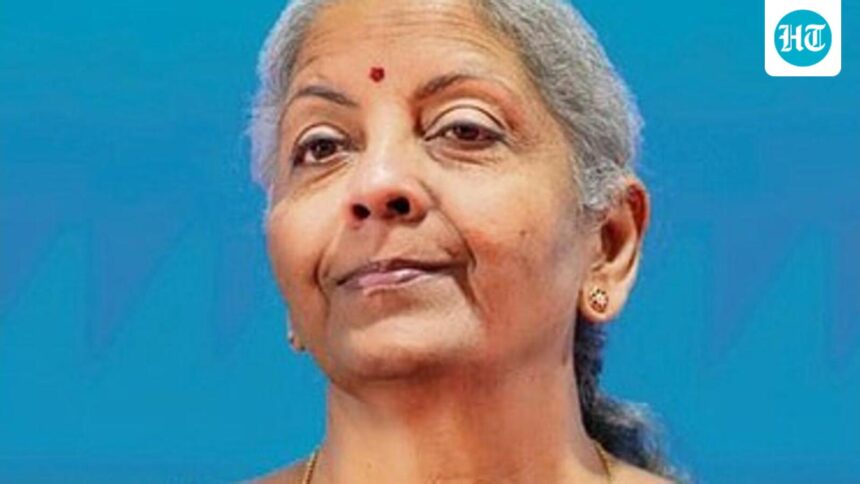
Union Finance Minister Nirmala Sitharaman on Monday intensified her attack on Tamil Nadu Chief Minister M K Stalin over the Centre’s rhetoric on the state’s bonus policy for paddy procurement, accusing him of creating “false narratives” and trying to drive a wedge between the Center and the states.

The Minister also released a copy of the January 9 letter sent by Expenditure Minister Phumlunmang Phwalnam to the state government which is at the center of the political storm. Tamil Nadu is scheduled to go to the polls on April 23.
She added that building food security requires constructive, continuous and positive engagement in the field of agriculture with all stakeholders. “However, Stalin seems to be continuing what he and his party do best, which is drawing a wedge between the Center and the states, creating false narratives and presenting themselves as protectors of farmers and other Tamil people,” she added.
Addressing an election rally on April 11, Stalin claimed that the Center had ordered the Tamil Nadu government to stop offering incentives for paddy procured from farmers as it leads to increased production.
Sitharaman responded to it on Sunday in a post on X, stressing that the letter sent to chief secretaries of all states was merely an advice to integrate incentive policies with national priorities.
Stalin insisted that he was only adhering to the letter sent to the state government, which indicated that the state government should consider discontinuing the bonus as the state’s additional bonus for paddy had led to bumper production. “I have not mentioned anything that is not in that letter. There is no need for me to do so,” Stalin said in a post on X on Monday, daring the Union minister to publish the letter.
Read also:FM slams CM Stalin’s claims on rice procurement incentives
Sitharaman shared the letter on
Noting that staple foods depend on imports and domestic food security becomes vulnerable to external shocks and price fluctuations, Sitharaman said: “This is not sustainable for a country of India’s size.”
“Expanding domestic production of legumes and oilseeds is not only an economic necessity, but also a strategic need,” she wrote on X.
“Doesn’t he (Stalin) know that the huge imports of palm oil are because our demand for edible oil is not being adequately met by oilseed supplies. It is the same with pulses. Farmers can get better prices for crops where there is a gap between supply and demand. Clearly, the interest of farmers is not in CM Stalin’s mind,” she said.
Sitharaman said that by encouraging the production of pulses, oilseeds and millets, India aims to achieve the twin goals of “food security” by improving access to protein-rich crops and “economic stability” by reducing the edible oil import bill.
Pointing out that many state governments across party lines understood the concept and responded in the spirit of cooperative federalism, Sitharaman said: “Only Prime Minister Thiru Stalin chose to raise it.”
She said that Stalin, instead of “wasting time on anti-Centre rhetoric”, should explain to the people of Tamil Nadu “why he is actually giving opportunities to foreign interests instead of making us self-reliant for pulses and oilseeds”.
Read also:Sitharaman suggests setting up a committee to evaluate the impact of AI and improve job opportunities
Maintaining that any Prime Minister would have welcomed the Centre’s view, Sitharaman said, “Stalin chose to distort a constructive proposal and turn it into an artificial complaint – because for the DMK, India’s strategic requirements are not a concern, but an opportunity to score political points.”
According to the state government’s policy note, in 2024-25, Tamil Nadu accounted for 4.72% of India’s rice production, 6.13% of maize and 6.45% of groundnut production, respectively.
During the period 2024-25, rice accounted for 34.66% of the total cultivated area. Thanjavur district emerged as a major contributor with a cultivated area of 2.10 lakh hectares, followed by Tiruvarur district with 1.96 lakh hectares and Tiruvannamalai district with 1.85 lakh hectares, the document said.