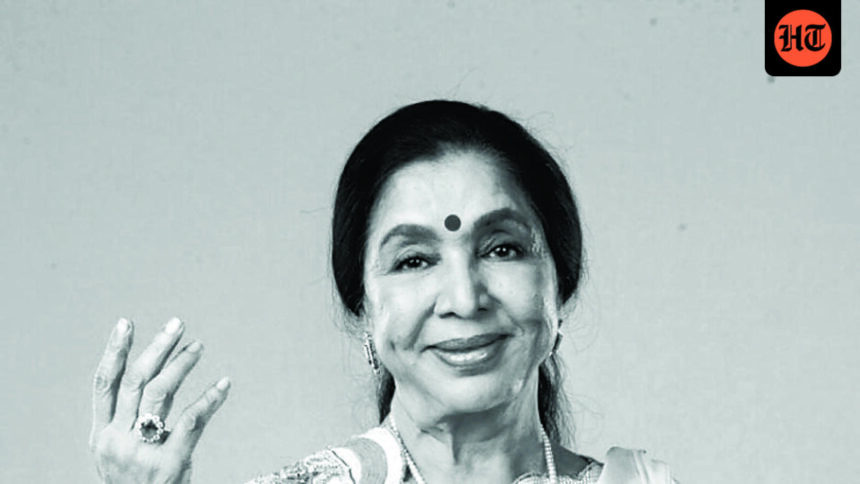
Asha Bhosle, a singer-songwriter and among India’s most beloved artists, died in Mumbai on Sunday, ending a glorious career spanning seven decades in which she sang more than 12,000 songs in 20 languages. She was 92 years old.

Bhosle was the last of a generation of great singers who took Hindi film music to its peak. The longevity of her career, her wonderful voice, and her openness to different musical inspirations means that she has influenced multiple generations of musicians and enthusiasts.
Condolences poured in from around the world hours after her death after a short illness. “Her unique musical journey spanning decades has enriched our cultural heritage,” Prime Minister Narendra Modi wrote on social media.
“The voices fade away, but her voice has retreated into a deeper chamber of memory, where it will continue to resonate with those who have known longing through song,” director Muzaffar Ali told HT. Asha Bhosle won the National Award for Ali’s song “Umrao Jaan” in 1981, and her songs are among the most memorable in her extensive oeuvre.
Born in Sangli, Maharashtra, on September 8, 1933 into a family of musicians with roots in Goa, she was only nine years old when she lost her father, Guru Dinanath Mangeshkar, the famous Marathi actor and singer. Lata Mangeshkar, the eldest of the five siblings, has joined a film studio in Kolhapur to keep the house fires burning. A year later, a young Asha also began participating when she sang her first song in the 1943 Marathi film, “Mazhe Bal” (My Child).
Although she has often been hounded by comparison with her sister, the legendary Lata Mangeshkar, Asha Bhosle has charted her own career path with her versatility, immense talent and perseverance. During the 1960s and 1970s in particular, the two sisters dominated the Hindi film music industry, often sparking debate among experts as to which of them was the GOAT.
Raj Thackeray, who knew the Mangeshkar sisters, compared them to the Leonardo da Vinci and Michelangelo of Hindi film music. “When you look at Da Vinci’s work, you keep feeling the perfection of it, the exquisite precision, the immense stillness, the spiritual experience that suddenly overwhelms you. All of this is felt in Didi’s (Lata Mangeshkar) singing… Then, in Michelangelo’s work, there is tenderness and passion and playfulness and rebellion too. Sometimes it feels as if his sculptures are impatient to break free from stone. It was the same with Asha Tai’s songs in her singing of longing, of mischief, of audacity, of this inherent human recklessness, And the intense desire to throw caution to the wind…” he wrote in a social media post.
This desire also affected Asha’s personal life when, at the age of 16, she eloped with a transport worker, Ganpatrao Bhosle, straining relations with her family. This was the year she gave birth to her first child and the couple was struggling to make ends meet.
In later years, Bosley would often recall her apprenticeship years. “I would do the morning chores – filling water, cooking, washing clothes – at our house in Borivali before leaving for work. Those were difficult times. I would travel by tram or train, going from studio to studio in search of a song. Beginner choir singers were paid $100 in those days,” this writer once recalled.
By the 1950s, Mangeshkar, Geeta Dutt and Shamshad Begum were at the forefront of singers, collaborating with distinguished music directors such as Anil Biswas, Naushad, C Ramchandra, S D Burman, Madan Mohan, Shankar-Jaikishan and Sajjad Hussain.
Bhosle had to content himself with talented but lesser-known composers like Hansraj Behl, Sardul Kwatra and Lachhiram, singing a mujra number here or a club song there.
But it was these so-called “B-grade songs”, meant to attract grandstand seats, that helped Bhosle cement her place in the fiercely competitive world of Hindi film music.
“By giving voice to vamps, ‘fallen’ women, Bhosle offered an appeal as a counterpoint to the heroine of Hindi cinema, who was condemned to uphold conservative values. This was long before the topic of women’s empowerment came into public discourse,” says writer and artist Prakash Pal Joshi. “Asha Tai made seduction look respectable.”
Her elder sister’s disagreements with two senior music directors, OP Nayyar and SD Burman, created a loophole which Asha Bhosle exploited with persistence and gratitude.
Her association with SD Burman has resulted in memorable songs like, “Achha Ji Main Haari Chalo” (“Kala Pani”), “Chhod Do Anchal Zamana Kya Kahega” (“Paying Guest”), “Haal Kaisa Hai Janaab Ka” and “Paanch Rupaiya Baara Aana”. “Chalti Ka Naam Gaadi”, “Raat Akeli Hai Bujh Gaye Diye” (“Jewel Thief”), but not limited to. It also introduced her to Burman’s young son Rahul Dev who would later become the central figure in her life and career.
But it was her association with OP Nayyar that brought her to the upper echelon of singers. Nayyar not only gave her the opportunity to sing for the leading ladies of the late 1950s and 1960s like Madhubala, Vyjayanthimala, Sadhana, Asha Parekh, Mala Sinha and Sharmila Tagore, but also helped her refine a style different from her illustrious sister.
“My songs needed a focused sound,” Nayyar once told this correspondent during an interview at his Marine Drive apartment. “Though he was a great singer, Mangeshkar’s voice was too fragile for my type of compositions, while Ashaji’s voice exuded a certain raw energy.”
The 18-year Nayar-Bhosle partnership has produced a rich harvest of tunes: ‘Maang Ke Saath Tumhara’ (‘Naya Daur’), ’Zara Haule Haule Chalo More Sajna’ (‘Saawan Ki Ghata’), ‘Yahi Woh Jagah Hai’ (‘Yeh Raat Phir Na Aayegi’), and ‘Jaiye Aap Kahan Jayenge’ (‘Mere Sanam’) ‘Koi Kehde Kehde Zamaane Se Jaake’ (‘Baharein Phir Bhi Aayengi’) Among many other things.
The two broke up in 1972. Old-timers remember how the musicians fought back tears while recording “Chain Ae Humko Kabhi” (“Praan Jaaye Par Vachan Na Jaaye”). This emotional tune was the swan song of the Nayyar-Bhosle partnership.
Her 1965 collaboration with Rahul Dev Burman in Revitalized Hindi film music, bringing a modern folk feel. They went on to create a string of memorable cabaret numbers in other films such as “Piya Tu Ab Toh Aaja” (Caravan), “Duniya Mein Logon Ko…” (“Apna Desh”). RD modified old melodies, combining them with new musical phrases and influences: Arabic, Mediterranean, blues, bossa nova, matching powerful African rhythms with traditional dholak. Bhosle was quick to upgrade her vocal skills in order to keep up with the changing times and technology. In 1980, long divorced, she married R.D. Burman.
This new collaboration between Bhosle and Burman has brought a breath of fresh air into the smoky recording studios creating new beats for the youth of India inspired by flower power. “Sita Aur Geeta”, “Bombay to Goa”, “Caravan”, “Yadon Ki Baaraat”, “Jawaani Deewani” Hare Rama Hare Krishna They were just some of the films in which they created memorable music. This new phase is best summed up with two songs “Dum Maru Dum” (“Hare Rama Hare Krishna”) and “Chora Liya Hai Tum Ne Goh Dil Ko” (“Yadon Ki Baaraat”) Which remains popular to this day.
Even now, at the peak of her prowess, she has expanded her body of work and sound. While purists swear by its ancient numbers such as “Tang Aa Chuke Hain Kashm-e-Kash-e-Zindagi Sey Hum” (“Lighthouse”) and “Ab Ke Baras Bhej Bhaiya Ko Babul” (“Bandini”), She has upped her game for the post-liberation generation with songs like “Yay re, yay re, zur laga ki naash re.” from ‘reinventing itself for the more tech-focused genius AR Rehman.
But one of her greatest triumphs came between these two stages when she sang “Umrao jaan.” Khayyam, or so the story goes, asked Bosley to tone down her voice a note or two to enhance the song’s remaining impact. gazelle. after “Umrao jaan” There was no looking back for her.
She held concerts in the United States, Canada, the United Kingdom, and Dubai. In the early 1990s, she collaborated with Boy George and Stephen Lauscombe of the synth-pop band Blancmange; It was nominated for a Grammy Award. “Brimful of Asha”, British band Cornershop’s tribute to the famous singer, became an international hit.
Bhosle also collaborated with sarod maestro Ustad Ali Akbar Khan for ‘Legacy’, a special album that brought them a Grammy nomination. She also turned entrepreneur and established ‘Asha’s’ restaurant chain in Dubai, Kuwait, Doha, Bahrain and Abu Dhabi. Over the years she has been awarded a host of awards: Padma Vibhushan; Dadasaheb Phalke Award; Lata Mangeshkar Award offered by the Government of Madhya Pradesh; Maharashtra Bhushan Award and BBC Lifetime Award, among several others.
But despite the accolades, she often joked about her second position in Hindi cinema compared to her sister. “The world remembers Neil Armstrong as the first man on the moon. Buzz Aldrin was with him, too!” she once shouted at a public event, her tongue firmly in her cheek.
In her personal life she brought the same verve that could be found in her singing. There are many who attest to her sensational cooking. “Asha Tai made amazing paya soup and macchi biryani,” revealed close family friend Prasad Mahadkar. “Many of the female fishermen from the Grant Road market were her close friends.”
Personal adversity and bereavement failed to quench her great lust for life and music. “Asha Tai knew that life was unpredictable and fame was fleeting. She took each day as it came and continued working courageously – always one step ahead,” says Mahadkar.