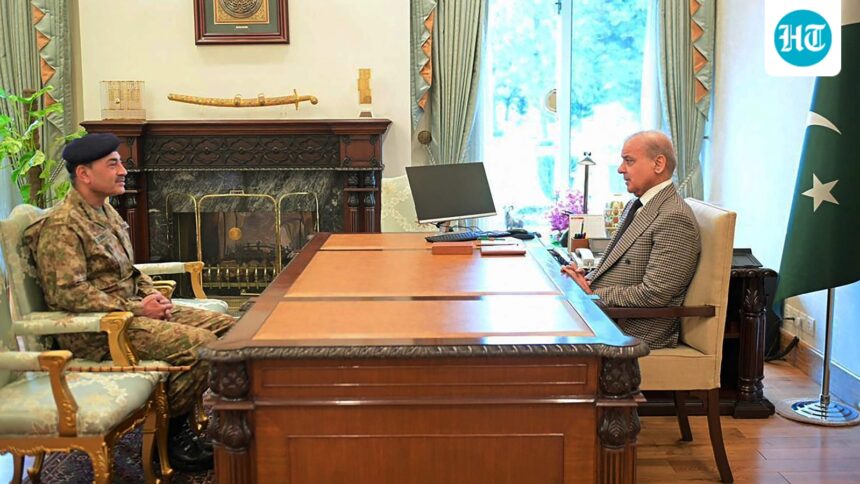
American President Donald Trump on Sunday praised Pakistani Prime Minister Shehbaz Sharif and Pakistan Army Chief Field Marshal Asim Munir, while again repeating the claim that he stopped Islamabad’s war with India last year, something New Delhi has repeatedly denied.

Trump’s new reiteration of this claim came in a post on the Truth Social website after Pakistan hosted talks between the United States and Iran to end the war between them, which began six weeks ago. The Republican leader said the meeting was held under the “very competent leadership” of Sherif and Mounir.
“The Vice President questioned me fully J.D. Vance, Special Envoy Steve Witkoff, and Jared Kushner, wrote about the meeting held in Islamabad through the very courteous and competent leadership of Field Marshal Asim Munir and Prime Minister Shehbaz Sharif, of Pakistan.
Trump described the two Pakistani leaders as “extraordinary men” and claimed that they “continually thank him” for saving the lives of 30 to 50 million people in the “horrific war with India.” He also said that he always appreciates hearing that.
The US President said: “They are very extraordinary men, and they constantly thank me for saving the lives of 30 to 50 million people in what would have been a terrible war with India. I always appreciate hearing that – the scale of humanity that is talked about is incomprehensible.”
The three-day conflict between India and Pakistan began when New Delhi struck terrorist launch pads inside Pakistani territory on May 7 last year under Operation Sindoor, in response to the Pahalgam terror attack. The ceasefire was announced on May 10, and Trump has claimed credit for it ever since, even though India has repeatedly said he had no role in it.
Failure of the US-Iranian talks
The United States and Iran have blamed each other for the failure of the talks to end six weeks of fighting that has killed thousands, roiled the global economy and sent oil prices soaring.
Vice President J.D. Vance, who led the US delegation to the Islamabad talks, said: “The bad news is that we did not reach an agreement, and I think this is much more bad news for Iran than it is bad news for the United States of America.”
Iranian Parliament Speaker Mohammad Bagher Qalibaf, who led his country’s delegation alongside Foreign Minister Abbas Araghchi, blamed the United States for failing to gain Tehran’s trust despite his team presenting “forward-looking initiatives.”
“The United States has understood Iran’s logic and principles, and it is time for them to decide whether they can gain our trust or not,” Ghalibaf said on Channel X.
The talks, which followed the ceasefire announcement last Tuesday, were the first direct US-Iranian meeting in more than a decade and the discussions were at the highest level since the 1979 Islamic Revolution.
Vance said Iran chose not to accept US conditions, including not building nuclear weapons.
“I could go into great detail and talk about much of what has been achieved, but only one thing matters – Iran is not ready to give up its nuclear ambitions!” Trump later said.
Iran’s semi-official Tasnim news agency said that “excessive” American demands had hindered reaching an agreement. Other Iranian media said there was agreement on a number of issues, but the Strait of Hormuz and Iran’s nuclear program were the main points of contention.
Pakistani Foreign Minister Ishaq Dar said it was “essential” to maintain the ceasefire. Speaking in Rome, Pope Leo on Sunday also called for a permanent ceasefire and expressed how close he was to the “beloved Lebanese people.”