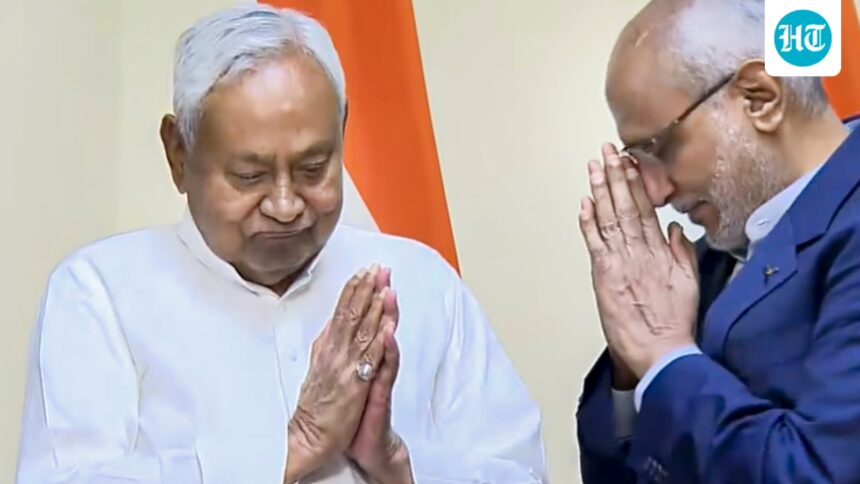
After weeks of political uncertainty in Bihar, a date has finally emerged: April 14. It is learned that Nitish Kumar, who was sworn in as a Rajya Sabha MP on Friday, April 10, will resign as chief minister of Bihar on that day, paving the way for the first BJP chief minister in the state, and the end of a two-decade political era defined by one man.

A history loaded with importance
April 14 is not an ordinary day on the calendar, politically or otherwise. It marks the birth anniversary of BR Ambedkar, the architect of India’s constitution and a prominent icon of the Dalit rights movement, and so the choice of date carries symbolism in Bihar’s deep caste landscape.
But there is another alleged reason that is spoken in somewhat hushed tones. The Kharmas period – an approximately month-long window considered inauspicious for major decisions according to the Hindu calendar and observed prominently in Bihar, Jharkhand and eastern Uttar Pradesh – ends on April 14. No senior leader has recorded this, but local media have emphasized the closeness of the auspicious calendar date and Ambedkar’s birth anniversary as being key to the choice of this date.
A long career comes to an end
Nitish Kumar’s departure from Patna’s political scene marks a historic shift, though leaders of his party Janata Dal (United) or JD(U) said he would stay back in the state capital and travel to Delhi to attend Parliament sessions.
Since Kumar first became chief minister in 2005, he has been Bihar’s longest-serving chief minister and most dominant political figure. By his own claim, he ended the RJD’s ‘jungle raj’ and led the state towards development, though he re-aligned with his enemy Lalu Prasad Yadav in the RJD in between.
His political journey stretches back to 1985 when he entered the Bihar Assembly as an MLA, and later served as a Union Minister in the BJP-led Atal Bihari Vajpayee-led NDA regime, before beginning long innings in Patna’s Ann Marg 1.
His move to Rajya Sabha is in itself historic. He is the first prime minister to announce his move to the Senate of Parliament.
Although health was cited as a reason, he cited his desire to become a Rajya Sabha Member of Parliament as the reason for his resignation. This would give him the unique distinction of being a member of the upper and lower houses both in Bihar and at the Centre.
Nitish Kumar resigned from the Bihar Legislative Council on March 30, fulfilling the legal requirement that a person elected to the Rajya Sabha must vacate his seat in the state legislative council within 14 days.
However, the constitution allowed him to continue as chief minister for up to six months without being a member of the state legislature, providing time for the NDA to finalize his successor.
Who are the competitors?
The BJP, the dominant partner in the NDA coalition but has never served as chief minister in Bihar, now has a chance.
The party won 89 seats in the 2025 Lok Sabha elections, making it the largest party in the Vidhan Sabha for the first time. While its ally JD(U) won 85 seats. The NDA swept 202 of the 243 seats, diminishing the RJD-Congress-led Mahagathbandhan.
Three names emerged at the top of the BJP list.
Deputy Prime Minister Samrat Chaudhry is widely considered the front-runner. As a key leader of the Kushwaha community, the second largest backward caste in Bihar, his elevation would boost the party’s OBC account. He currently holds the Home Affairs portfolio and is in his second term as Deputy Prime Minister.
Union Minister Nityanand Rai is another strong contender. He is a four-time former MLA from Hajpur and also served as state president of BJP.
Dilip Kumar Jaiswal, a three-time MLA and former BJP president in Bihar, is currently ranked first.
However, the BJP is known to draw new cards and faces when it comes to selecting state leaders.
There’s a dynasty subplot as well. JD(U) leaders are said to be backing Nishant Kumar, son of Nitish Kumar, who recently joined the party, as a potential deputy chief minister, making him the heir to his father’s legacy within the alliance.
The opposition led by RJD’s Tejashwi Yadav has accused the NDA government of plunging Bihar into uncertainty and two months without a Cabinet meeting.