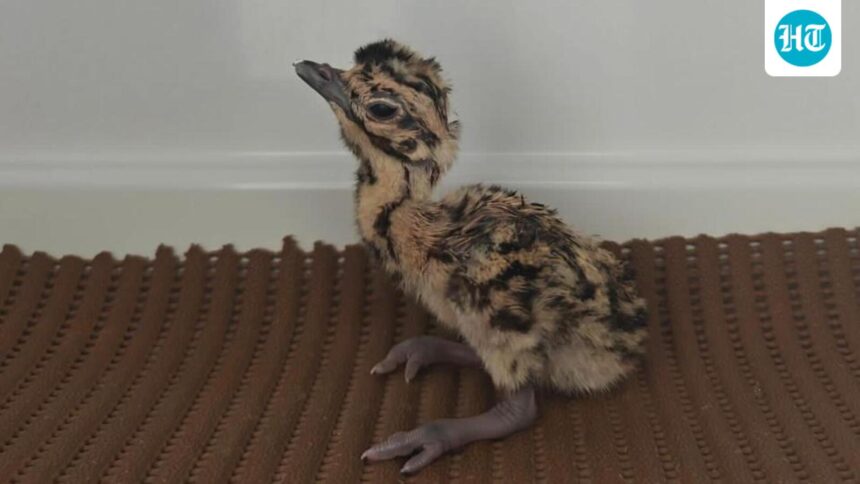
Three of the 11 great Indian bustard chicks recorded this season in Rajasthan’s Desert National Park were born through natural mating and not through the usual “human-assisted” breeding efforts, forest officials said.

Forest officials said birds reproducing on their own is a “sign of reduced stress” in captivity and “better adaptation”.
Earlier, efforts relied heavily on eggs collected from the wild. However, the birds at the Ramdevra and Soudasari conservation centers are now forming pairs and breeding independently. Experts believe that this achievement could play a decisive role in stabilizing the population of this species in the coming years.
The Houbara Recovery Programme, launched in 2016, is a joint initiative between the Rajasthan government, the Ministry of Environment, Forest and Climate Change and the International Fund for Houbara Conservation.
“Today, in addition to 33 founder birds, 46 great Indian bustards have been born here,” said Brijmohan Gupta, district forest officer.
“The biggest success is that scientists are now only playing the role of caregivers, with the birds themselves taking on the breeding responsibilities. If this momentum continues, the great Indian bustard population could reach a safe level within the next five years,” he added.
The Forest Department is preparing to release 79 bustards into open habitats. Officials said experts initially feared that captive-bred birds might have difficulty surviving in the wild, but the health of the chicks has boosted confidence in their preparedness.
Before their release, predator-proof fences were set up in grassy areas. In addition, bird diverters have been installed on high-tension power lines to prevent fatal collisions – one of the biggest threats to this species.
The Great Indian Bustard, also known as the ‘Godawan’, is listed under Schedule I of the Indian Wildlife (Protection) Act 1972, Appendix I of the Convention on International Trade in Endangered Species (CITES), and Schedule I of the Convention on Migratory Species (CMS) – providing it with the highest level of legal protection.
The great Indian bustard is the state bird of Rajasthan. Once widely distributed throughout the Indian subcontinent, its population has declined to less than 200 individuals, with the majority now found in Rajasthan and Gujarat, and smaller populations in Maharashtra, Karnataka and Andhra Pradesh.
The fourth phase of the conservation program is underway.
In 2022, the Jaisalmer Breeding Center collected 30 eggs, of which 24 successfully hatched, although two chicks later died. By April 2023, 13 more eggs had hatched through artificial incubation. The program focuses on captive breeding and creating a sustainable environment for future releases into the wild. The current phase, 2024-2029, focuses on developing artificial insemination techniques in addition to captive breeding, while continuing cooperation with the International Fund for Houbara Conservation.
The program has already achieved two major milestones: the successful artificial hatching of GIB eggs and the production of chicks through artificial insemination, representing important progress in the long-term conservation of this species.