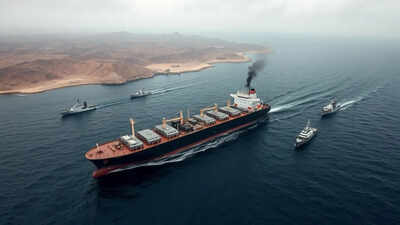
The Strait of Hormuz remained a critical checkpoint throughout the conflict involving the United States, Iran, and Israel. US President Donald Trump has warned several times that if Tehran does not open the strategic waterway to full and safe traffic, it could face dire consequences.The strait, a narrow passage between the Persian Gulf and the Gulf of Oman, has remained a point of contention because it carries nearly a fifth of the world’s oil supplies and serves as a vital artery for global trade.It is also a major route for liquefied natural gas and other commodities, making any interruption a matter of global concern.
Why can’t Iran fully reopen the strait?
Iran’s inability to restore normal shipping traffic is due primarily to the sea mines it deployed during the initial phase of the conflict. According to US officials, many of these mines cannot now be located. The New York Times reported that they were buried using small boats by forces linked to the Islamic Revolutionary Guard Corps. Some of these mines may have been swept away by sea currents, adding to the uncertainty. This means that large parts of the waterway remain unsafe, where a single undetected mine could severely damage a ship. As a result, shipping companies are unwilling to resume normal operations without verified safe routes.
Technical limitations and security concerns
It is much more difficult to remove sea mines than to place them. The process requires specialized equipment and trained personnel and must be performed slowly to avoid accidents. Iran currently lacks the capacity to carry out large-scale mine clearance operations within a short period of time.The situation is further complicated by the continuing security risks. There are concerns about possible drone or missile attacks, as well as the presence of small boats that could be used to disrupt shipping. Even after damage to its naval assets, Iran retains the ability to create uncertainty in the waterway, making its full reopening difficult.
Strategic pressure and negotiations
This issue has also become central to ongoing diplomatic efforts. The ceasefire conditions highlighted by Trump call for the strait to be reopened “fully, immediately and safely.” However, Iran indicated that any reopening would be subject to “technical restrictions,” a point raised by Foreign Minister Abbas Araqchi.The talks, attended by US Vice President J.D. Vance and Iranian officials, are expected to address how to restore safe passage. Meanwhile, Iran has proposed measures such as tolls and controlled roads, which the United States has rejected, describing the strait as an international waterway.These overlapping challenges have delayed the full reopening of the Strait of Hormuz. Until safe navigation is ensured, the waterway is likely to operate below normal capacity, with continued impacts on global energy flows.
Trump rejects the plan to impose tariffs on Iran
In the midst of the crisis, Trump strongly opposed Iran’s proposal to impose transit fees on ships passing through the strait. He told reporters, on Saturday (local time), that the United States will not allow any such movement, stressing that the waterway is an international route.“No, we won’t allow it, it’s international waters. If they’re doing it, we won’t let it happen,” Trump said, dismissing the possibility of allowing tolls.He also criticized Tehran for trying to use the Strait as leverage in negotiations, saying such actions amount to short-term pressure on global trade.