

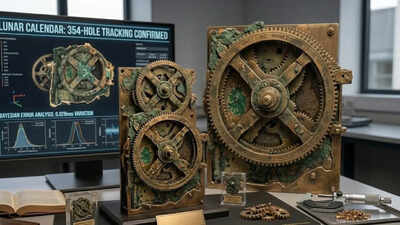
The Antikythera Mechanism has been described as the world’s first analog computer since it was found in a shipwreck off the coast of Greece in 1901, but until now, we haven’t known precisely how it was built inside.
The Antisythera Mechanism – an eroded chalk artifact discovered in a Roman shipwreck in 1901, has been called the world’s first analogue machine since the day it was discovered. However, its internal dynamics have remained mysterious over the past two millennia. One of the first major pieces of research using the new method was carried out by University of Glasgow scientists using experimental archeology combined with findings by Chris Podicelec (Clickspring) who experimentally constructed Antica Tirrena mechanisms.
Data were included in the full analysis using Bayesian statistics (which was first developed to find gravitational waves). The end result of this interdisciplinary research confirmed that this device was created and calibrated to track the lunar calendar and that it could provide us with a glimpse into how advanced ancient Greek craftsmen were in their time and how advanced they were also at the same point in history compared to today’s modern digital computers.
Chris Podislik helped scientists solve a mystery The oldest computer in the world
According to the University of Glasgow, YouTuber Chris Podisilk, creator of the Clickspring YouTube channel, can be credited with starting a hack that stems from his years documenting his attempts to create a replica of the Antikythera Mechanism. This process allowed him to provide researchers Graham Won and Joseph Bailey with important physical data that helped them use modern statistical models to analyze ancient parts of the mechanism.
His applied experimental archeology has provided researchers with essential data that traditional observational methods have been unable to provide for more than 100 years.
How scientists mapped a 2,000-year-old ring
Glasgow researchers determined that the mechanism’s calendar ring contained either 354 or 355 holes using Bayesian analysis, as written in the Horological Journal. This method is a commonly used statistical analytical method to analyze gravitational wave signals in space by removing background noise.
Their use of this method with data provided by the Clickspring transcript revealed that the calendar was designed to follow the Greek lunar calendar, with 354 days (followed by one intercalated day).
It was therefore not a representation of the 365-day solar calendar.
Why was 2,000-year-old computing ahead of its time?
According to this research, the holes in the ring were arranged with a radius of about 77.1 mm with a radial difference of only 0.028 mm, indicating that the ancient Greeks were likely able to apply very sophisticated dividing machines or engineering techniques.
These results prove that technological progress was much more advanced than previously thought, and that mechanical computing was much more advanced than previously thought 2,000 years ago.
How did the ancient Greeks mechanically encode bronze using this device
Originally discovered in 1901 off the coast of the island of Antikythera in Greece, this device was manufactured around 60-70 BC, and is now known to be the world’s first remaining example of analogue computing. The Antikythera Mechanism functioned as a celestial calculator, mechanically encoding solar eclipses and the astronomical motion of the five known planets through the geometry of precisely calibrated gear teeth.