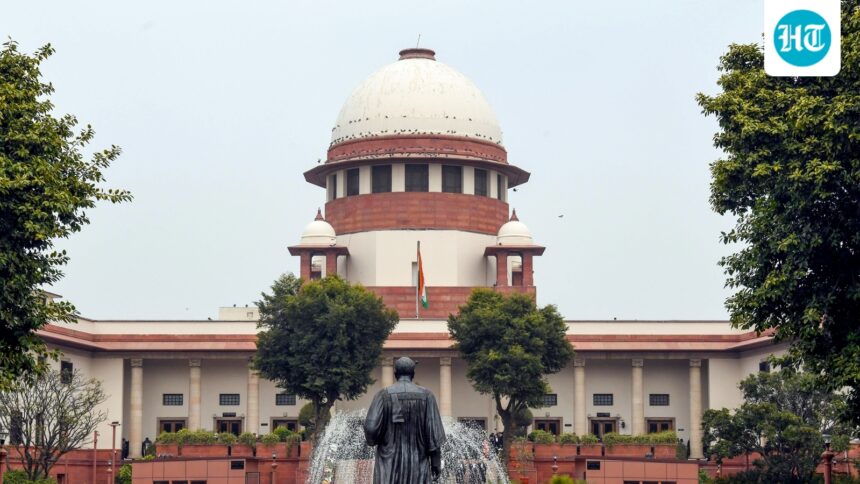
The Supreme Court on Wednesday hit back against the Union government’s argument that courts cannot pass judgment on religious practices by calling them superstitious or irrational, reminding the Center that even religious freedoms under the Constitution are subject to public order, morality, health and other fundamental rights.

On the second day of the hearing of the Sabarimala reference, a nine-judge bench led by ICC Surya Kant stressed that while courts may exercise restraint in religious matters, they cannot be “entirely stripped” of their jurisdiction when the practice is found to blatantly violate constitutional guarantees.
“If something shocks the conscience of the court… on the face of it, there may be no need for further judicial exercise. The court will simply say that it is against public order, morality or health,” the CJI observed, responding to Solicitor General Tushar Mehta’s submissions. The bench also includes Justices B V Nagarathna, M M Sundresh, Ahsanuddin Amanullah, Arvind Kumar, A G Masih, R Mahadevan, Prasanna P Varali and Joymalia Bagchi.
Read also | SC questions use of ‘untouchability’ to test Sabarimala entry ban
This exchange represents a continuation of the Court’s careful examination of the Center’s central argument that secular courts lack the institutional competence to determine whether a religious practice is superstition and that such reform should be left to the legislature. Mehta said that judges, as experts in law rather than religion, should refrain from classifying practices as irrational or unnecessary, warning that such a practice could amount to judicial overreach in matters of faith.
But the bench was not convinced by the sweeping nature of this submission.
Read also | Question of faith beyond judicial review: Government before Supreme Court over Sabarimala
Justice Amanullah described the argument as “overly simplistic,” stressing that courts retain the power to examine whether a practice is superstitious, even if the method of reform ultimately rests with the legislature.
Justice Sandrich added that adopting a “hands-off approach” in all such cases would effectively strip the courts of their constitutional role, especially when the practice is so clearly a violation, drawing comparisons to practices like sati, he said. For his part, Justice Bagchi tested the limits of the Centre’s argument through hypotheticals, asking whether the courts would remain powerless if practices such as magic were considered part of religion in the absence of legislative intervention.
While Mehta stressed that such issues can be addressed on the basis of public order and morality, and not by describing them as superstitions, the bench repeatedly pointed out that judicial review cannot be limited to such a narrow limit.
At the same time, Justice Nagaratna emphasized that courts, while examining fundamental religious practices, must do so from within the philosophical framework of the religion itself, but always subject to constitutional constraints. She noted that “this does not detract from the court’s jurisdiction in an appropriate case,” stressing the balance between respect for doctrine and constitutional scrutiny.
Read also | The Supreme Court’s Sabarimala Review Bench reflects diversity across religion, region and gender
The session also witnessed a broader debate on the meaning of “morality” under Articles 25 and 26, with the Center arguing that it should be understood as “societal morality” rather than “constitutional morality” – a concept it described as vague and undefined.
The bench appeared to be divided on the matter, with Justice Bagchi observing that constitutional morality governs secular life, while religious practices may be guided by the internal morality of the sect, raising questions about how to reconcile the two in a constitutional democracy.
In an aside, the CJI also questioned the reliance on academic writings in constitutional jurisprudence, particularly in the 2018 Joseph Shine judgment that struck down the offense of adultery, stating that such views are ultimately “subjective”.
At the same time, the bench made it clear that Joseph Shine’s validity itself is not directly under challenge in the current proceedings, even as the Center urged the court to declare its rationale not to be good law.
The court, which will continue hearing the case on Thursday, was tasked with answering questions arising from the 2019 reference, including the scope of judicial review of religious practices, the contours of the doctrine of essential religious practices, and the meaning of constitutional morality.