Logo text
[Thisstorycontainsspoilersfor”MyOdds”theApril8episodeof[Thisstorycontainsspoilersfor“MyOdds”theApril8episodeofScrubs.]
throughout the operating period Scrubs – Both the original series and this season’s revival – John C. McGinley’s Dr. Perry Cox was, as McGinley himself said, “a very damaged man.” The character uses an arsenal of insults and perversions to cover up weaknesses that he adamantly refuses to acknowledge or show.
It turns out he’s no different as a patient.
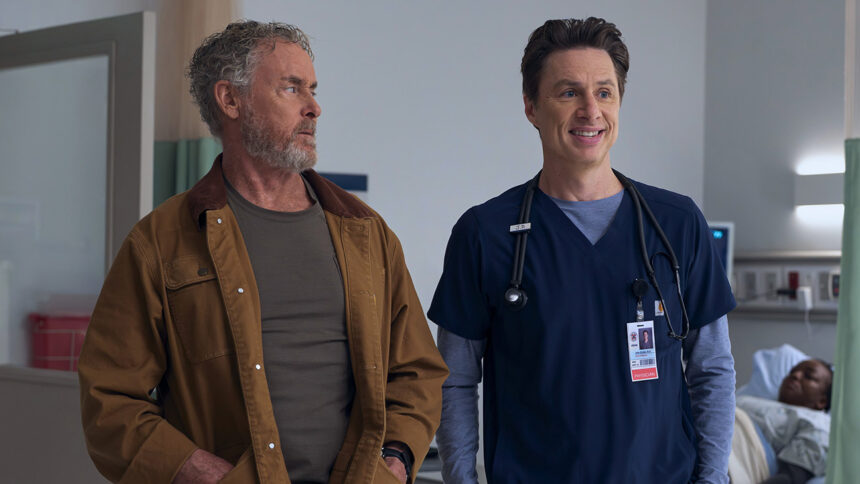
The penultimate episode of the season, “My Odds,” brings Dr. Cox back to Sacred Heart. At first it seems he’s only there to briefly check on J.D. (Zach Braff) — the hospital’s head of medicine after Cox stepped down in the season premiere — before heading to dinner with the equally sour Dr. Kevin Park (Joel Kim Booster). However, the episode shapes up in a way that makes it clear that Perry is spending a lot of time in the hospital. Sure enough, just as J.D.’s voiceover makes the same point, Perry passes out in the hallway.
He’s been diagnosed with an autoimmune disorder — one that can be treated but will cause him to spend more time in the hospital, under J.D.’s care. As he did all his life ScrubsPerry resents the idea even though he knows, at some point, that J.D. is giving him good advice.
“I think the character of Zach, as the protagonist, is on the hero’s journey… the hero needs a threat,” McGinley said. Hollywood Reporter. “There has to be a risk. Right now, the threat is that his trainees are not learning the way they should be learning. But he [also] It requires a personal threat. The scene must be crisp. Incorporating Cox back into this satisfies that.
McGinley points out that Cox’s stubbornness is also linked to the way he has always approached his work. Weapon-level sarcasm and withering monologues are part of how he teaches and who he is. He left Sacred Heart at the beginning of the season, choosing J.D. as his successor, as he realized that his method of teaching wasn’t landing with the current generation of trainees (this point is also the subject of a well-played joke in the episode’s final scene), and he attempts to atone for his past tactics in a heartfelt confrontation with Sarah Chalke’s Dr. Elliot Reid.
“I think his perception is that by teaching these people how to save lives, he’s serving a greater good, and the greater good is saving their lives. Don’t worry about my life. You’ve got me,” he said. “You have to take care of the greater good. So when I teach you, or Elliot, or you, or J.D., or whoever, there’s a bigger game at play here. We’re not changing light bulbs, we’re not hooking up pipes, we’re saving lives. Cox has to pick up on those things.” [His well-being] It has to take a back seat to the goal, and the goal is for you people to be able to do it without me.
McGinley also praised the show’s writers, past and present, for not letting Dr. Cox’s “parade of aberrations and mischief” become one-note over the course of the character’s life. “Perry Cox is a very damaged man, isn’t he?” He said. “Writers can write damage without making a character redundant. The leading guy has to get the girl, the girl has to get the leading guy, and then as they go from there, they have to invite new challenges into their story. The writers, over 10 years now, have managed to make it not a redundant exercise in revisiting the same conflicts.”
For all its absurdity, Scrubs She never hesitates to confront the reality of her hospital – where patients die despite the best efforts of doctors and nurses, and it can have a profound impact on them. McGinley said Cox’s current situation reminds him of a guest appearance Brendan Fraser made early in the series’ original run: Fraser played Ben, Cox’s brother-in-law who was diagnosed with leukemia during two episodes of the first season. Ben returned in Season 3, seemingly in remission, but then went into cardiac arrest and died — a fact that Cox refused to face for a while.
“We saw the impact it had on Cox in a very disturbing way,” he said. “For him to face this internal challenge, this challenge with his organs, you might be able to see the end. When your friends and my friends have the chance, you can reconcile things before they pass. This is a whole different journey. Obviously some of your friends and mine have been taken out and there’s no such thing as a verb to ‘reconcile’ – things go sideways. Cox has now had an opportunity to either put things right, or whatever the cliché is. And he’s taken it upon himself to do it.”