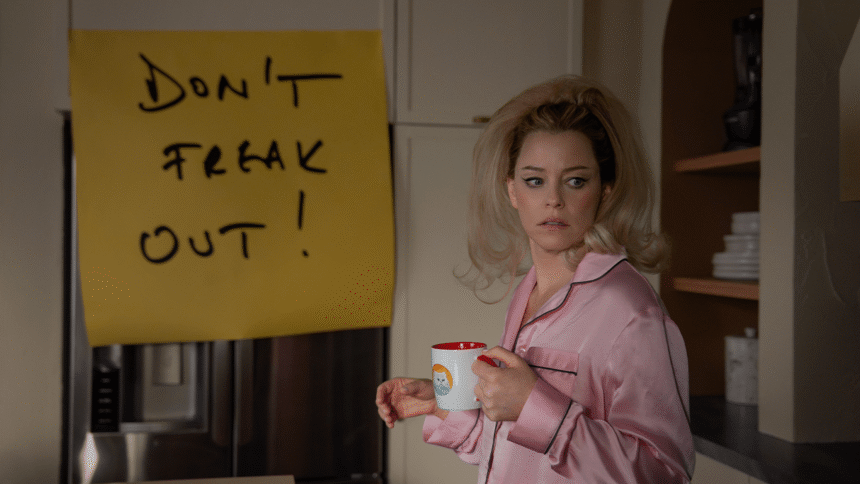
The first thing to know about him The mini wifePeacock’s new drama based on a short story by Manuel Gonzalez, is that the title is anything but metaphorical. Or rather, in the sense that it centers on a woman who feels vulnerable in her marriage — but those feelings quickly become literal when Lindy (Elizabeth Banks) is accidentally reduced to six inches tall by her scientist husband, Les (Matthew Macfadyen).
The second thing to know is that despite this strange and attention-grabbing concept, The mini wife It offers too little return to hold a person’s attention for long. Too sour to choke down when it wasn’t so hard to swallow, this ten-episode slog probably could have been slimmed down in size itself.
The mini wife
Bottom line Big bug.
Broadcast date: Thursday 9 April (Peacock)
ejaculate: Elizabeth Banks, Matthew Macfadyen, OT Fagbenle, Sian Clifford, Sofia Rosinski, Aasif Mandvi, Ronnie Cheng, Zoe Lister-Jones.
Creators: Jennifer Ames and Steve Turner, based on the short story by Manuel Gonzalez
The inciting incident reaches what was already an inflection point in the Littlejohns’ marriage. Married for 20 years and miserable for the past few years, they have fallen into an annual tradition of promising that they will do better in the new year, but retreating into their usual bickering at the slightest provocation. As quickly becomes clear in the Greg Mottola-directed premiere, this holiday season is no exception. When workaholic Les bails on their anniversary with plans to hide out in his lab, Lindy, a promising novelist whose career was partly put on hold so Les could pursue his own, announces that she’s done for good.
Then she is exposed to an errant spray of an experimental chemical he was working on, and finds herself more trapped than ever thanks to her new, smaller size.
To give credit where it’s due: In a sea of largely indistinguishable streaming shows about rich white people trapped in unhappy marriages, creators Jennifer Ames and Steve Turner offer a fresh twist on this bloated subgenre, if nothing else. Although it doesn’t look completely original, think about it War of the Roses via Honey, I’ve cut back on the kidswith a sprinkling of liberalism Girl gone References for good measure – at least it’s not another coastal murder mystery.
Its initially sarcastic, comedic tone is also a selling point. world The mini wife It’s a high-rise setting, where offices are lit in sick shades of green and yellow and staffed by helpful, red-painted lab agents who all seem to have the name Bob. Meanwhile, the frequent use of the tilt effect to create exterior shots reminds us that while Lindy may be trapped in a literal dollhouse, she’s not the only one trapped in a waking nightmare. (The CG used to shrink Lindy is less elegant and less convincing.)
The sense of absurdity is crucial to retaining it The mini wife In the realm of sci-fi comedy rather than, say, sick body horror or horrific abuse drama. But the extravagance does less favors for its characters, who never cease to feel like grotesque caricatures of themselves.
Macfadyen is utterly cartoonish as Les, a person obsessed with chasing the Nobel Prize who reacts to every minor setback with his stomping steps and whiny, toddler-like tones in his voice. But he’s hampered by a script that can’t decide whether Liz is meant to be a threat or a clown, worthy of our sympathy or merely our contempt.
Performance-wise, he’s at least better than Banks, whose soda-can-sized stature forces Lindy to read most of her lines in an oversized shout. If Lindy is the obvious victim in this scenario, she can hardly be called a sympathetic victim. Both before and after miniaturization, she is so hungry for validation that she will steal student work or have a romantic relationship with an admirer (Richard OT Fagbenle) who happens to be a classmate of Les.
In generous light, it is possible to see how The mini wife He could have turned his unlikable yarn into a uniquely barbed take on the toll of professional ambition, or the way in which each generation’s worst shortcomings are passed on to the next. (Lindy and Les, products of deeply flawed families, share a college-age daughter, Lulu Sofia Rosinski, who has inherited their tendencies toward selfishness, arrogance, and vindictiveness.) Or to conceive a more creative picture that takes the family situation to more surreal, dramatic places.
But despite the sheer breadth of its 40-minute episodes, The mini wife He lacks the curiosity to see Lindy’s condition as more than a slightly exaggerated manifestation of mundane relationship issues, or the audacity to trace her more toxic traits into already dangerous territory. Even with frequent flashback fillers to Les and Lindy’s happier days — as well as subplots revolving around Lindy’s book agent (Cian Clifford, who makes the best of it) or Les’ new coworkers (Ronnie Cheng as a man-child investor and Zoe Lister-Jones as his icy but sexually frustrated second-in-command) — the series seems to have lost steam by about halfway through its season.
recently, The mini wife He tries to turn all this pent-up bile into undisguised sweetness—to try to convince us that Lindy and Les never stopped caring about each other, and that maybe they’ll find their way to happiness together again. In the show’s calculations, their obsessive torment of each other is evidence not of their incompatibility but of their rightness toward each other. When asked early on why she didn’t leave, Lindy explained: “We know the real me. The worse me. And he still loves me.”
But by the end of the season — by the end of the second episode, really — we’ve seen so much of the worst of them, and so little of the best, that it’s hard to see what there is to love about any of these unfortunate souls. For my money, Lulu and Lindy best sum up this family’s predicament, during a rare heart-to-heart between mother and daughter. “We’re all bad,” Lulu says, in awe of seeing someone change their life. “Which is disgusting,” her mother agrees. A Pulitzer Prize-winning novelist like Lindy, I think it’s fitting that I couldn’t have said it better myself.