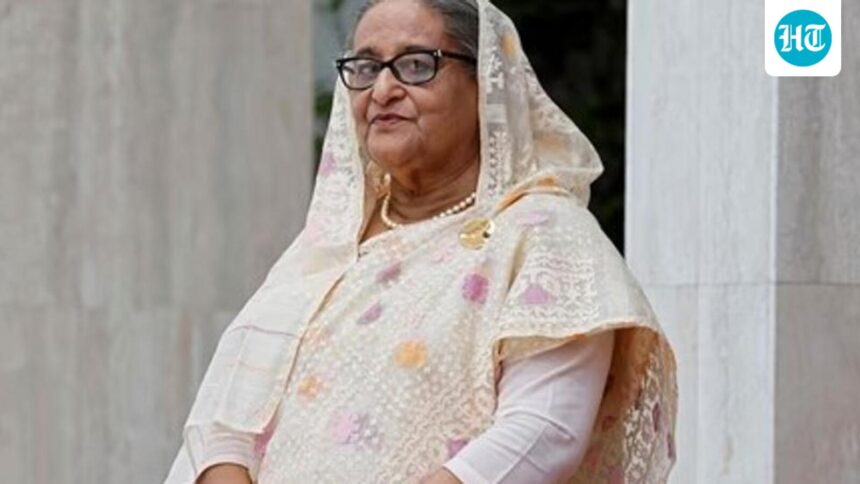
The presence of former Bangladesh Prime Minister Sheikh Hasina in India remains a major point of contention in bilateral relations, and Dhaka will reiterate its extradition request while ensuring that the issue does not affect the ongoing process of normalization of relations after a period of unprecedented tensions, people familiar with the matter said on Wednesday.

The people, who spoke on condition of anonymity, explained that Hasina’s Awami League party – which was barred from contesting this year’s general elections that were swept by the BNP – has a future in the country’s political scene but without her presence, provided it acknowledges the mistakes it made while in power.
Hasina, 78, has been living in self-imposed exile in India since her government was overthrown in August 2024 after weeks of student-led protests. The previous interim government led by Muhammad Yunus first requested its handover in December 2024, and Dhaka has since reiterated the request several times. India has not responded to the request, with officials claiming that the Bangladeshi side has not completed all legal formalities.
The matter is expected to be raised during Bangladeshi Foreign Minister Khalilur Rahman’s meetings with Indian interlocutors, including External Affairs Minister S Jaishankar, on Wednesday. Rahman is the first minister from Dhaka to travel to New Delhi since the Bangladesh Nationalist Party (BNP) formed the government led by Prime Minister Tariq Rahman in February.
Read also: Sheikh Hasina’s exile in Delhi is under the microscope as the BNP returns to power in Bangladesh
The people pointed to Hasina’s conviction in criminal cases in Bangladesh – where the Awami League leader was sentenced to death in November 2025 by the International Crimes Court after being found guilty of crimes against humanity over the suppression of student-led protests – and said this was reason enough to seek her extradition. They emphasized that the India-Bangladesh extradition treaty must mean something in the context of this request.
While stating that the Awami League has a future without Hasina, provided the party accepts its mistakes during the 15 years it was in power under her leadership, people have made it clear that overall bilateral relations will be separated from the issue, while Dhaka reiterates the need to hand over the former prime minister. They added that the development of other aspects of the relationship will not be conditional on this issue.
People explained that India, in Dhaka’s eyes, owed nothing more to Hasina, and that it had done enough by providing her with shelter after the overthrow of her government.
Meanwhile, people have indicated Dhaka’s intention to rebuild relations with New Delhi in several key areas, including a more liberal visa regime and restoring access to Indian land and sea ports to transship Bangladeshi exports. The people described India’s restrictions on medical visas as a “sore point” for the Bangladeshi side as Dhaka had to send people to other countries for treatment at a higher cost.
Bangladesh was the largest source of foreign tourists arriving in India between 2017 and 2023, with numbers peaking at about 2.6 million in 2019, and a large number of Bangladeshi citizens traveled to the country to receive medical treatment. Tourist arrivals fell to about 450,000 in 2025 after bilateral relations deteriorated, and Dhaka has repeatedly spoken of the need for India to open its visa issuance system again.
In the context of trade and investment, the people said Bangladesh is keen to boost trade with India and wants to remove restrictions on the use of Indian land and sea ports – imposed last year when relations with the interim government in Dhaka were at their lowest point – to boost Bangladeshi exports. People expressed their hope that the two sides would settle the issue.
Although economic ties were hit by bilateral tensions, two-way trade was worth $12.90 billion in FY24, and Bangladesh was India’s largest trading partner in the subcontinent.
People also expressed concern over India’s internal political discourse regarding Bangladesh, mostly related to the upcoming Assembly elections in the border states of Assam and West Bengal, and questioned the need to engage Dhaka on such matters. People wondered why Bangladesh was being dragged into such matters and insisted that the country should be left out of such discourse.
In this context, the people said that Bangladeshi territory will not be allowed to be used to undermine India’s interests, and Dhaka’s relations with Beijing and Islamabad should not be over-exaggerated. They added that although Bangladesh has relations with Pakistan, it will not work with the Inter-Services Intelligence (ISI) or take any action that is detrimental to Indian interests. They pointed out that the volume of trade between Bangladesh and Pakistan is still small. They added that Bangladesh has no plans to allow any country to use it to disturb peace in the region.
The people reiterated the BNP’s call to revive the South Asian Association for Regional Cooperation (SAARC), which had been in a moribund state for years due to differences between India and Pakistan, and stressed the role such a regional body could play.
The people also stressed the importance that the BNP government attaches to protecting the interests of minorities in Bangladesh, including Hindus, and said that these communities are safe in the neighboring country. They said that members of minorities constitute approximately 15% of ministers and administrative office holders in Bangladesh.
Bangladesh’s concerns over the killing of its citizens in shootings by Indian border guards were also raised by people, who said this remains an emotive issue in the country. They also pointed out that Jamaat-e-Islami had performed well in the recent elections in several districts along Bangladesh’s border with West Bengal, which witnessed such “border killings”, by exploiting “anti-Indian sentiments”.