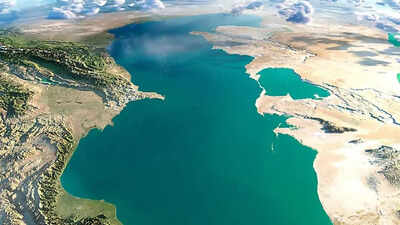
Lakes are often thought of as calm bodies of water with clear inflows and outflows, part of a continuous cycle that eventually connects to the ocean. Some lakes are in closed basins where water enters but never exits through rivers or streams.
These are known as inland lakes. Water simply collects, then slowly disappears through evaporation. It may seem simple, but the behavior of these lakes is very different from that of typical freshwater systems. Many of them are large, highly salty, and shaped more by climate than anything else. A few are well known across the continents, and each tells a slightly different story of geography, isolation and ecological balance.
From the Caspian Sea to Lake Chad: Inland lakes of the world Which never reaches the ocean
Caspian Sea
The Caspian Sea stands out as the largest inland lake on Earth. Despite its name, it is landlocked and has no direct connection to the ocean.It has borders with several countries, including Kazakhstan, Russia, Azerbaijan, Turkmenistan, and Iran. It extends hundreds of miles wide and reaches great depths in certain areas. The lake receives a large flow from rivers such as the Volga. This constant supply helps it maintain its volume, although evaporation remains a strong counteracting force.
Its ecosystem is diverse. Species of fish, seals and migratory birds depend on it. At the same time, pressures such as pollution, fishing and changing river flows continue to affect their condition.
Lake Balkhash
Lake Balkhash is another major inland lake located in Kazakhstan. It has a somewhat unusual structure. One side contains clear water, while the other side contains saltier water.This difference comes from geography. The lake is divided by a narrow area of land, and the flow from the River Ely mainly feeds one section.
The other section experiences more evaporation and less regeneration. Over time, human activity affected its balance. Water diversion and upstream use have reduced flow levels. Reports indicate that this has contributed to the high salinity in parts of the lake.It freezes during the colder months, adding another layer to its seasonal behavior. The lake is never static but changes with rainfall, river entrance and temperature cycles.
Lake Chad
Lake Chad is often discussed when talking about shrinking lakes. It is located in central Africa and is an important source of water for the surrounding communities.In previous decades, the lake covered a much larger area. Today, its size fluctuates greatly depending on rainfall and flow from rivers such as the Chari. Experts say a combination of reduced rainfall, water use and population pressure has contributed to its decline.
Agriculture and irrigation depend heavily on its resources. At the same time, climate fluctuations affect their recharge.
Lake Titicaca
Lake Titicaca is located high in the Andes Mountains between Bolivia and Peru. It is one of the highest navigable lakes in the world. Its height is notable, as is its cultural importance. Indigenous communities have lived around it for centuries. The lake supports agriculture, fishing and tourism.Although there is a small outflow, the system behaves very much like an internal sump. Most of its water balance depends on rainfall, river flow, and evaporation.Its surrounding environment is relatively stable compared to some other inland lakes. However, resource use and tourism place constant demands on the area.
Great Salt Lake
The Great Salt Lake in the United States is known for its high concentration of salt. It is one of the saltiest large bodies of water in the world.
It was formed as the remains of a much larger prehistoric lake. Over time, the climate changed, and the body of water shrank to its current size. What remains is shallow and highly mineralized.No fish can survive in its waters due to the salinity levels. Instead, specialized microorganisms and some bird species thrive around it. The islands within the lake support wildlife such as bison and antelope.Water flow comes from several rivers, but evaporation is dominant.
The size of the lake changes depending on seasonal conditions, although its salty nature remains constant.
What makes inland lakes different from other lakes?
An inland lake forms in a drainage basin that has no access to the sea. Water flows in from rivers, rain or melting snow, but it has nowhere else to go. It accumulates until it evaporates. This process leaves behind minerals and salts. Over time, these accumulate. It appears to be one of the main reasons why many inland lakes are salty compared to typical freshwater lakes.