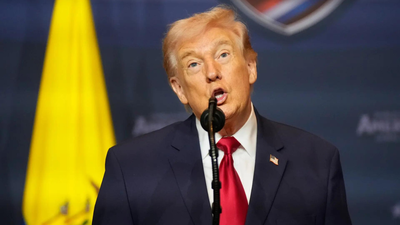
US President Donald Trump
TOI correspondent from Washington: In a surprise turnaround that brought the world back from the brink of a horrific blow, the United States and Iran entered into a fragile two-week ceasefire after days of escalating strikes and threats, providing a narrow window for diplomacy to achieve peace in the Middle East amid residual mistrust and suspicion.
The truce, announced by US President Donald Trump just two hours before his 8:00pm deadline to “wipe out Iranian civilisation”, represents a welcome – if chaotic – lull in the month-long conflict that has seen global oil prices soar 60% and the global economy increasingly soaring. However, questions remain about whether the ceasefire, reached through a combination of public signals and back-channel communications, represents a real turning point or merely an interlude in a volatile standoff.The parameters of the ceasefire, as understood from official statements and diplomatic sources, are limited but important. Based on a 10-point proposal drafted by Tehran, which Trump initially rejected as insufficient but now says forms a “workable basis” for talks scheduled to be held in Islamabad on Friday, it would see both sides halt direct military strikes and restrict allied or proxy forces for 14 days. Maritime activity in and around the Strait of Hormuz is expected to continue under tight surveillance, with unofficial guarantees of non-interference with commercial shipping.
However, no formal written agreement has been announced, and key details – including implementation and verification mechanisms – remain vague.This breakthrough did not come from the United Nations or traditional European mediators, but rather through extensive back-channel talks by Pakistan, whose Prime Minister Shahbaz Sharif and army chief Asim Munir reportedly contacted US Vice President J.D. Vance and Iranian Foreign Minister Abbas Araqchi to reach the initial truce.“Based on conversations with Prime Minister Shehbaz Sharif and Field Marshal Asim Munir of Pakistan, in which they asked me to halt the destructive force that will be sent tonight to Iran, and on the condition that the Islamic Republic of Iran agrees to the full, immediate and safe opening of the Strait of Hormuz, I agree to suspend the bombing and attack on Iran for two weeks. This will be twofold.” Cease fire!” Trump said in a social media post, presenting himself as the benevolent victor.
Although he claimed that the reason he agreed to a ceasefire was because “we have already met and exceeded all the military objectives, and we are still a long way from reaching a final agreement on long-term peace with Iran, and peace in the Middle East,” Trump acknowledged receiving a 10-point proposal from Iran, which he said was “a practical basis to negotiate on.” “Almost all previous points of contention between the United States and Iran have been agreed upon, but a two-week period will allow the agreement to be finalized and concluded,” he wrote. But this manipulation was countered by a statement issued by Iran via the Tasnim News Agency (the semi-official voice of the Iranian Revolutionary Guard), the authenticity of which was questioned by Trump. The statement, which congratulated the Iranian people for “forcing the criminal America to accept its 10-point plan,” described the truce as conditional and reversible, warning that any violation of it would be met with a “decisive response.”
” Trump dismissed the statement as “fraudulent” and “fake news spread by CNN,” while referring to a statement issued by the Iranian Foreign Minister. Part of this confusion appears to stem from overlapping – and perhaps divergent – signals within the Iranian leadership. The statements attributed to the Foreign Ministry took a somewhat more conciliatory tone, stressing the importance of dialogue and hinting at a willingness to hold structured talks.
This has raised speculation about the possibility of a rift between Iran’s diplomatic apparatus and the more hardline religious and security establishment that ultimately takes power. The diplomatic center of gravity for the ceasefire now shifts to Islamabad, where talks are scheduled to take place on Friday. However, Pakistan’s role too has not been without controversy. Some commentators noted that Sherif and Mounir effectively served as Trump’s wingmen, helping to broker a temporary pause that allowed the US president to back away from previous threats without appearing to back down under pressure. Critics point to the president’s previous warnings about overwhelming power — including rhetoric that sparked the destruction of Iranian civilization — as evidence of overreach that necessitated going off the diplomatic path. In this reading, the ceasefire is a face-saving mechanism rather than a negotiated balance. Social media posts showing the edited date of Sharif’s statement, which suggested he was posting dictated messages, sparked today’s developments.Trump’s surrogates reject such descriptions, insisting that the pause reflects strength and strategic discipline, not concession. However, this view remains controversial, especially in light of the growing comments about the so-called “taco” – “Trump always gets chicken out of it” – circulating in political and media circles. While such sarcasm is not part of the official political discourse, it underscores the local dimension of the narrative battle surrounding the ceasefire.Israel’s position adds another layer of complexity. Officials in Israel did not publicly oppose the ceasefire, but they did not unequivocally support it, while indicating a cautious, conditional acceptance that the ceasefire would not restrict their ability to act against perceived threats. At the heart of the upcoming talks in Pakistan are several unresolved issues that will determine whether the ceasefire can develop into something more sustainable. These include the scope of sanctions relief, the future of Iran’s nuclear program, the role of regional proxies, and security guarantees for maritime traffic. Diplomats will be watching for signs of cohesion in Iran’s negotiating position, especially whether the State Department’s tone matches that of the broader leadership.