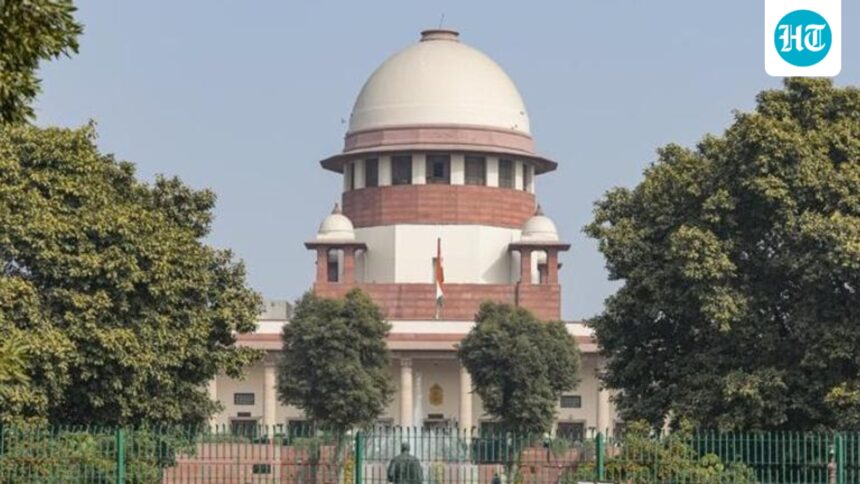
NEW DELHI: The Supreme Court on Monday told the Center that review of textbooks containing aspects related to legal studies and judiciary should extend to all classes without restricting it to Class VIII, which has become the subject of suo motu action following controversial remarks made in a social studies textbook.

With a supervisory committee headed by a former Supreme Court judge proposing to formulate a syllabus for legal studies and eliminating textbooks for Class VIII and above, the apex court said such a practice should not be limited to a few classes.
“I tell the panel that their examination should not be limited to Class 8 only. It can go up and down as there are some issues related to textbooks,” a bench of Supreme Court of India (CJI) Justice Surya Kant and Justice Joymalia Bagchi said.
The Center represented by Additional Solicitor General KM Nataraj informed the court that as per the recent court order, the education department had on March 16 constituted a supervision committee under the supervision of Justice (retd) Indu Malhotra.
Read also | IIT Gandhinagar cuts ties with professor amid row over NCERT textbooks
Nataraj said the committee will collaborate with the National Judicial Academy in Bhopal to review and finalize the curriculum for class VIII and higher classes.
He also informed the bench that as per the concerns raised by the court over the composition of the National Curriculum and Teaching Materials Committee (NSTC), it has been reconstituted with a 20-member body headed by former Vice Chancellor M C Pant and co-chaired by mathematician Manjul Bhargava, a professor at Princeton University.
The court sought changes in the composition of the NSTC after it was found that a reference to “corruption in the judiciary” in a class 8 social science textbook presented a distorted image of the judiciary in the minds of youngsters of impressionable age.
The textbook published by NCERT has been prepared by a team of three experts. The court had raised questions about their knowledge of the matter and blacklisted them to prevent them from dealing with the government or its institutions in any capacity. After their lawyers told the court that they were distinguished experts and not “passing academics,” the court agreed to consider their applications after two weeks.