Every decade sees new research reviving interest in the Shroud of Turin or what much of Christendom believes to be the cloth in which Jesus was buried. On Easter, Jesus rose from the dead to mark the end of Lent (a 40-day Christian season of prayer and fasting). The new study analyzes DNA from the Shroud preserved in an inert gas chamber in the Church of John the Baptist in Turin, and suggests that the linen used in the cloth could have come from the Indian subcontinent. However, carbon-14 dating of the shroud in the late 1970s concluded that its earliest date could not be earlier than the 14th century.

Aside from legends that Jesus Christ visited Kashmir during his lifetime and that the Shroud was made of fabric manufactured in India, there is more concrete historical evidence about the arrival of Christianity in South Asia that dates back 1,500 years to the 5th and 6th centuries of the Common Era.
India is mentioned in the New Testament
Any account of the arrival of Christianity in India begins with the opening chapters of the Acts of Thomas, a text within the New Testament. This comprehensive text was probably written in Syriac around the third century AD, and also exists in Greek, two later and corrupted versions in Latin, Armenian, and in parts in Ethiopic. And while he was speaking in this manner and growing angrier, it happened that there was a certain merchant coming from India, named Abanes, who had been sent from King Gundaphorus, and from whom he had received an order to buy a carpenter and bring him to him.
Read also: History City | Transgender identities have always been part of the cultural discourse in India
The account of Thomas’ journey to India describes the apostles in Jerusalem dividing the world among themselves, with India being assigned to Thomas’ Judas in the Syriac sources. He refused, saying: “I am a Hebrew man, so how can I go among the Indians and preach the truth?” Despite this, God launches a plan that eventually forces Thomas to go to India.
Upon his arrival, Thomas was brought before King Gundaphorus and questioned about his skills. It lists crafts made of wood and stone, including the construction of temples and palaces. The king commissioned him to build a palace, but Thomas instead gave the money to the poor. When the king found out, he was angry, but Thomas insisted that the palace was in heaven and would be seen after death. The imprisoned Thomas was eventually released when King Gad’s brother returned from the dead to testify that he had seen the Heavenly Palace. The story ends with the release of Thomas and the baptism of the king and his brother.
As Stephen Neale points out in A History of Christianity in India, coins have enabled historians to reconstruct much about the “king of India” mentioned in Thomas’s works. Gundovarnes, the self-proclaimed “Supreme King, Supreme King of Kings”, likely came to power around 16 AD and was still ruling in 45 AD parts of present-day Iran, Afghanistan, and northwestern India. However, by 78 AD, the Parthian line had ended, and was replaced by Central Asian rulers known in India as the Kushans, including the prominent king Kanishka. How the memory of Gondovarnes survived in Syriac-speaking regions more than a century after his death remains unclear, but it does suggest a greater connection between northwestern India and regions such as Iran and Iraq than previously thought.
Helen Moor van den Berg writes in Syriac Christianity: “In general, the Syriac churches are those whose origins go back to the Syriac-speaking Christian communities and Syriac writing of the 4th and 7th centuries in the area now covered by Syria, Israel/Palestine, Lebanon, Turkey, Iraq and Iran. These are the Maronite Church, the Syrian Orthodox Church, the Syriac Catholic Church, the Assyrian Church of the East and the Chaldean Church. The members of these churches today are scattered throughout the world, but their homeland In the Middle East and southwest India (Kerala).”
Read also: History City | Mamata’s Bhowanipore constituency is as old as it is fascinating
Christians constitute the third largest religion in India with about 3% of the population officially registered as followers of a sect, school or branch of Christianity. In the two election-related states, Kerala and Tamil Nadu, Christian voters are of great importance.
Interestingly, the links were forged through merchants.
Dr. Ken Barry writes in Art, Architecture and Religion Along the Silk Road: “At least from about the 4th to 5th centuries, we have documented evidence of the presence of Christians in southern India… The Romans were trading with southern India, many finds have been made in Egypt in the Middle East with Indian coral and pearls, and we also know that there was a Roman colony and archaeological evidence of a trading post.” The trading center (Muziris) was located at Pattanam near the present-day city of Kochi, and Pliny the Elder refers to it as “the first trading center of India”.
Saint Thomas Christians
In Chennai’s Mylapore, devotees gather daily at St. Thomas Church to pray over what they believe are the apostle’s remains. In this church there was a strange cross, the object of veneration. Combining the eastern symbol, the lotus flower, with the Christian ‘cross’, these bas-relief crosses have been excavated at several places in present-day Kerala and Tamil Nadu.
Another more interesting aspect of some of these crosses is that they are inscribed using Pahlavi script which adds another layer of the Persian-Syrian connection between Christianity and India. Because Pahlavi fell into disuse after the fall of the mighty Sasanian Empire in 650 AD, scholars have suggested that these crosses could date to the 7th century or earlier.
Besides Melwapore, similar crosses were found in the Valiyapally Church in Kottayam, Kerala.
Popularly known as Saint Thomas or Mar Thomas Silva crosses, they symbolize the Prophet and his Indian followers known as Nasranis (derived from Nasiriyin, a Syrian word for Christian), Malankara Nasrani, Syrian Christians, and simply Syrian Christians in India. Although this community began under the Church of the East over the centuries it has dispersed, following many other liturgical traditions such as Eastern Catholicism, Eastern Orthodoxy, Protestant, and others.
Arrival of the Portuguese
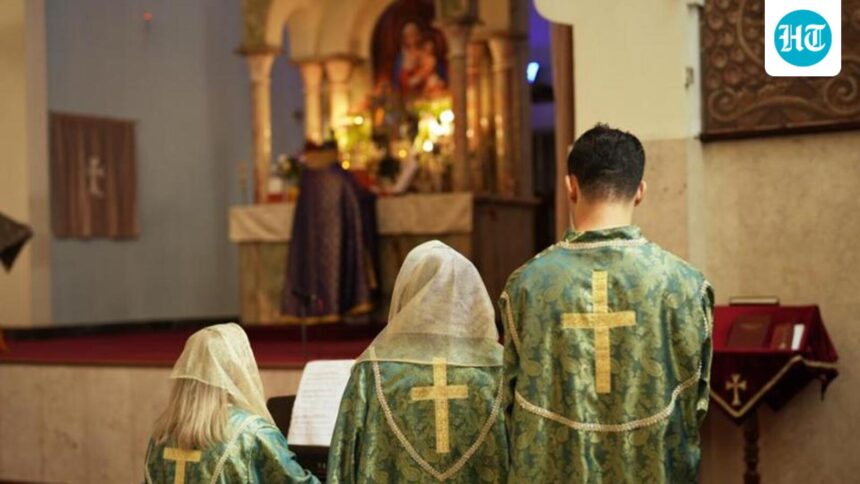
The Malankara Christian community has incorporated Indian and Syrian Christian traditions as seen in their customs be it burning lamps and candles not to mention the lotus cross as seen above. When the Portuguese Catholics arrived in force on the western coast of India, they recorded the presence of the Syrian Christian community and their churches with unusually high crosses in Malabar.
Because of their intolerance of these deviant practices, the Jesuits resorted to suppressing and persecuting local Christian communities and their practices. The Malankara immediately resisted this. In fact, the Mar Thoma Church was officially created in opposition to Portuguese religious policies. Peter Galadza wrote in Eastern Catholic Christianity, “In reaction against Portuguese religious persecution in 1653 at Mattancherry (the ‘Oath of the Cross of Conan’) Saint Thomas Christians pledged to reject Jesuit directives and thus established the Church of Saint Thomas.”
Read also:History City: The evolution of labor rights in India throughout history
In 1510, Goa and its surroundings were captured by the Portuguese, and are remembered for their notorious Inquisition, book burnings, and forced conversions, as well as a strict policy of adherence to the Catholic Church. Therefore the oldest churches outside the Kerala and Tamil Nadu region are found in Goa and Maharashtra. In Mumbai (formerly Bombay) alone, there are three churches built in the 16th century even before the famous Taj Mahal which was constructed in 1631. These three churches are St. Michael’s Church in Mahim (1534), St. Andrew’s in Bandra (1575), and St. Bonaventure on the Island of Mada (1575).
The arrival of the British East India Company in the 18th century was marked by a policy of non-conversion, but this changed as Company rule strengthened, and from 1810 Christian missionaries were allowed to proselytize and build schools, hospitals and orphanages among other institutions. After the transfer of power from the Company to the British Crown under the Government of India Act 1858, the missionaries gained institutional support and were able to attract millions of people into the fold of Jesus Christ across the country.
HistoriCity by Valay Singh is a column about a city in the news based on its documented history, legends, and archaeological excavations. The opinions expressed are personal.