There was a striking pattern in voter roll deletions in Nandigram, West Bengal, where Muslims, who constitute about 25% of the population, accounted for 95.5% of the deletions across seven supplementary lists. Non-Muslims, who constitute nearly 75% of the population, represent only 4.5%, according to data from the Election Commission of India (ECI).

These figures are based on an analysis by the Sabar Institute, a Kolkata-based public policy research organisation, which examined IEC voter roll data from Supplementary Lists 1, 2, 3, 4A, 7, 8 and 9. In six of them, the percentage of Muslims removed ranges from 60.9% to 98.7%. This trend crosses gender lines, with differences in male and female deletions, but with a consistent religious skew.
The only exception is List 4A, where 100% of the deletions were non-Muslim women, and no deletions of Muslims were recorded.
The disparity becomes more severe when compared to the share of the population. If the deletions were proportional, Muslims would account for about a quarter of the deletions. Instead, they make up almost all of them (95.5%), according to the report.
A separate data set from December 2025, based on the ECI criteria of Absent, Converted, Deceased and Duplicate (ASDD), shows Muslims representing 33.3% of deletions and non-Muslims 66.7%. Even this suggests an overrepresentation relative to the population share, although much less pronounced than in the supplementary lists.
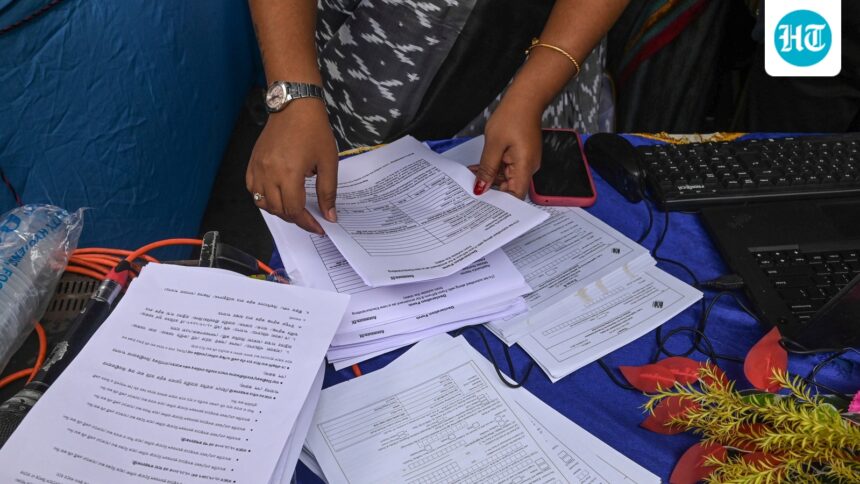
Voters whose names were deleted after scrutiny by judicial officials can appeal to 19 appellate courts set up by the Election Commission of India across West Bengal. April 6 is the last date to submit nominations for the first phase of Assembly elections, which includes Nandigram, scheduled to be voted on April 23. Under election rules, electoral rolls are frozen after the nomination deadline, leaving deleted voters a limited window, until 3pm on April 6, to seek compensation.
Nandigram remains one of the most politically sensitive constituencies in West Bengal. It was the site of the 2021 Assembly elections in which Chief Minister Mamata Banerjee narrowly lost to the BJP’s Suvendu Adhikari. Any irregularity in the voter lists here carries major political implications.
The Election Commission of India has not commented publicly on the religious composition of the constituency deletions.
On Sunday, Banerjee said at a rally in Samserganj: “Cast your votes in retaliation for the deletion of people’s names, and against SIR so that the results reflect that.” “They (the European Commission) deleted the names of some, while intimidating others,” she claimed.
Reacting to the allegations, Sukanta Majumdar said: “The position of Speaker was a constitutional duty to clean rolls and prevent fraud and the TMC was afraid to hold fair elections.” He dismissed Banerjee’s claims as “fear-mongering” and accused her of “trying to protect illegal hackers and fake voters.”
According to experts from the Sabar Institute, the data raises questions about the process followed, the standards applied, and the reasons for the sharp discrepancy between the population share and the removal of voters, which calls for a response from the electoral authorities.