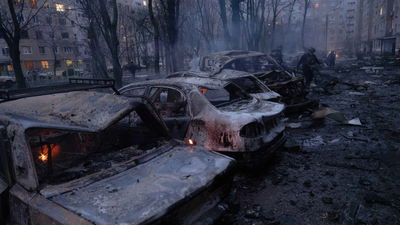
Ukraine launched a greater number of cross-border attack drones than Russia in March, the first month since the war began in 2022 that Kiev appears to have outpaced Moscow in long-range drone attacks, according to daily military data analyzed by ABC News. The numbers indicate a potential shift in one of the most important fronts of the war: the battle of long-range strikes, as both sides attempt to destroy infrastructure, weaken military capacity and raise the cost of continuing the conflict. The Russian Defense Ministry said it shot down 7,347 Ukrainian drones during March, the highest monthly total ever reported and an average of 237 drones per day. The ministry only publishes numbers of Ukrainian drones it says have been intercepted. Meanwhile, the Ukrainian Air Force said the country was attacked by 6,462 Russian drones and 138 missiles during the month. According to Kiev, 5,833 drones and 102 missiles were intercepted or suppressed – about 90% of the drones and just under 74% of the missiles. This means that Ukraine encountered a daily average of just over 208 drones and four missiles during March. However, the total number of Russian drones and missiles reported by Ukraine — 6,600 in total — set a new monthly record for Moscow’s long-range attacks, showing that Russia continues to mount a heavy air offensive even as Ukraine expands its offensive capabilities.
But the importance of Ukraine’s growing drone campaign lies not only in numbers, but in its target. Over the past year, Ukraine has particularly focused on striking Russia’s oil refining and transportation infrastructure, with the aim of disrupting a key source of revenue used to support Moscow’s military campaign. Among the most famous attacks in March were attacks on the Baltic Sea ports of Ust-Luga and Primorsk, two major oil export centres.
Kremlin spokesman Dmitry Peskov denounced the strikes as “terrorist attacks.” Zelensky defended such operations in February, saying the Russian energy sector was a “legitimate target” because oil revenues help fund attacks on Ukraine. “We don’t have to choose whether to hit a military target or an energy target,” Zelensky said while addressing students at the National Aviation University in Kiev. “He sells oil, takes money, and invests it in weapons.
Zelensky said about Russian President Vladimir Putin: “Ukrainians are being killed with these weapons.” Russian officials have largely sought to downplay the impact of Ukrainian attacks, often attributing damage and casualties to falling debris from intercepted drones rather than direct strikes. When they acknowledge the damage, they often describe the strikes as “terrorist attacks.” However, publicly available videos and photos indicate that a large number of Ukrainian drones are penetrating Russian air defenses and striking sensitive military and industrial sites. The attacks have continued despite the resumption of US-brokered peace talks, with drones and missiles remaining a central tool for both Kiev and Moscow as they seek to undermine each other’s ability to fight and finance the war. At the same time, official figures for both sides should be treated with caution. Experts noted that both Moscow and Kiev may have an interest in overstating the success of their air defenses or highlighting the scale of upcoming attacks to support broader political and military messages. March data suggests that while Russia is still launching more long-range weapons overall, the Ukrainian campaign is becoming broader and more sustained as domestic production increases. Ukrainian President Volodymyr Zelensky has repeatedly stressed the importance of expanding Ukraine’s long-range offensive arsenal. “Our production potential for drones and missiles alone will reach $35 billion next year,” Zelensky said in October.
“Despite all the difficulties, the Ukrainians are creating their own national defense product that, by some standards, is already superior to many other products in the world.” Zelensky added: “Never before in history has Ukraine’s defense been so far-reaching and been felt in this way by Russia.” “We must make the cost of war completely unacceptable to the aggressor – and we will do it.” Most Ukrainian attacks are believed to be carried out using cheap, domestically produced drones.
Ukraine is also increasingly using interceptor drones designed and manufactured by Ukrainian companies to shoot down Russian drones. Kiev now produces its own cruise missiles as well, including the Flamingo missile, which it says has a range of more than 1,800 miles. But drones still make up the vast majority of projectiles mentioned in Russian daily reports. The Ukrainian Air Force publishes daily figures on Russian missile and drone attacks, including the number of attacks intercepted and the number of attacks that hit their targets.
According to these figures, Russia carried out the largest 24-hour strike by either side during the month, launching 948 drones and 34 missiles on March 24. The increasing use of long-range drones has also raised concerns that the war could extend beyond Russia and Ukraine. Drone strikes in neighboring countries have heightened these concerns, especially near NATO territory. NATO aircraft are regularly launched in countries such as Poland and Romania in response to Russian drone attacks near Ukraine’s western border.