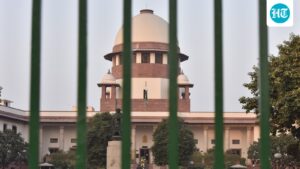
NEW DELHI: The Supreme Court has ended a decade-long matrimonial dispute that had escalated into over 60 cases across the country, facilitating a comprehensive settlement between the estranged spouses and granting them divorce, ending one of the most litigious matrimonial disputes to have reached the Supreme Court.

A bench of Justices B V Nagrathna and Ujjal Bhuyan invoked Article 142 of the Constitution to give “quietness” to the litigation between the spouses, stating that the parties had voluntarily arrived at a settlement covering all disputes arising out of their marriage, which was celebrated in 1994.
The case reached the High Court in the form of contempt proceedings, but over the course of hearings in January and February this year, the bench actively engaged with both sides to explore the possibility of a resolution. What followed was a structured, court-facilitated negotiation process, ultimately culminating in the filing of a joint application seeking to dissolve the marriage on mutually agreed terms.
After recording the presence of both parties in court, the court confirmed in its order issued on Thursday that the settlement was reached “of their own free will without any coercion or undue influence.” The court then proceeded to examine the terms of the agreement and found “no legal impediment” to accepting it.
The settlement stipulates permanent alimony $Rs 1 crore paid by the husband to the wife, along with the transfer of his share in the Lonavala property through a registered gift deed. The court ordered his release $An amount of 90 thousand was deposited in its register with the petitioner, to complete the financial terms of the settlement.
The agreement also guaranteed the complete closure of all disputes between the two parties. It has been recorded that all past, present and future claims arising from the marital relationship have extinguished, and neither party will file any further civil or criminal proceedings against the other.
Noting this, the Supreme Court went further and quashed all the issues pending between the parties, including criminal complaints, domestic violence proceedings, writ petitions, contempt defenses and appeals through lower courts, high courts and even the Supreme Court itself. The settlement addendum lists 61 separate lawsuits initiated over the years, reflecting the sheer scale of the legal battle.
The court made it clear that not only will all these cases be terminated, but any future complaints on the same subject will also not be considered. Both parties have been barred from pursuing further lawsuits against each other, effectively drawing a final line under years of acrimony. The order also set aside all previous judicial directions issued in the context of these proceedings, ensuring that no remaining claims or liabilities will survive settlement.
The ruling also highlighted how the court was guiding the matter towards resolution through a series of interim orders. Starting January 13, the court registered the parties’ willingness to separate and worked to settle financial and property matters. Over the course of multiple hearings, she fine-tuned terms, addressed disputes over assets, verified compliance, and secured commitments from both sides, before ultimately accepting the final agreement.
Importantly, during this period, the court also ordered that no coercive steps be taken by either party against the other, creating a neutral space for progress in the negotiations.
By activating Article 142, the Court ensured that procedural obstacles did not stand in the way of reaching a complete solution. This clause enables the Supreme Court to make any order necessary to achieve “full justice,” and in this case, it was used to bypass technical restrictions and put an end to all pending litigation in one fell swoop.
I finish