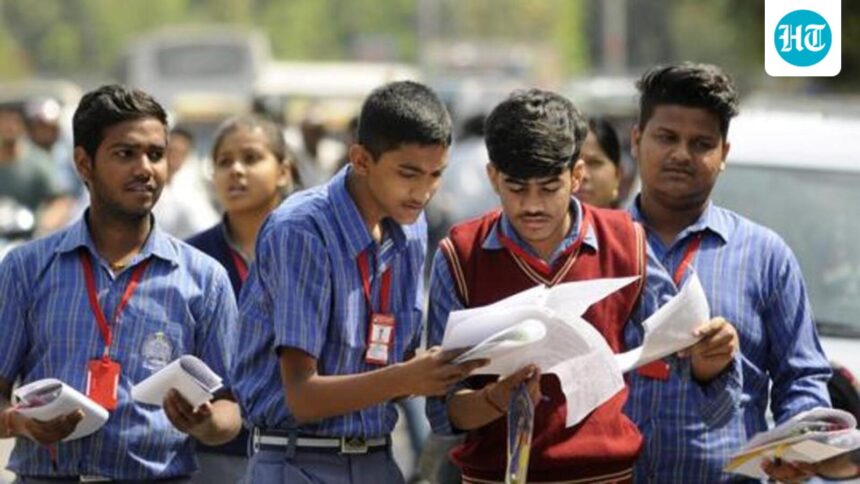
The Central Board of Secondary Education (CBSE) on Thursday issued major changes to the secondary school syllabus and the pattern of Class 10 board examinations. In line with the National Education Policy (NEP) 2020 and the National Curriculum Framework for School Education (NCF-SE) 2023, the changes will apply to students entering Year 9 from the 2026-27 academic session, with the first batch facing the new board examination format in 2028.

Under the new CBSE secondary curriculum announced on Thursday, language subjects will be organized into three levels – R1, R2 and R3 – as part of a structured trilingual model. R1 will be the student’s primary language, studied at an advanced level, while R2 will be a different language studied at a relatively lower level. R3 will be introduced as a compulsory subject from Semester 6 in the 2026-27 academic session and expanded to Semester 10 by 2030-31.
During the transition phase, students must study and pass a third language as part of their secondary education. The same language cannot be selected for both R1 and R2. Even if identical textbooks are initially used, the syllabus and assessment for each level will differ, meaning that students may face separate question papers and different difficulty levels depending on whether they choose R1 or R2.
“As per the recommendations of NCF-SE-2023, two of these three languages should be indigenous languages of India,” the curriculum document states.
CBSE has listed 44 languages covering all the scheduled languages listed in the Eighth Schedule of the Constitution of India. Main language topics include Hindi, English, French, Nepali, German, Russian, Santhali, Maithili, Dogri, Konkani and others.
Students currently enrolled in Class 9 will have to appear in at least two languages in the Class 10 board examinations in 2028.
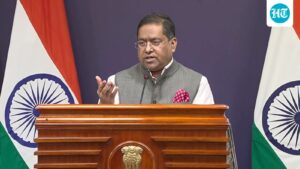
“Currently, all language subjects are treated at the same level, so we have a very complex schedule and the 2027 board exams will be the last board exams according to the current language textbooks. 2028 will be the first year in which we will have two languages compulsorily – one at R1 level and the other at R2 level. The board exam schedule for Class 10 examination in 2028 will be prepared accordingly and the language subjects exam will be held over two days – one day will be held for R1 level and the second day for R2 level. R2 and 2031 onwards for three days – one day for R1 level, a second day for R2 level, and a third day for R3 level,” CBSE Chairman Rahul Singh said during a webinar on the new scheme of the study.
Singh added that the 2027 board exams for Class 10 students will follow the same guidelines and syllabus as the 2026 board exams.
Mathematics, science and social sciences
Mathematics and Science will undergo a major structural transformation with the introduction of a two-tier system from the 2026-27 academic session. All students will study the standard curriculum and sit a three-hour, 80-point common examination. Those seeking higher proficiency can choose an additional ‘Advanced’ level in either or both subjects, comprising a separate one-hour 25-mark paper designed to test higher order thinking skills (HOTS) and deeper conceptual understanding.
While the standardized test is mandatory, the advanced paper will be optional. Results from the advanced paper will not be added to the overall score; Alternatively, students achieving 50% or more will have advanced qualifications reflected separately on their mark sheet. The 20-mark internal assessment component will remain unchanged, with no advanced marking. This reform replaces the current standard core mathematics system and aims to provide greater flexibility while enhancing conceptual depth. The two-tier structure will be introduced for Class IX students in 2026-27, with the first Class X board exams in this format scheduled for 2028.
At secondary level, Social Sciences will be updated with new textbooks and a stronger focus on analytical, competency-based learning in line with NCFSE 2023. Covering history, geography, political science and economics, the subject will focus on inquiry, case studies, map and data analysis and real-life applications to build critical thinking and civic understanding. However, the assessment pattern will remain unchanged, with an 80-mark board examination and 20 internal assessment marks, retaining the current structure but shifting the focus towards application and reasoning.
Artificial intelligence and professional topics
Besides the core subjects – languages, mathematics, science and social sciences – CBSE will offer key curriculum areas such as computational thinking (CT) and artificial intelligence (AI), vocational education, physical education and well-being, and interdisciplinary studies. CT and AI will be implemented in phases first and will become mandatory components of board examinations from 2029.
The remaining areas – vocational education, physical education, arts education, and interdisciplinary studies (including People in Society and the Environment in Chapter 9) – will be assessed internally by schools through practical competency-based approaches, with an emphasis on civic understanding, sustainability, and real-world application of knowledge. “These are meaningful subjects… We will prepare rubrics for internal evaluation… They should not turn into a marking exercise,” Singh said.
This rubric will be followed in the 2028-2030 board examinations, before further changes are implemented – such as the introduction of a third language test from the 2031 board examinations.