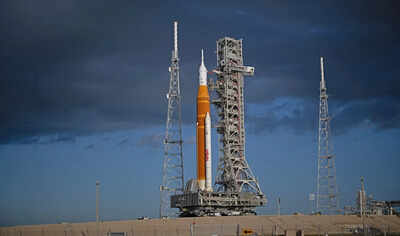
Since there are only a few days left before NASA launches the Artemis 2 mission, the world is looking forward to this mission not only because of the spacecraft’s historic flight to the Moon, but also because of the weather conditions that will accompany the launch.
According to official announcements, there is an 80% chance of better weather at Kennedy Space Center in Florida. This is a positive sign for the mission because the weather plays a very important role in launching the missile. Any slight change in weather could cause a delay in the missile launch.
Artemis II weather forecast launch: What does that 80% mean?
According to NASA, the Artemis 2 launch is 80 percent “go”, indicating that conditions are generally favorable for a launch.The 80% rating is an indication that weather conditions, including wind speed, cloud thickness and precipitation, are likely to meet stringent safety requirements for a launch. A high “launch” ratio is always a welcome sign, especially for such an important launch.It is worth noting that the launch is not completely certain, as the weather is not always predictable, and even the slightest change in the weather can cause the launch to be postponed.
Meteorologists from the US Space Force and NASA are monitoring the situation, especially with regard to cloud formation and winds, which are among the most important reasons for delaying the launch.
Why weather is critical to space launches
Weather is one of the most important factors to consider in a space mission. Rockets, like NASA’s SLS system, have to travel through different layers of atmosphere, making them vulnerable to weather conditions.Take cloud formation, which can interfere with tracking systems and pose a risk if accompanied by lightning strikes.
There may also be strong winds, especially at high altitudes, which affects the stability of the missile during ascent. According to recent updates from NASA, cloud formation and possible strong winds are the issues related to the Artemis II mission.Furthermore, various rules must be adhered to according to Artemis’ weather standards, such as the “thick cloud rule”, in order to ensure a safe mission. Such rules prevent a mission from being launched when electrical charges in the clouds are likely to cause lightning strikes.
Final countdown: Monitoring conditions until liftoff
The Artemis 2 mission is the first manned orbit around the Moon in more than 50 years, making it a landmark event in space exploration. The mission will include four astronauts who will be sent into space aboard the Orion spacecraft. The team will embark on a 10-day journey, and the results will be used to test vital systems that will be used in future missions to the Moon and other regions. The fact that the weather is expected to be good adds to the excitement of this historic event. Although the weather appears suitable for launch, NASA experts will continue to monitor the weather until launch time arrives. The launch date has already been set, and any changes in the weather could result in a delay of hours or even days. Experts pointed out that flexibility in this case is essential, bearing in mind that safety should be the main priority. The fact that the weather forecast indicates an 80% chance of suitable weather can only be a plus.Although challenges such as cloud cover and wind are still being monitored, the weather is largely suitable for the mission. As humanity prepares to return to deep space, this mission is actually a symbol of progress, and the weather is working in NASA’s favor.