

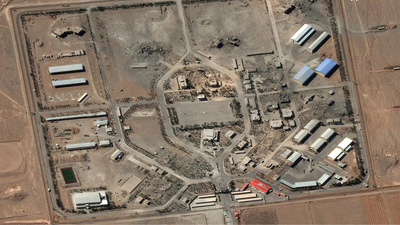
The US raid on Isfahan has brought renewed focus on one of Iran’s most sensitive strategic axes. While Iran has not specified the extent of the damage, a media report indicates that US forces used 2,000-pound bunker buster bombs to hit a large ammunition depot in Isfahan.Donald Trump shared a video on social media showing flames sweeping through the Iranian Isfahan facility.
Iranian media reported that preliminary results indicated that strikes in central parts of the country targeted certain “military sites,” although specific locations were not revealed.
He watches
“Evidence”: Continuous Iranian strikes destroy the American Buehring camp; Troop posts and hangars were left in ruins
Fars News Agency quoted Akbar Salehi, the security official in the Isfahan Governor’s Office, as saying that initial assessments indicate that some military facilities in the province were bombed.
He added that no details were immediately available about the extent of damage or casualties.
Why is Isfahan important?
Long known for its cultural heritage, Isfahan has become a central node in Iran’s defense and nuclear infrastructure, especially when the United States and Israel continue to target its key structures. The province hosts major military and industrial facilities.The province hosts a range of vital facilities linked to nuclear research, manufacturing and defense production, making it central to Iran’s long-term security and technological capabilities.
At the heart of its importance lies its role in the Iranian nuclear program. According to a report issued by the International Atomic Energy Agency earlier this year, the Isfahan facility contains uranium enriched to 60% purity, just below weapons-grade levels. Experts say such materials can be improved relatively quickly, putting the site at the center of international scrutiny over Iran’s nuclear ambitions.Isfahan’s infrastructure combines aboveground and underground elements.
While large parts of the industrial complex are spread across open terrain and can be seen via satellite images, the most sensitive materials are believed to be stored in a network of fortified tunnels built under nearby mountains. This dual structure reflects efforts to balance operational scope and protection of critical assets.The underground tunnel complex, with multiple entry points, is designed to protect high-value materials from outside threats and surveillance.
However, the exact design and internal condition of these facilities remain largely unknown, adding to the uncertainty surrounding the site’s resilience and carrying capacity.
reconnaissance
Do you support military strikes on sensitive sites in Iran such as those in Isfahan?
Besides nuclear activity, Isfahan also contributes to Iran’s broader defense manufacturing ecosystem, enhancing its strategic weight. Any disruption of facilities in the region could have impacts not only on Iran’s nuclear program, but also on its military supply chain.The attack on Isfahan highlighted the intensity of the month-long conflict between the United States and Israel on the one hand and Iran on the other, which extended to the broader Gulf region. Iran’s continued grip on the Strait of Hormuz, a critical artery for global energy flows, has effectively disrupted shipping, sending oil prices sharply higher and destabilizing international markets.