Scientists from the British Antarctic Survey have made a breakthrough in understanding a decades-old geographic mystery by identifying a large granite body buried beneath the West Antarctic Ice Sheet (WAIS).
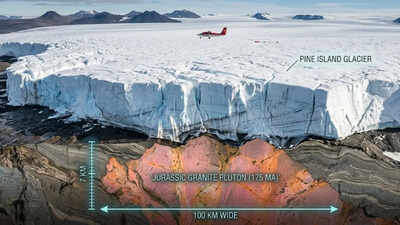
The team came up with the puzzle after noticing some strange (pink) rocks on top of black volcanoes within the Hudson Mountains. They then carried out state-of-the-art airborne gravity surveys and modern radiometric dating to determine how these “irregular” rocks were linked to the massive Jurassic-age molten granite body (the “Hidden Giant”), which is 100 kilometers across and covers a surface area roughly half the size of Wales, extending 7 kilometers deep beneath the Pine Island Glacier.
The hidden giant’s incredible solidity will also significantly affect rates of ice flow into the ocean, providing a new factor in the knowledge base used to predict global sea level rise due to rates of ice melting around the world.
Origin of 175 million year old rocks found in Antarctica
It all started with a geological anomaly in the Hudson Mountains in West Antarctica, where large, bizarre pink granite boulders were found on top of dark volcanic peaks. The pink granite (“irregular”) rocks were in no way similar to the volcanic rocks surrounding them, and after much debate, scientists concluded that these rocks had been “snatched” from the valley floor by a thicker, ancient ice layer and then deposited over the volcanic peaks as the ice receded.
According to research published in the journal Nature, using zircon U-Pb geochronology (radiometric dating), scientists determined that these rocks are about 175 million years old, dating back to the Jurassic period when the supercontinent Gondwana began to collapse.
How did scientists discover a 100-kilometre-long granite body under the Antarctic ice?
Because the source of the pink rocks was buried under miles of ice, the British Antarctic Survey used airborne geophysical surveys, flying a Twin Otter aircraft equipped with geophysical instruments, to conduct gravity and magnetic surveys above the Pine Island Glacier in order to determine the density of the material below. Eventually, they discovered a massive granite body, or “pluton,” about 100 kilometers across and 7 kilometers thick; The approximate area of the granite body is half that of Wells. This large mass of granite is harder and more stable than the surrounding sedimentary basins.
Why a granite body in West Antarctica is key to climate models
This discovery is important not only because of its geological importance, but also because it will impact climate science.
Pine Island Glacier, one of the fastest melting glaciers in Antarctica, is one of the largest contributors to global sea level rise. The “hidden giant,” or the largest granite formation in the world, provides the basic support or structural skeleton of the ice sheet. Since granite is an exceptionally dense and hard bedrock, it would be a high-friction site where the glacier would grip the ground more tightly or cause a “sticky” point in places, thus slowing the movement of the glacier to the ocean.
The exact shape and location of this granite formation will be a key variable in computer models predicting how much sea levels will rise in 2100.
The granite body is considered the “missing link” in Earth’s history
In addition, this granite body provides a glimpse into the history of Gondwana. According to the USGS research paper, the chemical composition of the granite rocks indicates that they formed during a period of intense tectonic activity and rifting, providing geologists with a more complete record of the “missing links” in the West Antarctic Rift System. He confirms that the site was once an area with large amounts of magma that was injected into the Earth’s crust and cooled below the surface before it was covered by the West Antarctic ice sheet millions of years ago.