

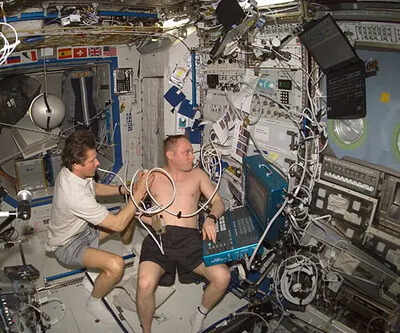
Space, as most of us believe, is a quiet and peaceful place, but for those who live and work on the International Space Station (ISS), it can also be a place of physiological surprises.
A recent incident, in which veteran NASA astronaut Michael Finke told The Associated Press that he appeared to have lost his ability to speak, has refocused attention on the profound impact space can have on the human body. Although this may seem like a scary prospect, scientists are quick to reassure us that this event, while not entirely unexpected, is not entirely unexpected. The fact of the matter is that our bodies are designed to operate within a specific gravitational field, and in space, even simple actions like speaking may not always work as expected.
Although the reasons for this are not yet certain, scientists are working to understand the reasons behind this happening.
How does microgravity affect speech and the human body
In space, one of the first things an astronaut notices is that bodily fluids move toward the upper body and head. On Earth, gravity ensures that bodily fluids are evenly distributed. However, in space, this is no longer the case. According to NASA, this is known as “fluid shift” and can cause nasal congestion.
This not only affects the astronaut’s appearance, but also how he communicates. Speech is a complex process in which sound is coordinated with airflow and resonance in the mouth and nose. Pressure in the head can cause an astronaut’s voice to differ. In fact, astronauts have noticed that their voices sound different in space. It may appear softer or nastier.In most cases, these effects are minor. However, it is an example of how subtle physical changes can affect an astronaut’s ability to communicate in space.
Possible causes of temporary speech loss
The inability to speak can be explained by a combination of neurological and physical factors. Space travel is known to affect the central nervous system, including the way the brain communicates and transmits signals to the muscles needed to speak.A neuroscience study conducted by KTH Technology Research Institute in Sweden has proven that microgravity affects motor control and coordination, especially in the early stages of adaptation.Speaking requires a high level of coordination. It requires precise coordination of breathing, vibration of the vocal cords, and movement of the tongue and lips. If any of these elements are impaired, even for a short time, it may lead to difficulty speaking.Another factor that can be taken into consideration is the psychological factor. Astronauts work in a confined space and are required to perform a high level of responsibilities.
It may lead to difficulty speaking, as it may happen to anyone on earth.
What does space research tell us about such incidents?
NASA’s Human Research Program (HRP) has long been interested in understanding the effects of space travel on the human body over time. Research has always indicated that many of the changes that occur in space, whether in relation to muscle control, balance or perception, are part of the adaptation process. The human mind is also required to learn and understand how to interact in space, because it is in a state of weightlessness.
This affects coordination and reaction for a period of time. However, it is also important to note that most changes are reversible. The human body adapts to space and then returns to normal again once it returns to Earth. There is also no evidence to suggest that temporary speech problems in space lead to harm.
A glimpse into the complexity of living in space
This unusual accident is a reminder that space is not only a technological challenge, but also a biological one.
The human body is in harmony with the Earth, and even small changes in environmental conditions have unexpected consequences.Although the exact cause of the temporary inability to speak is not yet clear, it is also a reminder of the need for more research as space missions become longer and more complex. As we prepare for missions to the Moon or even Mars, we will need to understand these subtle but important effects.In this sense, incidents like this remind us of what space exploration means, not only reaching other planets, but also learning how we, as humans, can survive in space.