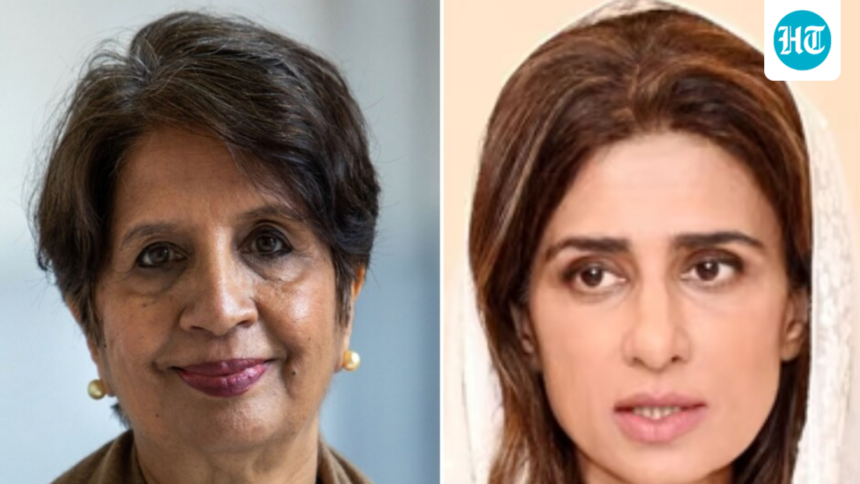
When former Indian Foreign Minister Nirupama Menon Rao criticized India’s idea of ”strategic autonomy” in the ongoing war between the US and Iran, she did not use the word Pakistan as such in her X article. But former Pakistani Foreign Minister Hina Rabbani Khar decided she had to intervene.

This launched a conversation on Monday, March 30, about friendship and shared interests with Pakistan, with discussion of having more women making decisions.
Written by the former Indian diplomat
Strategic autonomy — a word used by Prime Minister Narendra Modi’s government to define India’s geopolitical position — “cannot mean adjusting our language to conform to hierarchies of power,” Rao said in her original article.
“Assassinations of leaders, killings of civilians, public assertions of the use of force – these are no longer aberrations but tools,” she wrote. “In such a world, silence is not neutrality. It is read, interpreted, and often misunderstood as consent.”
She noted that India has long been claiming a privileged space in global affairs, “not as an appendage of power, but as a voice shaped by its civilizational experience and its history of speaking for sovereignty, restraint and balance.”
In an argument at odds with those made by Congress leader Shashi Tharoor, among others, she wrote: “Restraint has its place. Calibration is necessary. But when fundamental questions arise – about sovereignty, the limits of power, and the protection of civilians – India cannot afford to remain silent.”
She took issue with the idea that ethics have no place in diplomacy: “The moral compass is not the adornment of foreign policy. It is its direction. Without it, realism drifts into accommodation, and independence into obscurity.”
Rao, who retired as foreign secretary as the second woman to hold the top post in India’s foreign ministry, said the war between the US and Iran had “harmed India’s interests in almost every practical sense”.
She cited rising costs, “narrow diplomatic space,” pressure on shipping, the “complexity” of Chabahar, and “new instability in a region vital to India’s economy and foreign strategy.”
This has led to a rare and rational exchange of views across the India-Pakistan border – although the warring parties are only past holders of power or positions, not current ones.
Pakistani Khar speaks of deep nostalgia
Pakistani Hina Rabbani Khar reshared Rao
It framed the issues raised by the West Asian War as ones that India and Pakistan must address together.
“As a citizen of the region, it was and remains incumbent on all of us to make South Asia a safe and prosperous place for all its citizens. I hope the current trend is an aberration and not the final chapter in South Asia’s fate,” Khar wrote.
“Women must speak up,” Rao responded
Nirupama Menon Rao seems to have noticed Khar’s intervention very quickly. She shared Khar X’s post and urged women in India and Pakistan to “spread our inherent common sense and suggest ways forward in our relationship.”
“We need a women’s gathering. Not to throw accusations at each other, but to think calmly and rationally about the future that awaits us. For the sake of our children,” she wrote.
She said that cooperation between India and Pakistan “remained confined to one scenario: territory, terrorism, and counter-accusations” for decades. She suggested “expanding the framework.”
She explained in the current context: “In West Asia, especially the Gulf, our interests often run parallel: energy security, diaspora well-being, maritime stability, and crisis response… Engagement here should not weaken our positions, create false equivalence, or reopen familiar disputes. It can remain tightly bound, issue-specific, and without compromising fundamental differences.”
In essence, Rao called for moving forward on specific issues of immediate or common concern.
“Skeptics will argue that Pakistan cannot partition, that any engagement risks being exploited, and that peripheral cooperation has never changed the underlying hostility. But the purpose here is not to transform, but to isolate. Not to resolve the conflict by other means, but to prevent it from determining by all means,” she explained.
“Some might also say that Pakistan has found a ‘role’ in the Iranian crisis, and India should not be seen as seeking to play that role. But it is not about visibility or mediation,” she wrote, without naming names.
Indian Foreign Minister S Jaishankar sarcastically described Pakistan as a “dalal” (middleman) country when asked how the neighboring country plays the role of peacemaker between Washington and Tehran.
Rao further argued for the need for a reset in India-Pakistan relations: “This moment underscores a larger truth: even adversarial nations act outside the scope of their disputes when interests demand it.”
In an apparent reference to Khar, she also said: “Sometimes, broadening the scope is not a weakness. It is a strategy. Women have to speak up.”
“Stop the Romance”: Counterpoint
But a prominent leader from India does not seem to agree with the reset idea.
“Stop this romanticism of engaging in dialogue with Pakistan,” Priyanka Chaturvedi, a Shiv Sena (UBT) MP, wrote on X, without explicitly saying whether she was referring to the Rao-Khar exchange.
Chaturvedi, whose party is in the opposition, wrote: “Whom does one talk to, what power does their government or elected representatives have? It is the army that has the power and all they seek is to harm India.”
Hina Rabbani Khar’s previous comments calling India a “rogue state” last year also drew a sharp response from Chaturvedi.