

MUMBAI: The Reserve Bank of India’s unorthodox move to stabilize the rupee by forcing banks to unwind foreign exchange positions exceeding $100 million will prevent a slide towards 95, even as markets worry about a possible escalation in the Iranian conflict and the possibility of a US ground invasion.The move will also cause banks with large open positions to lose money. Over the weekend, banks pressured the Reserve Bank of India to either relax or give more time. With the Reserve Bank of India (RBI) holding steady, banks will have to start unwinding their businesses on Monday to meet the April 10 deadline.As of Friday, banks could operate net open positions of up to 25% of their net worth. In practice, major lenders were often placing large dollar bets, sometimes exceeding $1 billion, on expectations of rupee depreciation.
The new cover forces a quick reversal. By April 10, 2026, banks must reduce these exposures to $100 million. This forces them to sell dollars and buy rupees to fill the gap.
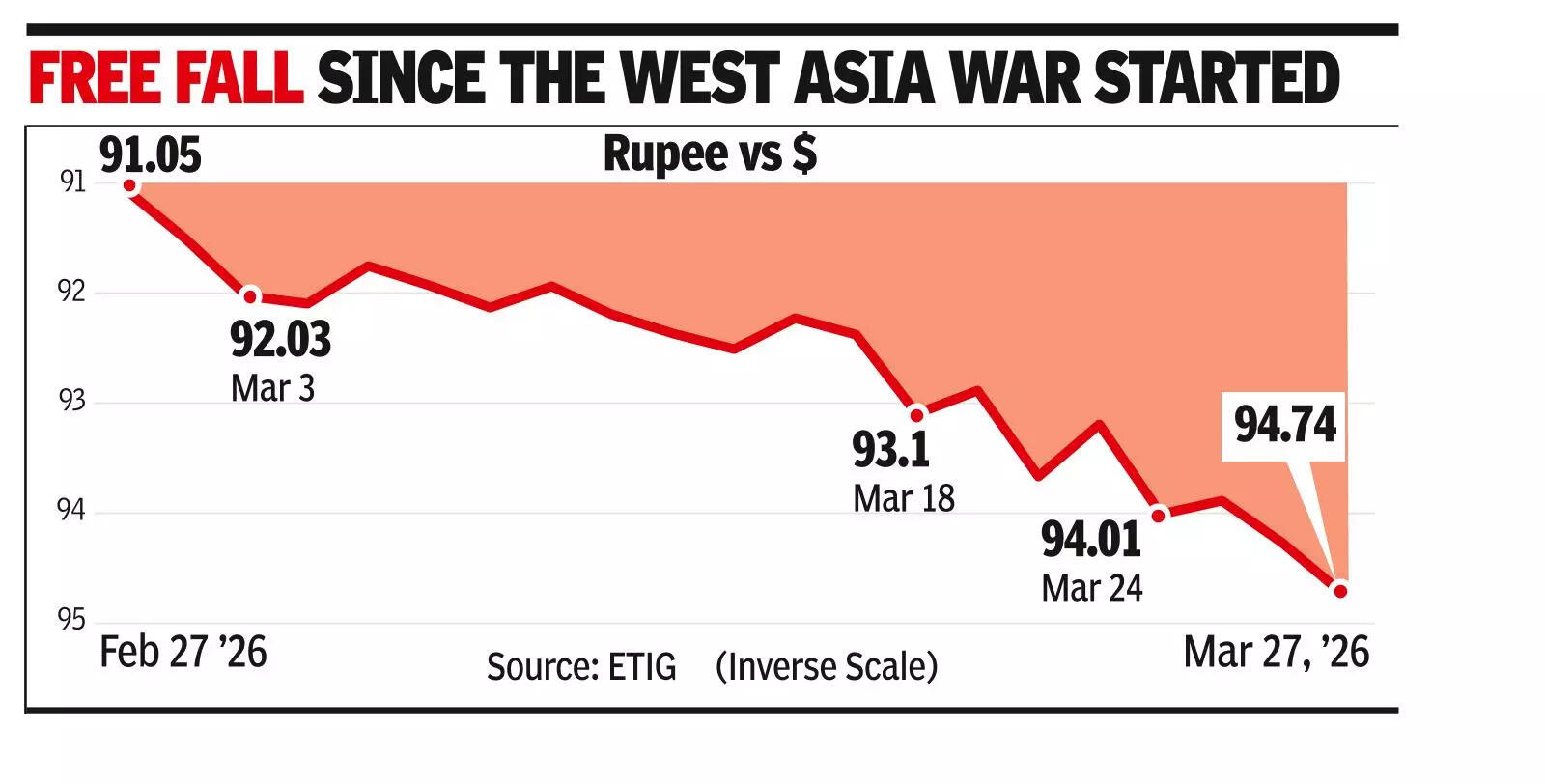
Free fall since the start of the West Issa War
Uday Kotak described the move as an “unconventional political measure” sparked by the West Asia crisis that has entered “uncharted territory.” “This reminds me of the book Bimal Jalan played as RBI Governor in 1998 when the rupee was depreciating sharply after the Asian crisis. If things get worse geopolitically, is there a chance of a new version of the FCNR(B) scheme?” He said.
Some bankers doubt the existence of special schemes to raise dollars. Previous dollar cleansing practices were based on offering guaranteed returns to non-resident Indians, who borrowed cheaply abroad and kept the money in India. Such tactics may be less effective now. Investors have access to a wide range of structured products, and it is cheaper for the Reserve Bank of India to raise dollars through rupee-dollar swaps, bankers said.Despite the RBI’s move, pressure remains on as the dollar is expected to rise globally on rising geopolitical tensions, inflation fears and selling of FPIs across markets. “FPIs have been net sellers on all trading days in March, so far, taking total sales till March 27 to a record high of Rs 1,18,093 crore,” VK Vijayakumar said. The main drivers are conflict in West Asia, risks to remittances in the Gulf, and the hit to growth and profits from rising crude oil prices.