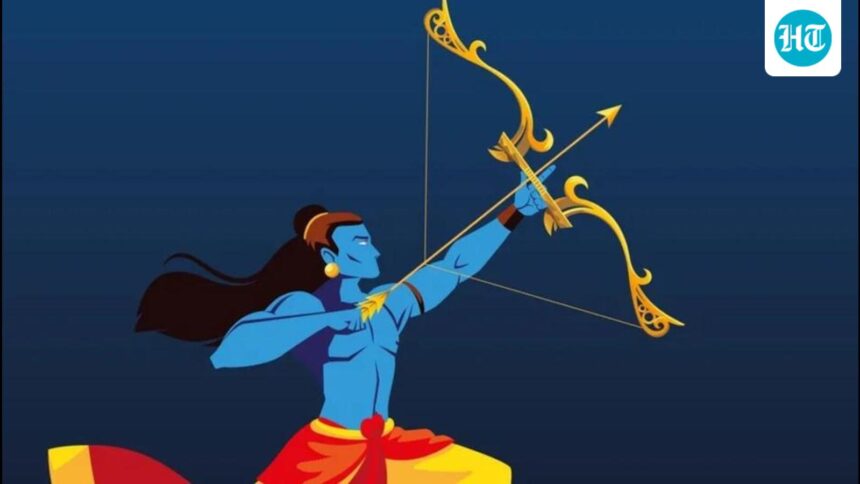
Ram Navami has just been celebrated. On this occasion, my thoughts turn to the beautifully lyrical way in which Tulsidas (1532-1623), in his Ramcharitmanas, describes this special moment. Tulsi Ram was a committed bhakt. In fact, he was to Ram what Surdas was to Krishna. No one less than this complete and steadfast devotee can write Ramcharitmanas. The epic written in Avadhi – an easily understood language of northern India – is still sung and recited by millions upon millions. Manas’s unprecedented popularity led historian Vincent Smith to describe Tulsidas as the greatest man of his time in India, greater even than Akbar himself, with whom the poet was a contemporary.

Tulsidas describes the time and environment of the Lord’s birth with lyrical precision and confidence: Naumi tithi madhu maasa punita; Sakala Pacha Abhijita Haribrita; Madhyadivasa ati Seeta na ghama; Bhavana kala loka beshrama
It was the ninth day of the waxing moon (Sakala – the bright half) of the holy month of Chaitra; The moon has entered the star called Abhijeet, which is very dear to Hari; It was midday, and neither too hot nor too cold; The entire atmosphere was imbued with holiness, and people felt calm and at ease.
In further chaupais upon the birth of Shri Ram, Tulsi weaves in many complex thoughts and emotions. The poet begins by setting the mood, explaining how the time of birth was very auspicious and had the blessings of all the gods. The atmosphere was joyful and festive, and the entire universe was shaking at the approaching appearance of the Lord.
When Shri Ram was born, the first two qualities Tulsi attributed to him were compassion and compassion. Written by Bhai Prakat Kripala, Deen Dayala, Kaushalya Hitkari. Kripala is a kind, benevolent and humane person. “Din Diala” means savior of the weak and helpless.
In later verses, Tulsi continually links these virtues to Ram. When Lakshman asks Ram the definition of dharma, the Lord answers: Par hita sarisa dharam nahi bhai; Para Peeda sam Nahi Athamai (There is no greater dharma than benefiting others, and there is no greater sin than causing harm to others).
To go back to birth, Tulsidas, an accomplished poet, plays on Kaushalya’s disbelief in the fact that she gave birth to the Lord of the Universe. When Ram is born, he appears in full regalia of his divine splendor, with his four arms holding weapons and his body decorated with all the divine symbols. Tulsi brings out Kaushalya’s sense of wonder at how she – an ordinary lady – could be the mother of someone who is the master and ruler of the world.
Kaushalya says the birth of God – in whose pores there are several universes – is considered unbelievable, even laughable. Ram smiles at her confusion and comforts her by telling many stories of the past, explaining how he was born and how she is his mother. Tulsi says that he does this significantly to arouse within her a mother’s love for her child – Vatsalya.
With Vatsalya’s emotion rising within her, Kaushalya asks Ram to shed his divine form and adopt the form of an ordinary child. These are the most poignant lines in this section: A mother asks God to be her son and not the Supreme Being. Her request is that Ram activate Leela to play the role of the child, because the joy of motherhood is Param Anupa’s – like no other.
When the Lord heard her request, he responded, and suddenly the divine form disappeared, and he became a crying child in his mother’s arms. ‘Sona pachana suhana rudana thana hoi palaka surabhupa: Hearing his mother’s request, the sage lord of the immortals became a baby and began to cry.’
This entire depiction brings together a kaleidoscope of emotions, as the birth of the avatar blends effortlessly with the expectations of the mother, creating an image that has remained indelible for generations. Tulsidas rightly says that those who internalize this sequence of events – the mother’s call, and Ram, in response to her request, relinquishing his divine form to become a newborn child – attain the Lord’s eternal blessings.
Tulsi concludes by making the philosophically important point that Shri Ram took on the human avatar of his own free will, an aspect of his unfettered powers, because by definition he is not bound by the traditional constraints of mortality – the senses, the three gunas – rajas, tamas and sattva – or the shackles of maya.
(Pavan K Varma is an author, diplomat and former Member of Parliament (Rajya Sabha). Views expressed are personal)