While looking at sepia-toned family photographs on his occasional visits to his ancestral home in Danapur, Bihar, Subodh Gupta says he always relishes his constant absence from them. As the youngest of six children, it was easy to sneak away without anyone noticing.

This is no longer the case, of course.
The 62-year-old, one of India’s most celebrated artists, is in a pensive mood ahead of his big show in Mumbai starting on April 3. If Gupta has mastered the art of disappearing from family photos, he has also mastered the art of appearing at the Arts and Crafts College in Patna. “There was a college, there were large classrooms and dormitories, but there were no teachers.” He says his parents were relieved that he was at least going to university and moving away from the street theater that had begun to waste his time.
He picked up the art practice from a hard-working fellow student and honed his skills by taking on assignments with advertising agencies, publishers and doing wedding decor. But the nights he spent at Patna railway station, not far from home, he indulged in art – painting sleeping passengers on the platform, a lone watchman, and a bored café owner. “I didn’t go to art school to become an artist,” Gupta says. “I went because I wanted to work in theater, and I needed a way to survive.”
But trips to art galleries in Delhi opened his eyes to a larger art world, as did his encounters with art masters such as F. N. Souza and M. F. Hussain. But it was his own journey – through theatre, graphic design and life experience – that shaped his artistic language, expressed mostly with kitchen tools.
“You have to find your own language,” he insists. “Don’t imitate someone else.”
Today, Subod is often spoken of in the context of global readymades, similar to the way contemporary global artists such as Simone Leigh, Jeff Koons, and Joana Vasconcelos use ordinary, mass-produced objects to create art.
While Gupta follows (Marcel) Duchamp’s tradition of readymades, his work is more materially intense – he uses his pots and dung cakes to talk about sustenance, memory and the unspoken infrastructure of the home. “It takes the language of global contemporary art and grounds it in very specific Indian realities – the kitchen, the street, the village – and shows how those local stories are in fact universal,” says Claire Lilly, a Mumbai-based curator who was also a long-time curator at Frieze Sculpture in London.
The exhibition, titled “A Handful of Heaven,” displays a mix of old and new works. But his highlight “depending on how people see it” is a large column installation – his largest work – which took 10 years to make.
The exhibition consists of four floors, each with its own emotional and conceptual rhythm. The first floor will offer visitors a mix of early works and new pieces as an introduction.
The exhibition then expands both physically and philosophically – the second floor is dedicated to the installation, drawing from a central thematic idea linked to the exhibition’s title. On the third floor, the experience opens up to the monumental column, while the fourth floor displays new canvases, creating a vertical continuity that reflects the passage of time itself.
“It’s not just about stuff,” he explains. “It’s about walking through life and feeling it.”
“‘A Handful of Heaven’ is a powerful exhibition because Subodh takes something as universal as the bed to talk about heavy and relevant topics like migration and shelter. In today’s world of movement and often displacement, beds – filled with everything from demolition rubble to spice grinding stones to old televisions – have become a way to talk about the ‘unspoken infrastructure’ of our lives. It is about how we carry our memories and our need for security with us, no matter where we go. “It’s geopolitics through a very intimate human lens.”
Witness the time
The mammoth column titled “Earth Kingdom” is inspired by the ruins the artist encountered during his travels through India and the West, and the imagined ruins of Greece. “I had not yet been to Greece when I started my work, but I saw pictures. I imagined it and made my own version,” says Gupta. “Monuments inspire me; they are ready-made sculptures. When you look at ruins, you see the past. But at the same time, you imagine the future. And you wonder – how far back were those ruins? And suddenly, the past looks like the future.”
Around this work, Gupta creates an atmosphere to evoke an ancient land. The dinosaur bone – cast in aluminum – recalls a period long before humans existed. The moose, which the artist has never seen in real life, appears as an almost mythical creature. The ostrich, cast in bronze but painted white, stands both real and unreal.
“These animals stand as witnesses,” says Gupta. “They have seen what we have not seen. They carry the memory.”
The reinterpretation of monuments made of stainless steel, cement, mosaic fragments, and ceramics—“broken slabs of good earth”—holds the illusion of age while being distinctly contemporary.
Inner garden
Alongside these compositions appears a quieter body of work: a series of three paintings entitled “Interior Garden.” At first glance, they look like botanical compositions, but as Gupta says, “A flower is never just a flower.”
Inspired by the philosophy of Ikebana, the Japanese art of flower arranging, the works present an arrangement of balance, rhythm and internal balance. There is also a spiritual undercurrent: the offering of flowers in the Buddhist tradition, where the arrangement becomes a ritual. “It’s about your inner garden. How nature balances you,” he says. “What you see is who you are.”
Stupa every day
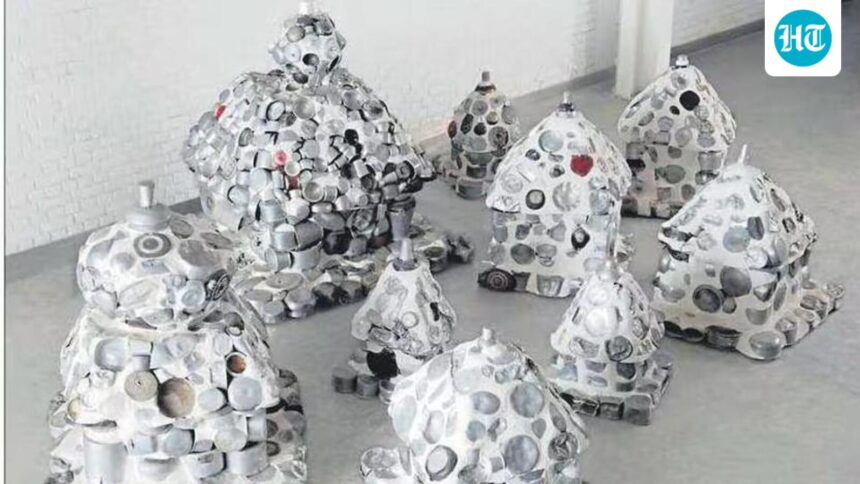
Another stunning group of works in the exhibition is a series titled “Nine Stupas” – sculptural forms inspired by Buddhist architecture, but made from used and discarded aluminum utensils. The artist got the idea during a visit to Ladakh, where clusters of small stupas dot the landscape.
The tools – collected from scrap markets, destined to be melted down and sold in blocks – bear traces of everyday life. “Meals are eaten in anger or joy, families gather, and moments are forgotten.”
“What makes Nine Stupas so special is how he connects Subodh’s personal history to a much broader spiritual landscape. “He draws from two very different parts of his life: his roots in Bihar, the cradle of Buddhism, and his travels in Ladakh, where he was struck by the presence of these ancient Buddhist stupas,” says Lele. “When you stand in front of them, you realize that these are not just sculptural compositions, but bear the traces of countless meals and years of domestic labor. “By arranging them in this sacred and monumental architecture, he is essentially saying that the most mundane and repetitive acts of care are just as sacred as any religious relic.”
Indeed, today, despite international recognition, his connection with Bihar remains deeply personal. “It is my home,” he says. “I love Bihar – despite its challenges, stagnant institutions, lack of infrastructure and wasted potential.” “That’s why growing up in Bihar makes you stronger – and you gain a rare confidence that enables you to take on the world.”
(“A Handful of Heaven” will open at NMACC’s Art House on April 3, and will be on view for six weeks.)