A senior Maharashtra political leader keeps his fists clenched while delivering speeches, on the advice of a teacher. Another senior politician is said to perform rituals on full moon or new moon days, and even skip official programs on these inauspicious days, also on the advice of the guru.

A few years ago, the chief minister of a neighboring state quietly traveled to the western state of Maharashtra to perform a ritual there, when he thought his political position was at risk. To maintain confidentiality, he changed his security cover, saying this was a personal visit.
Are politicians more superstitious or spiritual than most? Or is their loyalty to self-proclaimed clergy just another step in the rules of the political game – a ritual either way?
The arrest of Nashik’s “Godfather” Ashok Kharat has cast a spotlight on a shadowy tribe of self-proclaimed spiritual leaders, whose role lies at the intersection of faith, superstition, power and politics.
From Sathya Sai Baba to Bhayu Maharaj, and figures like Jagadguru Ramanandacharya Narendracharya, also known as Narendra Maharaj, such personalities attracted the state’s political elite into their orbit.
These spiritual leaders are often charismatic and possess exceptional leadership skills, and are an important cog in the political machinery; Some are known to have brokered deals when governments were wavering.
These so-called “godfathers” also enjoy an enviable fan base, fostered by years of philanthropy and quasi-spiritualism, a vote bank pivotal to the fortunes of all political leaders. No wonder politicians are looking to patronize them.
As a result, the ashram, or headquarters of these gurus, is frequented by senior figures in the political and bureaucratic establishment as well as other dignitaries. To keep frightened political loyalists addicted, some of these gurus invent rituals that promise good luck, wealth, and success. Prime ministers, leaders of major political parties and bureaucrats consult them before making major decisions, contesting elections and even taking professional steps.
It’s a heady combination – one that brings success on the ground level.
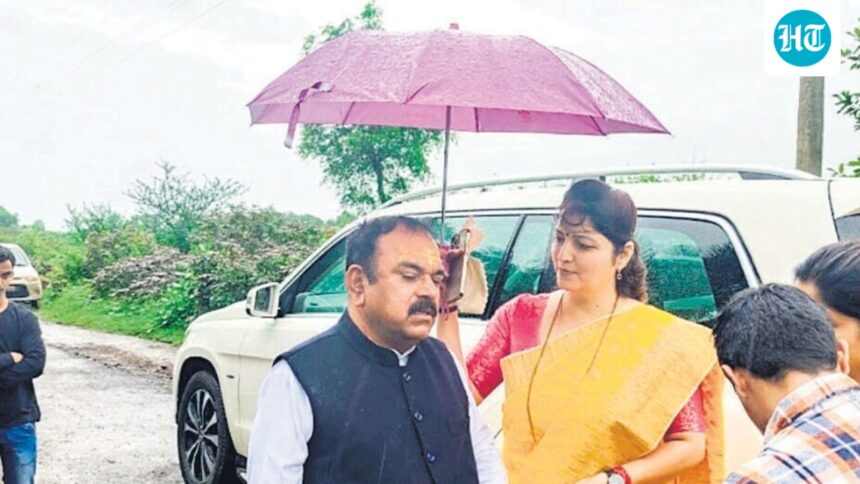
When Rupali Chakankar resigned as state women’s commission president over her closeness to Ashok Kharat, the ‘godfather’ of Nashik, more skeletons could have fallen from the closet.
Already, pictures circulating online of Deputy Chief Minister Eknath Shinde, his wife Lata, and former School Education Minister Deepak Kesarkar visiting a temple run by Kharat have created a storm.
Rationalists and critics ignore the supernatural powers that these teachers claim to possess, while acknowledging their reach and influence. “They help create a cover for Benami dealings of powerful people because under the guise of a religious leader, they are generally not questioned about their wealth. This leads to a quid pro quo situation,” said Hameed Dabholkar, member, state working committee, Maharashtra Andhradha Nirmulan Samiti (MANS).
“Politics is a cruel profession, and political leaders do not believe in human solutions to their problems,” he says. “They prefer to set themselves up as gods to provide the antidote to uncertainty.”