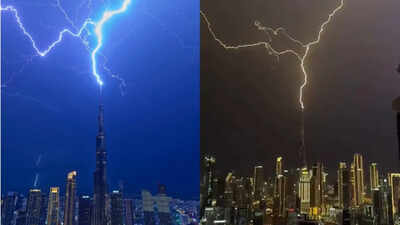
This stunning photo of the Burj Khalifa taken by Dubai Crown Prince Sheikh Hamdan bin Mohammed Al Maktoum is going viral: Here’s why
Recent thunderstorms and rain in the UAE have flooded social media platforms with dramatic images of lightning striking Dubai’s iconic Burj Khalifa, and as a result, many viewers have been left asking the same question: How could the tallest building in the world survive a direct lightning strike?The answer lies not in luck, but in advanced engineering designed specifically for such moments.
Read on if you’re also wondering what actually happens when lightning strikes Dubai’s most iconic skyscraper and why it’s completely safe.
Dubai Crown Prince Hamdan bin Mohammed Al Maktoum ‘s diffuse Burj Khalifa photo breaks the internet
Amid the dramatic thunderstorms sweeping across the city, Sheikh Hamdan bin Mohammed Al Maktoum, Crown Prince of Dubai and Deputy Prime Minister and Minister of Defense of the United Arab Emirates, took to his Instagram account to share a popular photo of the moment. Widely known as ‘Fazza’, he captured a moment that instantly resonated across social media when he shared a stunning photo of Burj Khalifa lit up by lightning and thunder.
The prince commented on it, saying: “A moment worth stopping for #Dubai,” which included a lightning bolt and sparkling emojis. The post quickly went viral, blending Dubai’s distinctive grandeur with the raw power of nature. More than just a photograph, this image reflected the city’s ability to transform turbulent weather into a visual spectacle, where engineering marvels meet fleeting but awe-inspiring moments.
Lightning strikes Burj Khalifa in Dubai, United Arab Emirates: Why is it not dangerous?
The clips that have gone viral may look terrifying, with bolts of electricity piercing the sky and striking the 828-metre-tall tower, but experts say that’s exactly what the building was designed to do.
In fact, lightning striking Burj Khalifa is normal, expected and deliberate. Tall buildings naturally attract lightning, and the Burj Khalifa, as the tallest in the world, acts as a giant lightning rod.
Science: How the Burj Khalifa in Dubai, United Arab Emirates deals with lightning
- Strong lightning arrester on top: At the top of the tower there is a lightning rod system. It detects electrical activity in the atmosphere, intercepts lightning before it spreads and safely directs the energy to the building’s protection system. Think of it as a controlled entry point for lightning.
- Faraday cage effect: One of the most important safety features is the so-called Faraday cage. The building’s steel frame, metal facade, and reinforced frame work together to create a protective shell that directs electricity around the outside, not the inside. This ensures that people inside are safe and that electrical systems remain protected.
- Bottom conductors – escape route: Once lightning strikes a building, the energy does not stay there. It travels via conductive paths and metal frames and is safely directed to the ground through specialized systems. This prevents the risk of fires, structural damage and energy surges within the building.
- Advanced grounding system: At the base of the tower there is an advanced grounding system that absorbs the electrical charge and distributes it safely to the ground. Without it, the energy would have nowhere to go, making the system incomplete.
- Smart sensors that “anticipate” lightning: What makes Burj Khalifa more advanced is its sensor-based system that detects weather changes, identifies lightning conditions and adjusts electrical polarity to attract and control strikes.
In simple terms, a building doesn’t just react to lightning; He predicts and manages them. The recent unstable weather across the UAE has led to lightning becoming more prominent due to strong storms, accumulation of clouds, dust and humidity affecting the atmospheric charge and increased precipitation.
This combination results in more visible and dramatic lightning, especially around tall buildings. As we’ve seen in recent shots, the hits are often brighter, longer lasting and more attractive but not more dangerous.
What really happens during a lightning strike on the Burj Khalifa in Dubai, United Arab Emirates
Despite the dramatic images, the real impact is minimal. When lightning strikes Burj Khalifa, the strike is absorbed from above, and the energy flows along the exterior and dissipates into the ground within seconds.
There is no explosion, no fire, and no danger to passengers. In fact, the system ensures that the interior is completely unaffected.Burj Khalifa is not unique in terms of lightning protection but it is among the most advanced systems. All major skyscrapers include lightning rods, grounding systems and surge protection, but the height and prominence of Burj Khalifa requires a more sophisticated, multi-layered system.
This makes it a target for lightning strikes but it is also one of the safest structures during storms.
The reason these strikes became so widespread is not the danger, but the spectacle. The final clips show lightning bolts lighting up the horizon, heavy hits hitting the tower, and storm clouds adding to the visual impact. As one recent report described, the lightning was “safely diverted through the tower system” despite the chaos caused by the storms throughout the city.
It is this contrast between visual drama and actual safety that fascinates audiences around the world.
The real risks during UAE storms
Although Burj Khalifa is safe, wider weather conditions still pose risks of road flooding, reduced visibility, traffic accidents, and flight disruptions. Authorities often advise residents to:
- Avoid unnecessary travel
- Stay inside during storms
- Follow official weather updates
This is because the danger is not the building but the environment surrounding it. A lightning strike is a reminder of the unpredictable, dramatic and awe-inspiring power of nature, as well as human engineering that is able to anticipate and control that power. Burj Khalifa is located at the intersection of the two. Yes, lightning can strike Burj Khalifa, but no, it does not pose a threat because behind every dramatic flash is a system designed to capture, control, and return it safely to Earth.