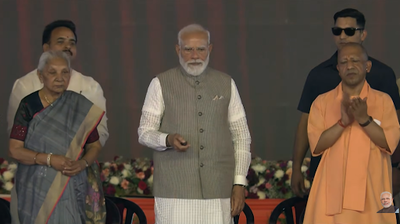
Prime Minister Modi inaugurates Jewar Airport
New Delhi: Prime Minister Narendra Modi on Saturday inaugurated the first phase of Noida International Airport at Jewar in Uttar Pradesh, marking a major milestone in India’s expanding aviation infrastructure.Prime Minister Modi was accompanied by Uttar Pradesh Chief Minister Yogi Adityanath and Governor Anandiben Patel.
He watches
PM Modi inaugurates first phase of Noida International Airport on March 28: All you need to know
Developed with an investment of around Rs 11,200 crore under the public-private partnership (PPP) model, the project is expected to enhance regional and international connectivity of the National Capital Region (NCR).
The airport is positioned as a major addition to India’s aviation network, with the aim of relieving pressure on existing infrastructure while supporting the country’s ambition to become a global aviation hub.
The second international portal for Delhi NCR
Noida International Airport has been developed as the second international gateway to the national capital, Delhi, complementing the existing Indira Gandhi International Airport, which currently handles the majority of air traffic in the region.
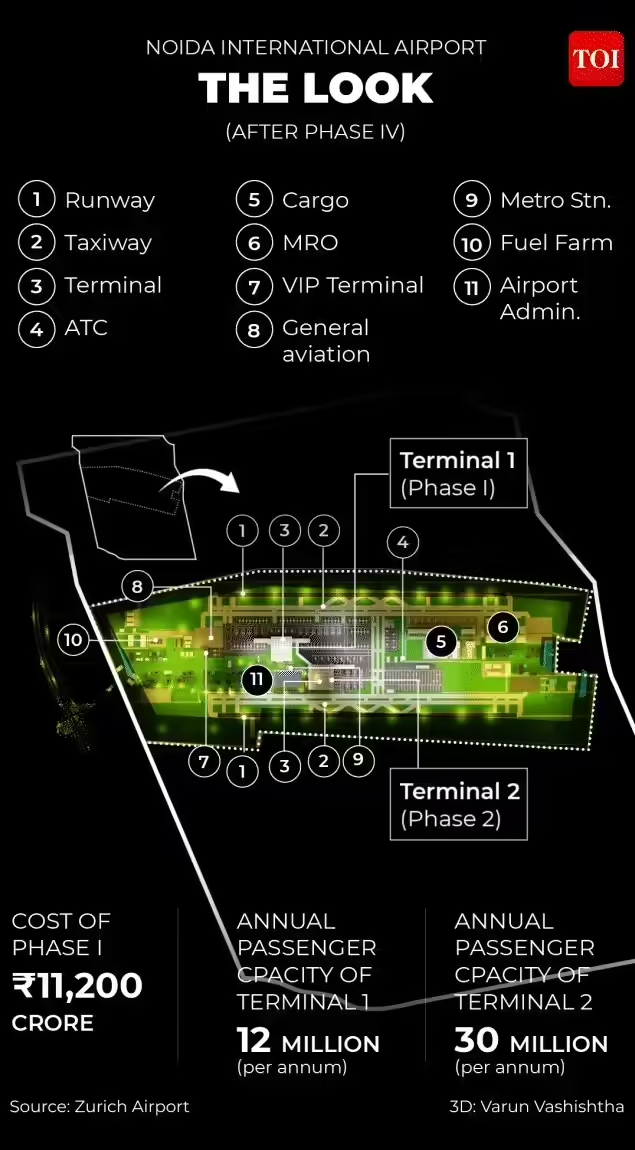
.
With increasing passenger demand and capacity constraints at IGI Airport, the new facility is expected to play a crucial role in distributing traffic more efficiently.The two airports will work together as an integrated aviation system, helping to reduce congestion, improve connectivity and enhance the region’s position among the world’s leading aviation hubs.
First phase capacity and future expansion plans
The first phase of the airport is designed to handle 12 million passengers per annum (MPPA), providing immediate relief to the growing demand for air travel in the region.The project has been planned with scalability in mind, with provisions made to expand the carrying capacity to 70 million passengers per year in subsequent phases. This long-term vision reflects the government’s strategy for future-proofing infrastructure and accommodating sustainable growth in air travel.
Modern infrastructure and all-weather operations
The airport features a 3,900-meter runway capable of handling wide-body aircraft, making it suitable for long-haul domestic and international operations.
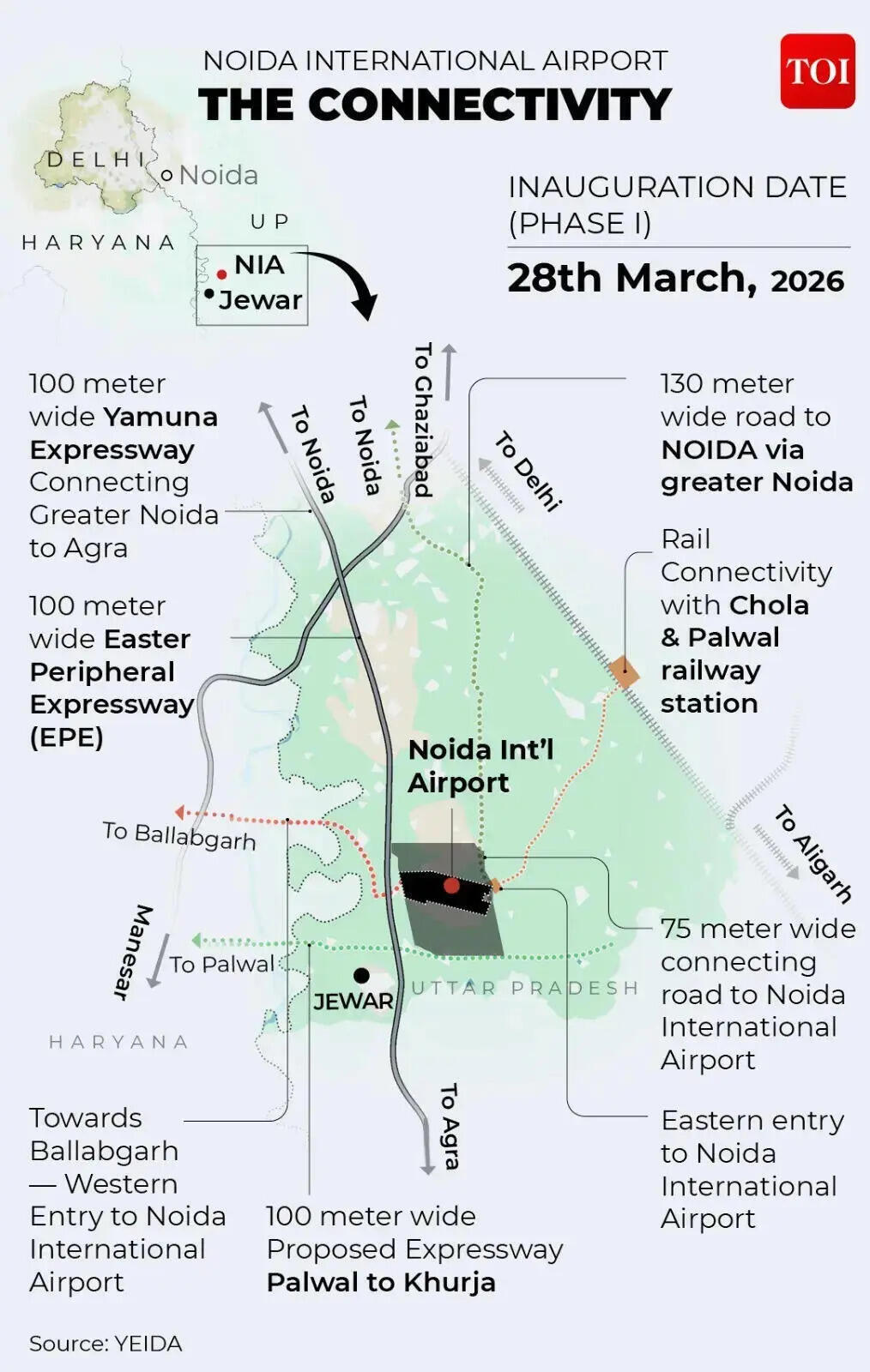
.
The facility is equipped with advanced navigation systems such as the Instrument Landing System (ILS) and state-of-the-art airfield lighting, and is designed to support efficient, all-weather, around-the-clock operations. These features ensure operational reliability even under difficult weather conditions.
Shipping hub and logistics ecosystem
In addition to passenger services, the airport includes a comprehensive cargo ecosystem aimed at enhancing logistics and trade.The intermodal freight center consists of an integrated freight terminal and dedicated logistics areas, with an initial handling capacity of more than 2.5 million metric tons per year. This capacity is expected to expand significantly to around 18 lakh metric tons in the future, making the airport a major freight and logistics hub in North India.
Dedicated MRO facility to enhance efficiency
A major component of the airport’s infrastructure is the 40-acre maintenance, repair and overhaul (MRO) facility.This dedicated facility is expected to improve operational efficiency by enabling airlines to service and maintain aircraft locally, reducing response times and operational costs. It also enhances India’s capabilities in aviation maintenance services.
He watches
PM Modi inaugurates first phase of Noida International Airport on March 28: All you need to know
Sustainability and future-ready design
Noida International Airport is designed as a sustainable and future-ready infrastructure project, with a focus on achieving net zero emissions.The project includes energy-efficient systems and environmentally responsible practices, in line with India’s broader climate goals. The airport development reflects the increasing focus on green infrastructure in large-scale projects.
The architecture is inspired by Indian heritage
The airport’s architectural design blends modern infrastructure with cultural aesthetics, and is inspired by traditional Indian elements such as ghats and havelis.This approach aims to create a distinct identity for the airport while giving passengers a sense of place rooted in Indian heritage.
Strategic location and multimedia communication
The airport is strategically located along the Yamuna Expressway in the Gautam Buddha Nagar area and is planned to be a multi-modal transport hub.It will feature seamless integration with road, rail, metro and regional transport systems, ensuring seamless connectivity for passengers and goods.
This connectivity is expected to significantly improve accessibility for travelers across Delhi NCR and adjoining areas.
Boosting India’s aviation ambitions
The opening of the first phase of Noida International Airport is seen as a major step in strengthening India’s aviation ecosystem.By expanding capacity, improving connectivity and integrating modern infrastructure with sustainability, the project is expected to play a key role in making Delhi NCR a major global aviation hub while supporting economic growth and regional development.