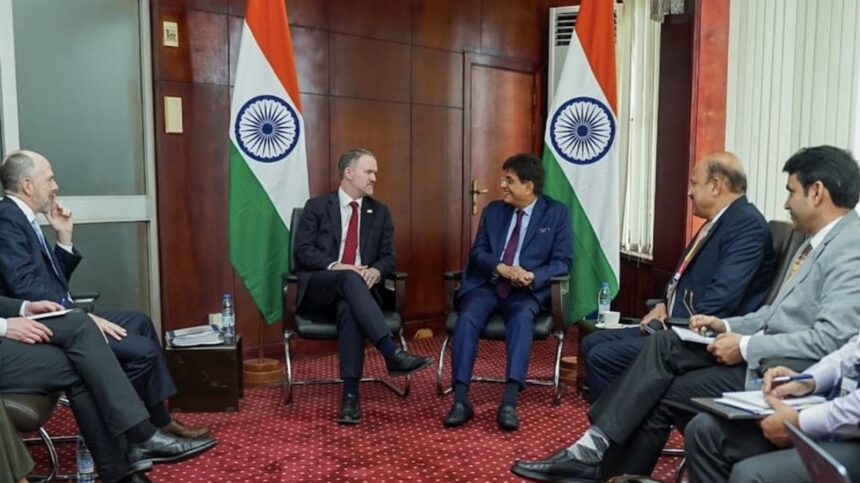
Indian Commerce Minister Piyush Goyal said on Friday that he had a “very productive discussion” with US Trade Representative Jamieson Greer on the sidelines of the World Trade Organization Ministerial Conference. The meeting will be held from March 26 to 29 in Yaoundé, Cameroon.

“We exchanged views on the #WTOMC14 agenda, next steps in the Indo-US FTA negotiations and explored ways to further deepen our economic cooperation and bilateral trade relations,” Goyal posted on X.
About two weeks later, amid the ongoing US-Israeli war on Iran, and after the US Supreme Court struck down most of the tariffs imposed by Donald Trump, Indian Commerce Minister Rajesh Agrawal said that the signing of the bilateral agreement would not happen until a new tariff framework was put in place.
Last February, India and the United States announced that they had finalized the framework for the first phase of their bilateral trade agreement. Under the proposed framework, the US agreed to reduce tariffs on Indian goods to 18 per cent.
However, the US tariff structure has since changed following the Supreme Court’s ruling against Trump’s sweeping tariffs. The agency report added that after the ruling, Trump imposed a 10% tariff on all countries for 150 days starting February 24.
Amid these developments, the meeting between the chief negotiators from India and the United States was postponed. The two sides were scheduled to meet last month to finalize the legal text of the agreement, which was earlier expected to be signed this month.
“The agreement was scheduled to be signed in March,” the Commerce Secretary said. “(But) when we said this, at that time, the Supreme Court ruling on the (International Emergency Economic Powers Act) tariffs had not been made. Now, with the Supreme Court ruling on the IEEPA tariffs, the tariffs themselves are not there. Now there are Section 122 tariffs… about 10 percent. So the deal that we finalize and sign has to be against the structure of the tariffs or the comparative advantage that you get.” India. In the American market.”
Along with the United States, the government said it is currently negotiating six free trade agreements with different countries and regional groups as part of efforts to expand trade partnerships.
Another report by news agency ANI added that negotiations are ongoing with Australia, Sri Lanka, Peru, Chile, the Eurasian Economic Union (EAEU) and Israel.