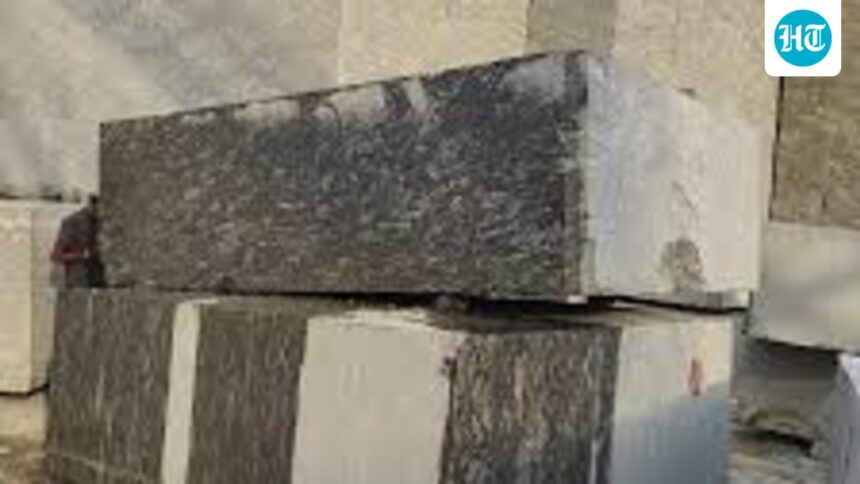
Jaipur/Barmer/Jalore: Rajasthan’s granite and marble industry is facing one of its worst recessions in recent years, as escalating tensions in West Asia disrupt exports, increase shipping costs and cause the closure of major industrial centers such as Jalore, Kishangarh and Ajmer.

Not only the supply of raw materials has been affected, but even the export of finished products has come to a complete halt, said Ram Niwas Baboria, president of the Rajasthan Granite Mining Association. “About 80% of the factories in Jalore are on the verge of shutting down, and those that are still running may survive for only 15 to 20 days,” he said. He added that the works are worth approx $800 crore per month in marble, granite and quartz business was severely affected.
Echoing Baboria’s concerns, Manoj Kabra, office bearer of the Kishangarh Marble Association – one of the largest marble markets in the state – said the ongoing conflict between Iran, Israel and the US has greatly affected both imports and exports. Sea freight charges rose by 25% to 30%, leading to a sharp increase in costs and discouraging new business deals.
“The volatility has also led to higher raw material costs, especially petrochemical products imported from the Middle East which are essential for marble processing. This has increased production costs,” Capra said. He added that many factory owners are either reducing or stopping production, which directly affects workers and their livelihoods.
From Ajmer, Jitendra Punia, president of Ramallia Mining Association, said exports have almost stopped while transportation costs have increased dramatically. “No new orders are coming in, and existing orders are not being dispatched due to uncertainty. The entire industry is in a wait and watch mode,” he added.
“A fixed shipment was invoiced at $300 per container with a value of $2,000 on arrival, citing war insurance by shipping companies,” Poonia said, citing a recent example. “This is our peak season, when 50,000 tons of material on average are exported to the Gulf, Vietnam and Turkey.”
Jalore was the worst affected
Jalore district, known globally for its granite exports, was the worst affected district. According to industry estimates, nearly 250 granite units were closed in the past two weeks as export orders fell sharply. The industry, which was earlier sending about 25 containers per day – nearly 80% of which were exported to the UAE – is witnessing an unprecedented slowdown.
Ramkishan Ranua, president of Jalore Granite Association, said the situation remains uncertain. “Until the war situation improves, we can only wait. If exports do not resume soon, more closures are inevitable,” he warned.
Local exporter Ashok Kumar said the disruption affected the entire export cycle. “Orders have stopped, payments have been delayed, and we are left with no choice but to temporarily close the units,” he said.
The recent unrest has exacerbated an already weak industry. From about 1,350 operational units earlier, nearly 750 units have already been closed over the past year due to lower global demand and continued uncertainty. The recent wave of closures has exacerbated the crisis.
“The granite industry in Jalore is largely export-dependent. With international markets being affected, the entire value chain – from mining to polishing – has taken a huge hit,” industry representative Tanmay Gehlot said.
The impact on employment has been severe. Each granite unit employs approximately 15 workers directly, in addition to many others in related activities. With 250 units closed, more than 6,000 workers have already lost their jobs, while thousands more face the risk of unemployment.
“Workers are migrating because there is no work,” said Shrawan Lal, a factory operator. “Even arranging food has become difficult for many families.”
The crisis also disrupted the supply chain. The daily movement of raw materials, which previously involved approximately 100 trucks, has decreased significantly. Loading activities have slowed, and export logistics remain uncertain amid rising shipping costs and geopolitical instability.
Industry stakeholders say the recovery will largely depend on how quickly global conditions stabilize. Until then, Rajasthan’s granite sector – once a strong export-driven industry – is still facing one of its toughest phases in recent times.