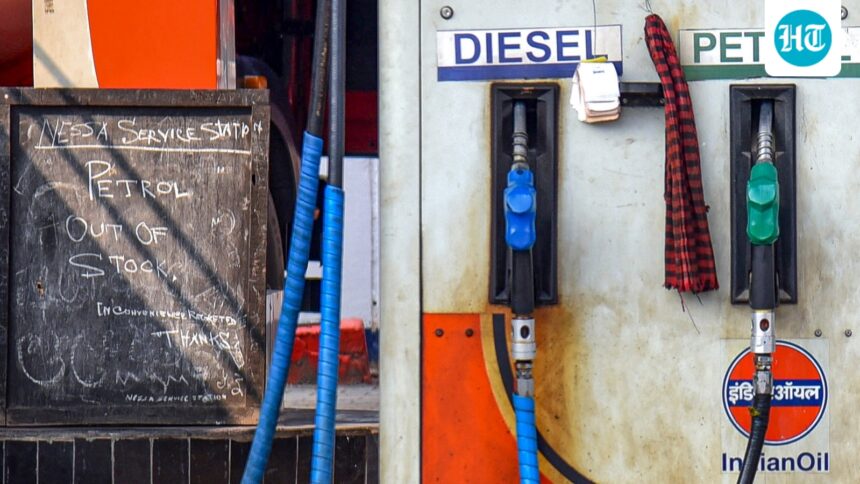
New Delhi: Private refiner Nayara Energy has raised petrol prices by $5 liters and diesel in it $3L on Thursday – becoming the first oil marketing company to review motor fuel prices since the conflict began in West Asia – while the Petroleum Ministry moved on the same day to refute claims circulating on social media that India has only six days of fuel stock left, asserting that the country has nearly two months of supplies.

These developments came as the conflict in West Asia continued for nearly four weeks, a period during which pressures on global energy supplies increased, raising anxiety among consumers in some parts of the country.
Panic buying erupted in several states for a second day on Thursday. The state government said fuel sales in Gujarat have risen four to five times since Monday, with long queues reported at fuel stations in Ahmedabad, Rajkot, Surat and Gandhinagar. Winding queues were also seen in Kashmir and parts of Karnataka, Uttar Pradesh and Goa, where officials and ministers maintained there was no shortage.
Nayara, which operates nearly 7,000 petrol pumps and is the country’s largest private fuel retailer, said its network “continues to operate normally, without interruption in service”.
Benchmark Brent crude was trading at $106.98 a barrel on Thursday evening, up nearly 47% from $72.87 before the conflict began on February 28.
Retail petrol and diesel prices sold by Indian Oil Corporation (IOC), Bharat Petroleum Corporation Ltd (BPCL) and Hindustan Petroleum Corporation Ltd (HPCL) have been frozen since April 2022 prices, although the three companies raised the price of premium or premium petrol last week by $2 per liter and the average sale of diesel in bulk to industrial users is approximately $22 litres.
“Since petrol and diesel consumers are highly price sensitive, raising fuel prices even marginally would push them away to nearby retail outlets of other companies where prices are lower,” said an industry analyst, who requested anonymity. “This is a smart way to minimize losses by selling smaller quantities without closing outlets. However, the burden of losses will shift to other companies, especially public sector oil marketing companies, due to their market dominance and inability to raise prices at will.”
However, he justified the private company’s move on the basis that while the government often compensates public sector corporate management companies for their losses from the budget, private companies have to bear the losses on their books.
IOC, BPCL and HPCL together control over 90% of India’s fuel retail market through approximately 101,470 outlets nationwide. Among other private sector retailers, Jio-BP, which operates over 2,000 pumps, maintained current prices; The company told HT that its mobility stations are “fully functional and adequately equipped”. Shell India, which has about 350 outlets, has historically priced PSU OMC higher.
All refineries are currently losing at least $$25 per liter on gasoline and diesel sales, said three executives who requested anonymity.
“as [West Asia] As the conflict approaches one month, its impact on Indian downstream players has become more evident, with IOCs’ petrol and diesel marketing margins turning negative, at – $“25/45 per liter over the current two weeks,” Sabri Hazarika and Arya Patel of Emkay Global Financial Services wrote in a research note.