New Delhi: India has nearly 60 days of physical fuel stock and no shortage of petrol, diesel or LPG anywhere in the country, the Petroleum Ministry said on Thursday, as it moved to counter what it called a “deliberate and coordinated misinformation campaign” leading to panic buying across several states.

The ministry said all of its more than 100,000 retail fuel outlets were operating without interruption, and not a single outlet had been asked to ration supplies — a rebuttal to social media posts citing six-day inventory figures and images of queues at pumps, some of which the ministry said were lifted from international news footage of rationing in other countries.
Regarding crude oil supplies, the ministry said that India is currently receiving more oil from its 41 suppliers than it previously arrived through the Strait of Hormuz, with increased volumes from the Western Hemisphere compensating for the disruption. Every Indian refinery is operating at more than 100% utilization and crude oil purchases have been restricted for the next 60 days. “There is no supply gap,” she added.
Read also | ’60 days of oil stocks and 800,000 tons of LPG’: Government releases stock details amid ’emergency’ concerns
Regarding strategic reserves, the ministry said India has a total reserve capacity of 74 days; With physical inventory covering approximately 60 days, combining crude oil inventories, product inventories and strategic storage allocated to the cave. “Nearly two months of steady supply is available to every Indian citizen regardless of what happens globally. The quantity in the strategic stockpile becomes secondary in such a supply situation. Therefore, any representation that India’s reserves are depleted or inadequate must be rejected with the disdain it deserves,” the ministry said.
State-owned Indian Strategic Petroleum Reserve operates strategic storage at three sites with a combined capacity of 5.33 million metric tons, currently at about two-thirds capacity — enough, according to the government’s 2021 estimate based on 2019-2020 consumption, to cover about 9.5 days of crude oil requirements alone.
The ministry claimed that the picture of LPG, which was the most severe pressure point since Iran struck the energy infrastructure at Ras Laffan in Qatar, had improved. Following the LPG Control Order, the output of local refineries was increased by 40%, taking daily production to 50,000 metric tons – more than 60% of India’s daily requirement of about 80,000 metric tons.
Read also | Switch to PNG if available or lose LPG supply: Government order for households amid shortage fears
Consequently, the net daily import requirement decreased to 30 thousand metric tons. On top of domestic production, the government said, 800,000 metric tons of LPG are on their way from the United States, Russia, Australia and other countries, arriving through 22 import terminals — double the 11 that existed in 2014. Oil companies are delivering more than five million cylinders a day; The ministry said that the demand for cylinders, which rose to 8.9 million last week, has returned to the usual daily demand of five million.
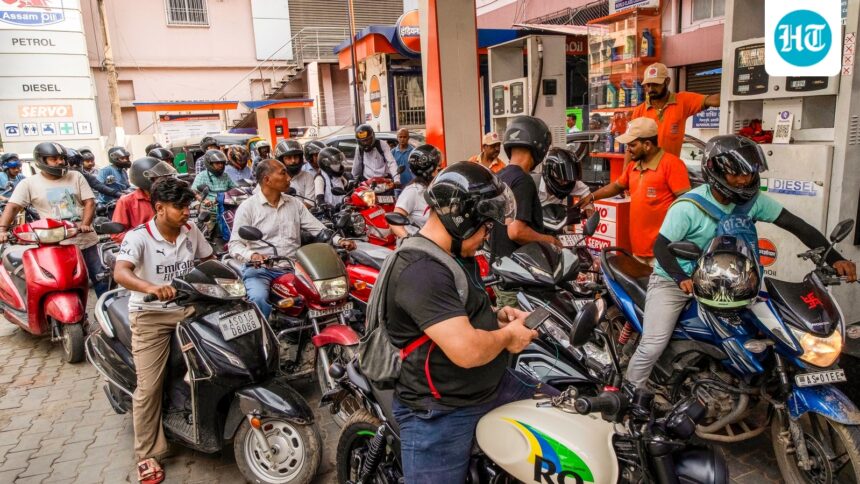
The government’s assurances did not succeed in completely eliminating the concern. Panic buying continued for the second straight day on Thursday, with long queues emerging at petrol stations in Gujarat state – where fuel sales have risen four to five times since Monday – as well as in Kashmir, parts of Karnataka and Goa. Some stations in Surat and Ahmedabad closed temporarily to replenish stocks. Select pump owners in surat purchases with $200 for two-wheelers and $2000 for four-wheel drive. To ease working capital constraints on traders, oil companies extended credit to pump owners for more than three days compared to the previous day.
Against this backdrop, private oil refiner Nayara Energy – the country’s largest private fuel retailer with nearly 7,000 outlets – raised petrol prices on Thursday by $5 liters and diesel in it $3, becoming the first oil marketing company to review automobile fuel prices since the start of the conflict. It is estimated that all refiners will lose at least $$25 per liter on regular petrol and diesel, with state-run IOC, BPCL and HPCL – which together hold more than 90% of the retail market – unable to pass on costs due to the government’s tacit control over pump prices. Regular petrol and diesel prices at state-run pumps have been frozen since April 2022.