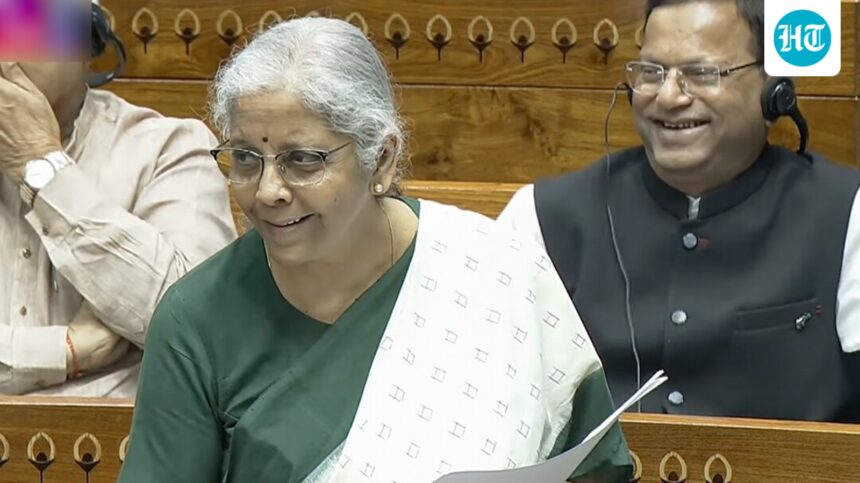
The Lok Sabha on Wednesday passed the Finance Bill, 2026, along with amendments brought by Union Finance Minister Nirmala Sitharaman to clarify surcharge on share buybacks and improve efficiency and procedural fairness of income tax administration.

Read also: Expectant father killed in bus overturn in Delhi’s Karol Bagh
The amendments clarify that a fixed surcharge of 12% will apply to share buybacks. When the Budget was presented on February 1, the government proposed that the consideration received by shareholders for buybacks, which has been treated as dividends for tax purposes so far, will be treated as capital gain and taxed accordingly at 30% for promoters or 22% for promoter companies.
The applicable surcharge was initially unclear, especially for promoters and high-income taxpayers, and now the amendment caps the surcharge on buyback income at 12%, reducing the effective tax burden on them.
Also Read: ECI removes 7 CAPF officers from West Bengal for attending iftar ceremony during poll posting
However, experts pointed out that for small buybacks, the flat rate of 12% could increase the tax burden, as the surcharge is imposed based on income thresholds.
Imposing a flat 12% surcharge on capital gains from buybacks to individual shareholders would significantly increase the effective tax cost, given the application of a lower surcharge structure – no surcharge on taxable income up to $50 lakh and 10% on taxable income between $50 thousand and $This amounts to Rs 1 lakh crore, explained Sandeep Jhunjhunwala, M&A tax partner at Nangia Global Advisors.
Also read: India updates Paris pledge with tougher 2035 climate targets on emissions and clean energy
“However, the impact of this adjustment will be largely limited to small and medium-sized repurchases, as large repurchases that exceed gains $“Rs 1 crore is already subject to a higher surcharge of 15%,” Jhunjhunwala said.
Jhunjhunwala also said that the clarification in the Finance Bill that approvals granted electronically in assessment, reassessment or recalculation proceedings cannot be invalidated on account of inadequate inference, authentication defects or lack of digital signature, with retrospective effect from April 1, 2021, appears to be a remedial and verification provision aimed at protecting the legality of documents issued electronically.
This could eliminate taxpayers’ positions in pending disputes and revive cases that would otherwise have been struck out due to procedural lapses, Jhunjhunwala said.
This effort aims to maintain income tax procedures that are substantially consistent with the law but may have procedural or technical flaws, he said.
Sitharaman told parliamentarians on Wednesday that the new Income Tax Act, 2025, which comes into effect from April 1, will help reduce litigation as financial limits for filing appeals in various forums have been raised.
The amendment to Section 140 of the Act approved by the Lok Sabha will raise the turnover limit under startup tax exemption from $100 Crores $300 crore, fully in line with the updated startup policy notified by the Department for Promotion of Industry and Internal Trade (DPIIT) in February 2026,” said Maheshwari of AKM Global.
The DPIIT order has revised the eligibility thresholds for India’s innovation ecosystem by increasing the turnover cap to $200 Crores for regular startups and $Rs 300 crore for deep tech startups.
This alignment ensures that fast-growing, innovation-driven companies no longer lose tax benefits simply because they expand quickly.
The draft law also proposed to abolish detention provisions in cases of non-payment of tax dues by the defaulting assessee.