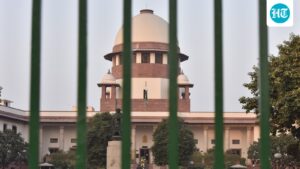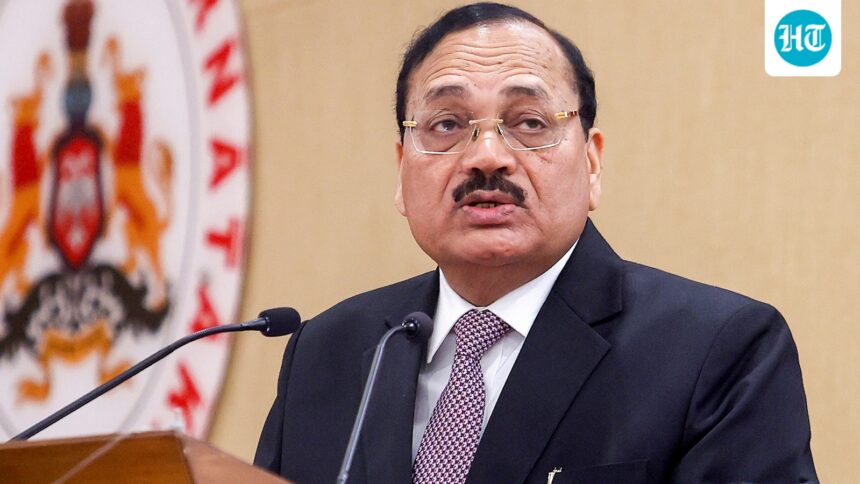
The Supreme Court on Wednesday took serious objection to what it termed an attempt to improperly influence judicial proceedings, after it learned that the father of a litigant had called the brother of India’s chief justice Surya Kant to question an order passed by the court.

Revealing the incident in open court, CJI Kant expressed strong disapproval of the behavior and warned of the possibility of criminal contempt proceedings. “He called my brother and asked him how the Chief Justice of India issued this order. Is he dictating to us?” commented the CJI, visibly annoyed.
The case relates to an application filed by Nikhil Kumar Punia, who claimed to have converted to Buddhism and was seeking to benefit from minority sanctuary despite being born into an upper-caste Hindu family. In January, the court rejected his claim, calling it “a new type of fraud.”
$Rs 29,000 Crore Liability”>Also Read | Supreme Court rejects NHAI review though $29,000 Crores Liability
On Wednesday, the bench, also comprising Justice Joymalia Bagchi, confronted the petitioner’s counsel over the alleged phone call made by the petitioner’s father.
“Now tell us why we shouldn’t initiate criminal contempt against your client’s father…Should I disclose this in open court?” asked the CJI.
The petitioner’s lawyer expressed his ignorance of the developments, indicating that he had not been informed of this information.
Dissatisfied, the court said the behavior amounted to “pure misconduct” and advised the lawyer to consider withdrawing from the case after verifying the facts. “As a lawyer, you should first consider withdrawing… Even if it is outside India, I know how to deal with such people,” the bench said, adding that such behavior would not be tolerated. The court also rejected any suggestion that such actions could affect the conduct of the proceedings.
The ICJ said: “No one dares to do this. And do you think I will transfer the case because of this? I have dealt with such elements for the past 23 years.” He also noted that the court viewed this behavior as part of a broader attempt to “manipulate” the proceedings. In the previous hearing on January 28, the bench termed the petition a “new type of fraud” after the petitioner revealed that he was born in the Jat Punia community before converting to Buddhism.
It rejected a petition filed by Punia and another upper category candidate from Haryana, who sought to claim minority benefits as Buddhists for admission in a minority-run medical college in Uttar Pradesh, despite their appearance in NEET-PG 2025 under the general category.
Read also | Supreme Court says there is no SC status for those who convert: ‘Caste status has been overshadowed in eyes of law’
At that time, the bench questioned how upper-caste general category candidates could claim minority status to secure admission benefits meant for disadvantaged groups. The petitioners had obtained the Buddhist minority certificates from a sub-divisional officer in Hisar in February last year. However, while appearing for NEET-PG 2025, they declared that they belong to the general category and do not fall under the economically weaker sections. The court noted that the claim of conversion appeared to have been made only after the candidates had failed to secure admission in a previous attempt, raising doubts about the bona fides of the move.
Raising serious concerns, the bench directed the Haryana government to explain the legal framework governing the issuance of minority certificates and whether such certificates can be granted to upper caste individuals who have declared themselves as general category candidates in competitive examinations. When the matter was taken up on Wednesday, the court did not proceed to examine the merits further, noting that Haryana was yet to submit its compliance report as per the earlier directions. “Let the state submit its compliance report…if not, the Haryana Chief Secretary will remain personally present,” the bench ordered. The case is now listed for hearing next week.