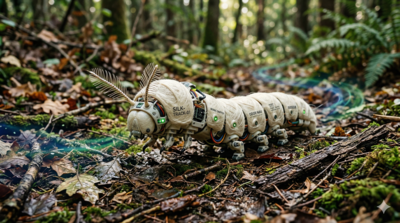
The idea that a robot “smells” its way through a complex environment has captured the imagination of scientists for years, but it always comes with a caveat: What if the robot loses a sensor? In a groundbreaking advance that combines biology and engineering, a new robot inspired by the humble silkworm can continue its search for odors even after it loses its sensor.
This not only reflects nature’s ability to adapt, but also has a number of potential practical applications, from disaster relief to environmental monitoring. By learning from insects’ ability to adapt, scientists are shaping the future of robotics in a surprisingly practical way.
How a silkworm inspired this scent-tracking robot
The inspiration for this innovation comes from the silkworm moth (Bombyx mori), famous for its exceptional ability to sense pheromones.
Even with a small brain, a moth can locate a mate using weak scent trails carried by the wind. What is even more surprising is that the moth can still move around even if it has lost one of its antennae.According to research published on the npj Robotics website, “Silkworm moths can… maintain efficient navigation using only one antenna.” This biological feature has been used as a basis for developing a robot that does not need perfect coordination in its sensors.
A robot that works with even one sensor
In the traditional method of scent tracking by robots, the robots must have at least two well-functioning sensors so that they can track the scent and move in the direction of the scent. This is because if one of the sensors malfunctions, the performance of the robots is greatly affected. However, this does not happen with this new method.The method the robot uses to track scent is not by using algorithms as in the traditional method, but by using a behavioral method inspired by insects.
The robot does not “panic” if one of the sensors fails, but rather changes its behavioral movements to be able to track the smell using the remaining sensor. Through studies, the performance of the robots was not affected, as the success rate of the robots remains the same even after the sensors fail.This is a major shift in the way robots are made, as the traditional way of making robots was based on precision.
Why are scent tracking robots important?
Smell-based navigation, also called automated olfaction, is an increasingly popular field with many practical applications. The robot, equipped with the ability to detect and track odors, can be used to locate survivors in disaster areas, track down gas leaks, or track down hazardous materials. According to researchers from the Research Organization for Information and Systems (ROIS) involved in this research, “These robots can play pivotal roles in disaster response, detection of hazardous materials and explosives, and environmental monitoring.” Unlike police dogs, which need training and get tired over time, robots can work without any interruption and even in dangerous areas without endangering anyone’s life.
A step towards smarter robots
This is because this is the general trend in science, where the emphasis is on learning from nature to solve complex engineering problems. Insects, despite their simplicity, have evolved efficient survival mechanisms to live in this world for millions of years.
This is done by replicating the mechanisms that led to the development of robots that are not only intelligent, but also flexible.This is best demonstrated by a robot inspired by a silkworm, which showed that losing any of the sensors is not a sign of failure, but rather a sign of adapting differently. This could be the beginning of something that will revolutionize how robots work in the world, since this field is constantly evolving.