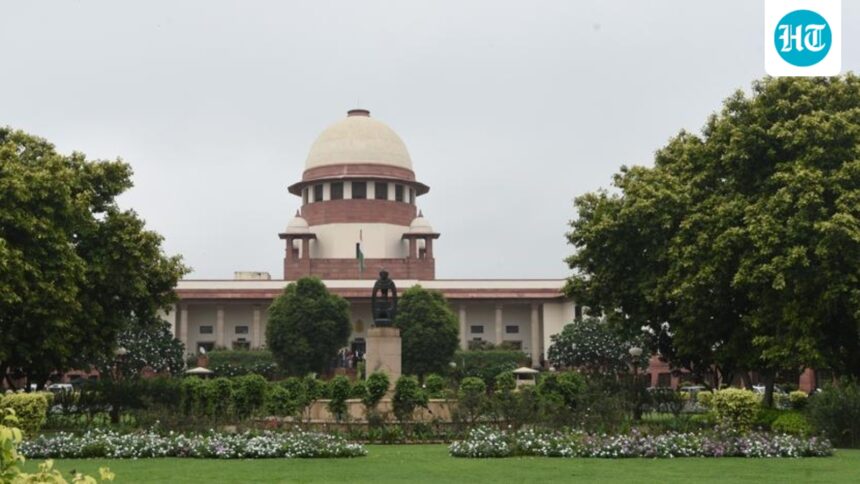
The Supreme Court on Tuesday held that conversion to Christianity and other religions results in loss of scheduled caste (SC) status, holding that a person professing a faith other than Hinduism, Sikhism or Buddhism cannot claim the constitutional protections and legal entitlements available to members of scheduled castes.

Upholding the decision of the Andhra Pradesh High Court, a bench of Justices Prashant Kumar Mishra and Manmohan not only affirmed the quashing of criminal proceedings in a case registered under the Scheduled Castes and Scheduled Tribes (Prevention of Atrocities) Act by a man who had already converted to Christianity, but also laid down a formal framework governing the impact of religious conversion on caste-based entitlements.
The court ruled that the ban under Section 3 of the Constitution (Scheduled Castes) Order, 1950 is “categorical and absolute”, making it clear that any person professing a religion other than Hinduism, Sikhism or Buddhism ceases to be a member of the Supreme Court from the moment of conversion, irrespective of his birth. The court stressed that this loss of status is automatic and entails the termination of all legal protections, reservations and entitlements associated with SC identity.
Outlining the broader constitutional framework, the court traced the origin of the SC and ST classifications to Articles 341 and 342 of the Constitution, asserting that these provisions aimed to address historical backwardness and social deprivation. While ST status may involve a more thorough and fact-based investigation into continued adherence to tribal customs and community acceptance, the position of scheduled castes, as the court held, is strictly governed by the 1950 Presidential Order.
The court highlighted the legislative development of Section 3 of the 1950 Ordinance, noting that it was originally limited to Hindus and was later expanded to include Sikhs in 1956 and Buddhists in 1990. It is noteworthy that Christianity was never included within this framework. In interpreting the term ‘confess’, the Court relied on its earlier ruling in Bongabrao v. D. B. Meshram (1964) to hold that it refers to an express and public declaration of faith, and not merely a private belief. He said the focus is on outward appearance through behavior.
Applying this test, the court found that the facts in this case were unambiguous. The appellant, Chinthada Anand, originally from the Madiga community (a notified court of inquiry in Andhra Pradesh), had been working as a pastor for over a decade, regularly held Sunday services, preached the Christian faith, and held a leadership position within the local Christian community. These activities constituted, as the council saw it, a clear and public recognition of Christianity.
“Once the appellant converted to Christianity, the caste status he had previously enjoyed eclipsed the view of the law,” the court said, rejecting the argument that caste identity by birth could survive post conversion. It also held that no person could profess Christianity and claim SC status at the same time, describing the two positions as “incompatible and inconsistent with the constitutional order.”
The judgment also dealt with the appellant’s reliance on the Andhra Pradesh Government Order, 1977 providing certain benefits to SC category converts. The court clarified that such orders only provide “non-statutory benefits” such as economic assistance and do not extend to statutory benefits such as reservation or protection under parliamentary legislation such as the SC/ST Act. It said the applicability of central legislation could not be diluted by state executive orders.
By clarifying basic legal principles, the Court established a set of “postulates” governing the status of the International Criminal Court. It held that the plaintiff must prove his membership of a notified caste through beyond doubt evidence; Converting to an unrecognized religion leads to complete loss of eligibility; No legal benefit can be claimed once this exclusion is activated. She further explained that reconversion was possible under the law, but only if three strict conditions were met: proof of original caste, reliable evidence of genuine reconversion and renunciation of previous religion, and, most importantly, acceptance by the original caste community. The court said that mere self-declaration was not sufficient.
The current case goes back to a complaint filed by Anand in 2021, in which he alleged that some individuals opposed his evangelical activities, assaulted him and used caste-based slurs. Based on his complaint, the police registered offenses under the SC/ST and IPC Act and filed a chargesheet. One of the accused approached the Supreme Court seeking quashing of the case, arguing that invoking the SC/ST Act was legally untenable given the complainant’s confession of conversion.
Agreeing with this contention, the Supreme Court last year held that the protective framework of the SC/ST Act is specifically for members of SCs and STs, and cannot be extended to those who have chosen to step out of that social and legal category by converting to another religion. It further noted that allowing such claims would amount to an abuse of the law.
The Supreme Court dismissed Anand’s appeal against the Supreme Court ruling and observed that there was no allegation or evidence of re-conversion or readmission into the Madiga community. On the contrary, Anand continued to work as a priest at the time of the alleged incident. It also rejected the argument based on the continued possession of a caste certificate, considering that the certificate could not negate the effect of conversion.
Therefore, the court held that Anand was not entitled to invoke the SC/ST Act and affirmed the decision of the Supreme Court quashing the proceedings against the accused. It noted that once the basic requirement of caste status was abolished, the protections provided for in this law were no longer available. The court also considered the remaining charges under the International Penal Code and found them untenable. It noted the lack of independent witnesses, restriction of movement or criminal intimidation, inconsistency in witness statements, and lack of material proving coordinated action. The court found no objective basis for prosecution, and upheld the dismissal of all charges.