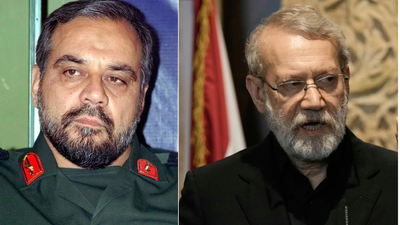
Muhammad Baqir Dhu al-Qadr (left) and Ali Larijani (right) (Photos/Agencies)
After the death of the head of Iran’s Supreme National Security Council, Ali Larijani, in a US-Israeli air strike, the Islamic Republic appointed Muhammad Baqir Zolqadr as his successor.
The country’s power has now shifted to a figure with deep roots in both the Islamic Revolutionary Guard Corps (IRGC) and Iran’s political establishment.
Who is Muhammad Baqir Zulqadr?
Mohammad Baqir Zolqadr, the former commander of the Iranian Revolutionary Guard, has been appointed as the new head of the Supreme National Security Council. The council, officially headed by President Masoud Pezeshkian, coordinates security and foreign policy in Iran and includes senior military, intelligence and government officials, along with representatives of Supreme Leader Mojtaba Khamenei.
Zulqadr’s appointment was announced on the 10th by President Pezeshkian’s Deputy Communications Officer. His career spans decades of military and political experience. He served in the Iran-Iraq War in the 1980s and later became Chairman of the Joint Chiefs of Staff of the Iranian Revolutionary Guard for eight years. He also served for eight years as Deputy Commander-in-Chief.In 2005, he was appointed Deputy Minister of Interior for Security and Police Affairs under President Mahmoud Ahmadinejad.
Since 2023, Zolqadr has been secretary of the Expediency Discernment Council, a powerful advisory body that mediates between Iran’s various centers of power and the Supreme Leader. Analysts said that his new role enhances the growing influence of the Iranian Revolutionary Guard amid uncertainty at the top of the Iranian leadership, especially since Mojtaba Khamenei has not appeared in public after his succession.The National Security Council plays a central role in Iran’s security and foreign political decision-making.
Larijani, one of the most prominent non-religious figures in Iranian politics, has been at the heart of the Iranian leadership’s response to the escalating war in the Middle East and the broader regional crisis. After Khamenei’s death, Larijani led a transitional council alongside two others, directing Iran’s crisis management until his assassination.With the appointment of Zolqadr, the IRGC now has a stronger presence in the council, which could impact military operations and diplomatic negotiations. Al Jazeera reported, quoting a source, that “the perception is that Dhu al-Qadr will have the final say on security and military affairs within the council.”According to experts, any potential talks with the United States or other regional powers would likely require Zulqadr’s approval. Analysts familiar with the Iranian political system said: “Anyone who participates at the negotiating table must obtain the approval of God Almighty.”