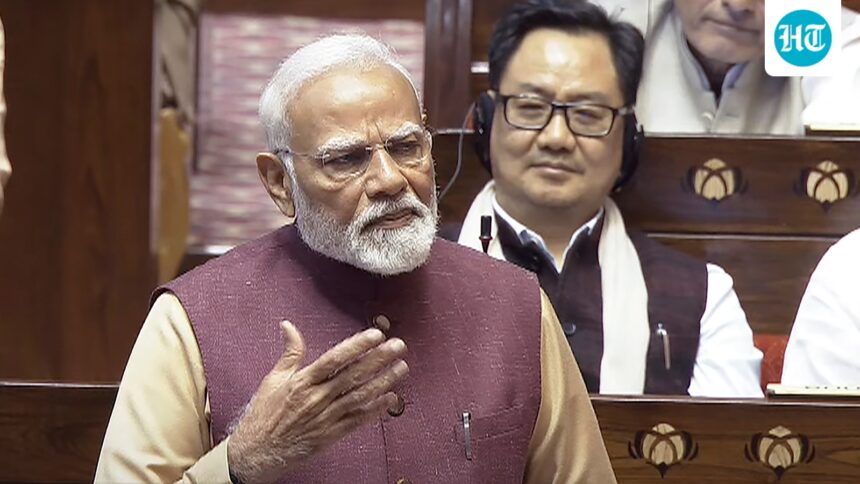
Prime Minister Narendra Modi on Tuesday, while delivering his Rajya Sabha address, urged citizens to prepare for challenges arising from the ongoing US-Iran war in West Asia, noting that its impact on energy supply chains and inflation could have long-term implications.

Modi said the government was working on all fronts to manage the situation and protect public interest, adding: “I urge the citizens to be prepared for every challenge. The impact of this war may be long-lasting, but I assure the people that the government is alert and the interest of the nation remains paramount.”
The Prime Minister also asked the states to work as one team and face the challenges as they did in the time of Corona. “The challenges ahead will test us. I urge all states to act proactively, because in difficult times it is the workers and weaker sections who are the worst affected. Steps must be taken to protect our migrant workers. State governments must also remain vigilant against black marketing, which tends to rise in such periods, and ensure that such practices do not take place,” Modi said.
Read also: ‘100% under Trump’: Rahul Gandhi targets PM Modi over silence on US in Lok Sabha speech
The Prime Minister said that, as in the time of Corona, the government has formed seven empowered groups to develop strategies on fuel, supply chains, fertilizers and keeping inflation under control: PM Modi in Rajya Sabha.
He also said that India is prioritizing the safety of its citizens during the conflict in West Asia, noting that more than 375,000 Indians have been safely evacuated so far, including more than 1,000 from Iran, while urging all parties to seek a peaceful solution.
“Any threat to human life in this war is not in the interest of humanity. Therefore, India is making continuous efforts to encourage all parties to reach a peaceful solution as soon as possible. In times of crisis, the safety of Indians in the country and abroad is our top priority. Since the war began, more than 3,75,000 Indians have returned safely to India. From Iran alone, more than 1,000 Indians have returned safely so far, including more than 700 youngsters who were studying medicine. The Prime Minister said that the government is working with full sensitivity during This is a time of crisis.
Modi added that due to the war, the Strait of Hormuz remains closed to the passage of ships containing gas and oil, but India has done its best to ensure that the energy needs reach the shores in time even during this difficult time.
“Through diplomacy, India is trying to ensure safe transportation of the country’s ships even in war. India has chosen the solution through dialogue to resolve this issue,” Prime Minister Modi said.
Adequate crude oil reserves with India: PM
The Prime Minister said India has sufficient crude oil reserves and robust arrangements to ensure uninterrupted supplies despite the ongoing conflict in West Asia. He noted that strategic oil reserves have been expanded to more than 53,000 metric tons, with plans to increase them to more than 65,000 metric tons, along with a significant increase in refining capacity over the past decade.
Modi stressed that the government is taking all necessary steps to maintain steady energy supply even as global trade through the Strait of Hormuz faces disruptions. He said that India is sourcing oil and gas from multiple regions, and recent shipments of crude oil and LPG have already arrived from various countries, with efforts continuing to secure supplies from all possible sources.
The Prime Minister also emphasized that India has diversified its energy imports from 27 to 41 countries in the past decade to reduce dependence on any single source. He added that the government is working to expand domestic gas distribution, including pipelined natural gas and liquefied petroleum gas, to enhance energy security.
Emphasizing that crises test resolve and preparedness, Modi said that the steps taken over the past 11 years, especially diversification of energy sources, have helped India manage such challenges better.