NEW DELHI: As the Education Ministry prepares to strengthen the open education framework through the National Institute of Open Schooling (NIOS), as part of a national effort to bring out-of-school children back into the education system, concerns have emerged over the institution’s finances and functioning.

A recent working paper from the National Institute of Public Finance and Policy (NIPFP), a think tank under the Ministry of Finance, highlights that NIPFP has not received government budget support since 2012-2013. Instead, it operates largely as a self-financing body, relying heavily on student fees, the newspaper notes.
It is further stated that although NIOS has accumulated large surpluses, its spending pattern raises questions. “In 2021-2022, the institute produced approx $188 crore in academic revenue and recorded a surplus of more than that $127 crore, with total reserves approaching $800 Crores. However, spending on employees ( $65.8 crore) was more than double the expenditure on academic needs of students ( $Rs 30.8 crore, the report says.
Experts believe that the source of concern is not the surplus itself, but rather how it is used, especially when students’ results remain modest. In 2024, pass rates were 60.14% for Grade 10 and 62.39% for Grade 12, among the lowest rates among school boards, according to government data.
“NIOS operates with a financial efficiency that reflects a for-profit corporation rather than a nonprofit educational board,” the paper published Feb. 18 said.
The study, titled “Promoting Government Open Schools: The Need for a Dedicated and Focused Policy for School Dropouts,” was authored by HK Amar Nath of NIPFP and Nikhil Rahangdale of the Indian Institute of Foreign Trade.
These findings come against the backdrop of the National Education Policy (NEP) 2020, which aims for 100% enrollment from pre-school to secondary level by 2030. However, data from the Periodic Labor Force Survey (PLFS) 2023-2024 shows that nearly two million children aged between 14 and 18 remain out of school, while more than 50,000 students fail board examinations annually.
The Ministry of Education described open education as a “practical alternative” for children who are unable to attend regular schools due to economic or social constraints.
However, the NIPFP report points to deeper structural challenges. Only 9.7% of India’s 1.47 million schools offer secondary education, creating what researchers call a “structural discontinuity” where student enrollment drops sharply after upper primary level.
NIOS currently serves around 27 lakh learners and has recorded over 41 lakh registrations in the last five years through over 10,800 study and testing centres. However, recruitment shortages persist, with 139 vacancies out of 394 blocked positions, according to parliamentary data.
Nath said the aim of the paper was not to criticize NIOS but to highlight funding gaps.
“NIOS is a registered society and is supposed to be a non-profit organisation. But from 2012 to 2013 onwards, it has not received government funding, even for revenue expenditure,” he said. “These open schools should not be completely dependent on government funding, but they also should not be completely dependent on fees.”
The study suggests directing 2-3% of total spending on education towards out-of-school adolescents to strengthen the system. Currently the center offers $2000 annually for out-of-school children aged 16-19 years, belonging to socially and economically disadvantaged groups.
“NIOS is a public institution and is not meant to make profit. The main question is whether the money is being used to support students,” said education teacher Anita Rampal.
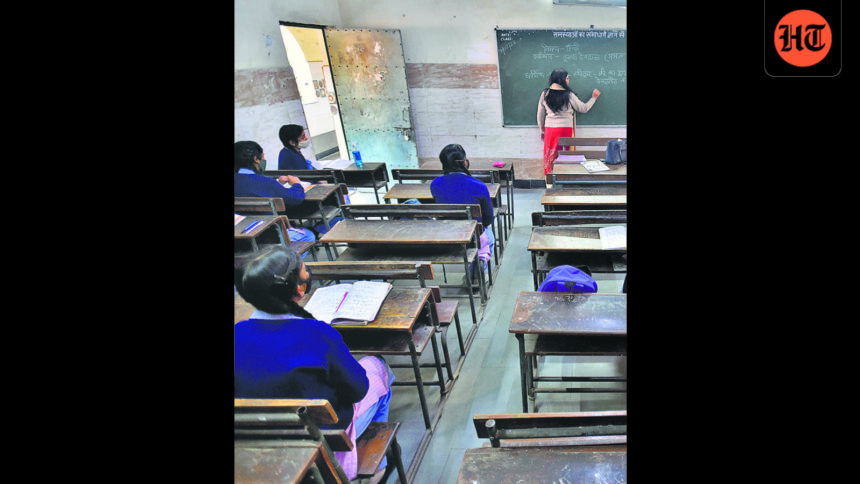
On the ground, operational issues remain. Officials at study centers reported irregular payments and low educational support. The classes, which used to be conducted throughout the year, are now limited to a month before exams due to delayed payments, said the director of the NIOS center in Delhi.
For many students, NIOS remains a crucial alternative. “I am enrolled in a photography and video editing institute. I wanted to join regular school with him but my financial situation did not allow me to do so,” said a class XII student at a Delhi centre. “NIOS is costing me a lot $9,000 per annum, including examination fees.
Rampal said weak academic support undermines the purpose of open education. “If students have no one to help them at all and they simply upload assignments, it becomes tokenistic,” she said, adding that open education “cannot become an alternative method of education in place of proper schools.”
NIOS and Education Ministry officials did not respond to HT’s queries for comment.