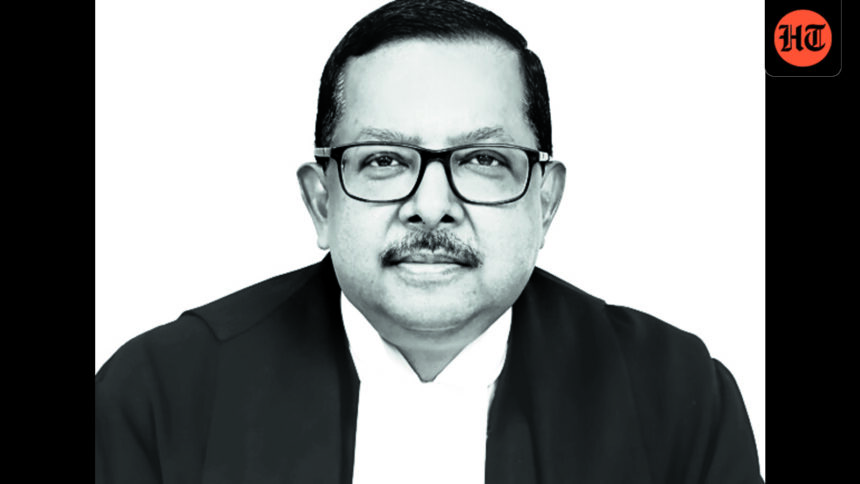
Supreme Court Justice Ujjal Bhuiyan on Sunday said the imprisonment of citizens for dissent and continued atrocities against Dalits “cannot be a model for Vixit Bharat”.

Speaking at the Supreme Court Bar Association (SCBA) conference in Bengaluru on the judiciary’s role in Vixit Bharat, Justice Bhuyan said: “While the government’s vision of Vixit Bharat, or a developed India by 2047, is laudable and achievable, economic growth cannot come at the cost of civil liberties and dignity.”
“In Vixit Bharat, there should be more space for dissent and debate. Dissent cannot be criminalized,” he said, warning of the growing trend of activating criminal law in response to protests, student movements, and even expression on social media.
He said the past few years had witnessed a pattern of “reckless registration” of criminal cases by the state, often on trivial matters. He said the FIR routinely submits public demonstrations or online content, landing individuals into lengthy investigations and imprisonment.
“The judiciary does not direct the state to register such cases. For trivial matters like public demonstrations and agitation, even by students, and sometimes even for memes and social media posts, FIRs are registered, investigation continues, and matters are taken to the Supreme Court. The Supreme Court should constitute special investigation teams,” Justice Bhuyan said.
However, he acknowledged that the courts had not always acted as effective monitors, and said: “Many within the judiciary also suffer from a more loyal than king syndrome. As a result, people continue to languish in prisons for months and months together without bail and without facing trial.”
Justice Bhuiyan also cited the well-established principle expressed by Justice V R Krishna Iyer that “bail is the rule and imprisonment is the exception”. He said this principle was steadily eroding in practice and several cases under the stringent Unlawful Activities (Prevention) Act were prime examples of this.
Citing data presented by the Ministry of Home Affairs (MHA) before Parliament, Justice Bhuyan noted that arrest rates under the UAPA remain high while conviction rates are very low, ranging between “1 to 6%” between 2019 and 2023. “This indicates an overuse of the law,” he said, adding that when the probability of acquittal is so high, continued imprisonment for five to six years raises serious constitutional concerns.
Regarding atrocities against Dalits and caste discrimination, Justice Bhuyan said developed India cannot tolerate entrenched social hierarchy. “In Vixit Bharat, we cannot have parents saying their children will not eat food prepared by Dalits. We cannot have Dalit men standing in the corridors and having other men urinate on them. Respect for the individual must be protected,” he added.
On gender diversity in the judiciary
Justice Bhuiyan noted the continuing shortage of women judges in India’s apex judiciary and called for greater scrutiny of the collegium system with regard to gender diversity in appointments. He warned that subjectivity in this process could lead to the exclusion of women from constitutional courts, and said the body must answer why fewer women are appointed once selections move away from purely merit-based criteria.
“The moment the process becomes subjective, and not just based on merit, women don’t make it,” he said.
Citing empirical data, Bhuyan noted that women’s participation has steadily improved in the lower judiciary, as recruitment has become more objective and examination-based. “Women in the judiciary represent between 27% to 50% in the lower judiciary, rising to nearly 60% in states like Telangana. However, this trajectory reverses sharply at the High Court and Supreme Court level, where appointments are made through the Collegium,” he said.
Justice Bhuyan added that the judiciary should not act as an “eternal critic” or “cheerleader” of the state, but rather remain steadfast in its duty to protect rights and uphold the rule of law. He added: “The judiciary must remain the judiciary only.”