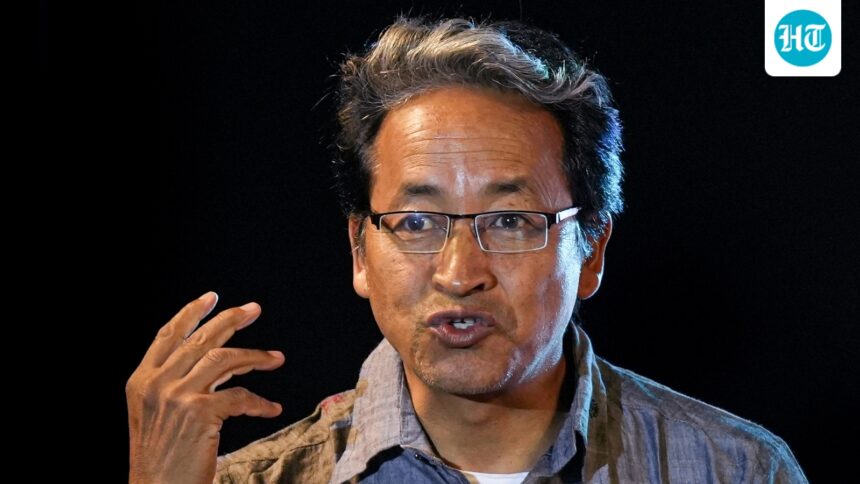
New Delhi: Climate activist Sonam Wangchuk was released from Jodhpur jail on Saturday after the Center scrapped his detention under the stringent National Security Act (NSA), six months after he was detained in the wake of violence in Ladakh last September.

In a statement issued in the morning, the Interior Ministry said it had decided to end Wangchuk’s detention “with immediate effect” after “due consideration.”
“The government remains committed to promoting an environment of peace, stability and mutual trust in Ladakh… In furtherance of this objective… the government has decided to cancel the detention of Sonam Wangchuk with immediate effect,” it added.
Officials in Jodhpur confirmed that the 59-year-old was released in the afternoon. “He was released from prison around 1:30pm today [Saturday] “On the order of the central government,” Ratanada SHO Dinesh Lakhwat was quoted as saying by PTI.
The centre’s detention was challenged in the Supreme Court through a petition filed by Wangchuk’s wife, Gitanjali Angmo. On February 16, the bench questioned the Union government on the authenticity of translated copies of Wangchuk’s speeches and ordered that the original pen he was provided with when he was arrested in September 2025 be submitted to the court.
Earlier, the court reviewed Wangchuk’s medical report and asked the center whether it would not extend his detention. But the center said that Wangchuk’s release was neither desirable nor possible. The next hearing has been scheduled for March 17.
Wangchuk was detained on September 26, two days after protests demanding greater autonomy for Ladakh turned violent, killing four people and wounding dozens. The Union government blamed Wangchuk, a 2018 Magsaysay Award winner and a prominent figure in the Ladakh statehood movement, for sparking the clashes.
The NSA enables both central and state governments to detain individuals without formal charges if they are deemed to be behaving in a way that is prejudicial to national security, foreign relations, public order or the maintenance of essential services. Detention can occur even in the absence of a trial and may last up to 12 months before review.
The Federal Ministry of Interior added in its statement on Saturday that it is working with stakeholders and community leaders to meet the aspirations of the residents of the area.
The statement said: “However, the prevailing atmosphere of marches and protests damaged the peace-loving character of society and negatively affected various sectors of society…”
The government reaffirmed its commitment to providing all necessary guarantees to Ladakh, and said it “still hopes to resolve issues related to the region” through constructive engagement and dialogue, including through the Higher Committee formed to address local concerns.
The state of Ladakh was created on 5 August 2019, after the Center effectively abrogated Article 370, which granted special status to Jammu and Kashmir, and divided the erstwhile state into two union territories – Jammu and Kashmir with a legislature and Ladakh without a legislature. Since then, a series of protests have rocked Ladakh and have had repercussions in Delhi. In February 2024, thousands protested in Delhi, Leh and other parts of Ladakh, demanding statehood and guarantees under the Sixth Schedule of the Constitution.
The Leh Apex Body (LAB) and Kargil Democratic Alliance (KDA), which are leading the agitation for Ladakh statehood and its inclusion under the Sixth Schedule, described Wangchuk’s release as a “huge victory” for the people of Ladakh.
“It is not just about Bangchuk, it is about the whole of Ladakh. We have maintained from the beginning that the allegations against him are baseless. Today, Ladakh has been vindicated,” LAB co-chair Tshering Dorji said today.