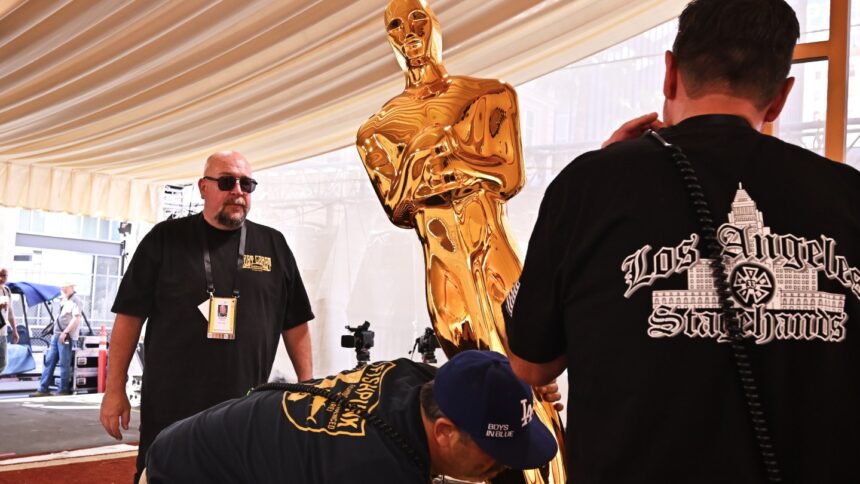
It’s Sunday afternoon in Los Angeles, and you’re trapped in an Escalade, weaving your way through traffic on your way to the Oscars, dressed brightly to celebrate but wishing you felt a little more festive. Instead, you watch the scene outside your window with a growing sense of dread.
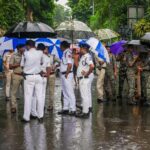
First, it was long stretches of barriers and metal fencing that lined Hollywood Boulevard as traffic headed toward the Dolby Theater. But even before you caught a glimpse of the place, you noticed the tight security. Officers are everywhere – there are patrol cars on every corner – and more than 1,000 law enforcement personnel have been deployed to the area as part of an unprecedented security operation for this year’s Academy Awards.
Traffic slows again, so you can catch a glimpse of the silhouettes on the rooftops – SWAT teams deployed on nearby buildings. The checkpoint ahead creeps forward as officers insert mirrors under cars and fangs weave through the line, searching for explosives.
You hear “Windows down. Open trunk” and comply. The line moves about one inch every five minutes.
This is what an Oscars ceremony looks like in the era of the Iranian war. Security at the concert has always been tremendous. But this year, in the weeks leading up to Sunday’s event, federal authorities issued a memorandum warning of a potential retaliatory threat against the West Coast — particularly California — linked to escalating tensions between the United States, Israel and Iran.
Officials admitted that there was no confirmed intelligence about a specific plot. But with U.S. forces actively engaged in a conflict that has made high-profile domestic targets a symbolic priority for Iran-aligned actors, law enforcement officials are taking no chances. The result is the most secure Oscars ceremony in memory — a fortress of concentric rings, AI surveillance, FBI intelligence gathering, and rooftop snipers surrounding Hollywood’s biggest night.
Limousines and SUVs now stretch long distances, all carrying guests to the same anticipated event. But each vehicle is stuck in the same position, trapped by barriers, surrounded by concrete, and unable to return.
There is precedent for this kind of stagnation. In 2023, protesters flooded nearby streets and surrounded vehicles heading toward the Oscars, halting arrivals before the show’s start time. Several individuals threw garbage and objects at waiting cars. Otherwise, the demonstration remained largely peaceful. But the risks are different this year. Trapped in a slow-moving convoy of high-profile passengers, trapped and unable to move, it’s hard not to let your mind wander to a darker place — toward footage of motorists in Israel, trapped in a stalemate as they try to flee the Nova Music Festival massacre during the October 7, 2023, Hamas attack.
Crowd of people in the street. The cars are frozen in place
“Every year, we monitor what is happening in the world,” Oscars executive producer Raj Kapoor said at a March 11 news conference aimed at allaying security concerns. “We have the support of the FBI and the LAPD, and it’s a close collaboration. This show has to run like clockwork. But we want everyone — attendees, viewers and even fans standing outside the barricades — to feel safe, protected and welcome.”
This year, the security perimeter around the Dolby Theater extends nearly a mile. The FBI’s Joint Terrorism Task Force actively monitors social media as it collects and analyzes real-time intelligence. At street level, the LAPD deployed SWAT teams, a bomb squad, and snipers — as well as a traffic management strategy specifically designed to prevent vehicles from approaching the stage in a straight line.
“In Los Angeles, we use security rings for target reinforcement,” Los Angeles Police Chief Jim McDonnell said this week. “Intelligence is the key – preventing something from happening before it happens.”
Dolby is located within Ovation Hollywood, a shopping complex where every retail tenant is closed and released throughout the week, allowing the complex to be closed in advance.
This year, advances in artificial intelligence are allowing technology to do a lot of work. The most effective plans at events like the Oscars combine what’s visible — officers, barriers, checkpoints — with what’s less visible, says Ryan Schoenfeld, CEO of AI security platform HiveWatch. “Hidden security can be more operationally impactful, while visible security acts as a stronger deterrent,” he said. THR. “Hidden measures often include technology, plainclothes personnel, and subtle physical design choices.”
Matt Sailor, CEO of surveillance company IC Realtime and a 20-year veteran of the industry, pointed to behavioral analytics as a rapidly evolving tool: AI-powered cameras that can detect the visual signature of a drawn weapon, flag any suspicious movement within dense crowds, and identify individuals on pre-loaded watchlists — those with a history of online stalking, harassment, or threatening behavior — in real time.
“Instead of relying solely on manual monitoring, AI-powered cameras continuously scan crowds,” Sailor said. “This turns passive video streaming into an active defense layer.”
But despite it all – the rings, the snipers, the AI cameras, the police dogs – there remains one threat that is difficult to control: the insider.
A good example of this is Will Smith’s slap of Chris Rock on stage at the 2022 Academy Awards. Smith was approved, was expected, and was approved through every layer of security. And yet.
“The convergence of sophisticated cyberattacks and localized violence represents a growing risk that planners are currently focusing on,” Schoenfeld said. “And this threat environment is not going away.”
Cars inch forward. The dogs run around the line. Silhouettes hold their positions on rooftops.
You can pass through the checkpoint. You are in.