

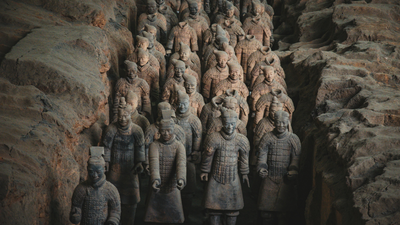
Imagine a vast underground palace, filled with treasures and guarded by an army of stone warriors, that has been kept tightly sealed for over two thousand years. This is the tomb of Qin Shi Huang, China’s first emperor, who unified the nation in 221 BC and chased immortality until his death in 210 BC.
According to the BBC, it was discovered near Xi’an in 1974 by farmers who drilled a well, and the site revealed the famous Terracotta Army, where thousands of life-sized clay soldiers were preparing for battle. However, despite this amazing discovery, archaeologists have never penetrated the inner shrine of the emperor. Whispers of deadly traps, rivers of toxic mercury, and fragile wonders within keep them at bay. It’s a tantalizing puzzle that mixes ancient ingenuity with modern caution, raising questions about preservation versus archaeological curiosity.
Are there deadly traps and mercury rivers in China? Qin Shi Huang’s tomb
Ancient texts paint a chilling picture of the tomb’s defences. Historian Sima Qian, in his Records of the Grand Historian (Shiji), described crossbows rigged to fire at intruders and mechanically flowing mercury to imitate China’s great rivers, such as the Yangtze and Yellow River. Sima Qian wrote, as mentioned in historical accounts of the construction of the shrine: “The craftsmen were ordered to make bows and arrows intended to shoot anyone who entered the tomb. Mercury was used to simulate the hundred rivers.”
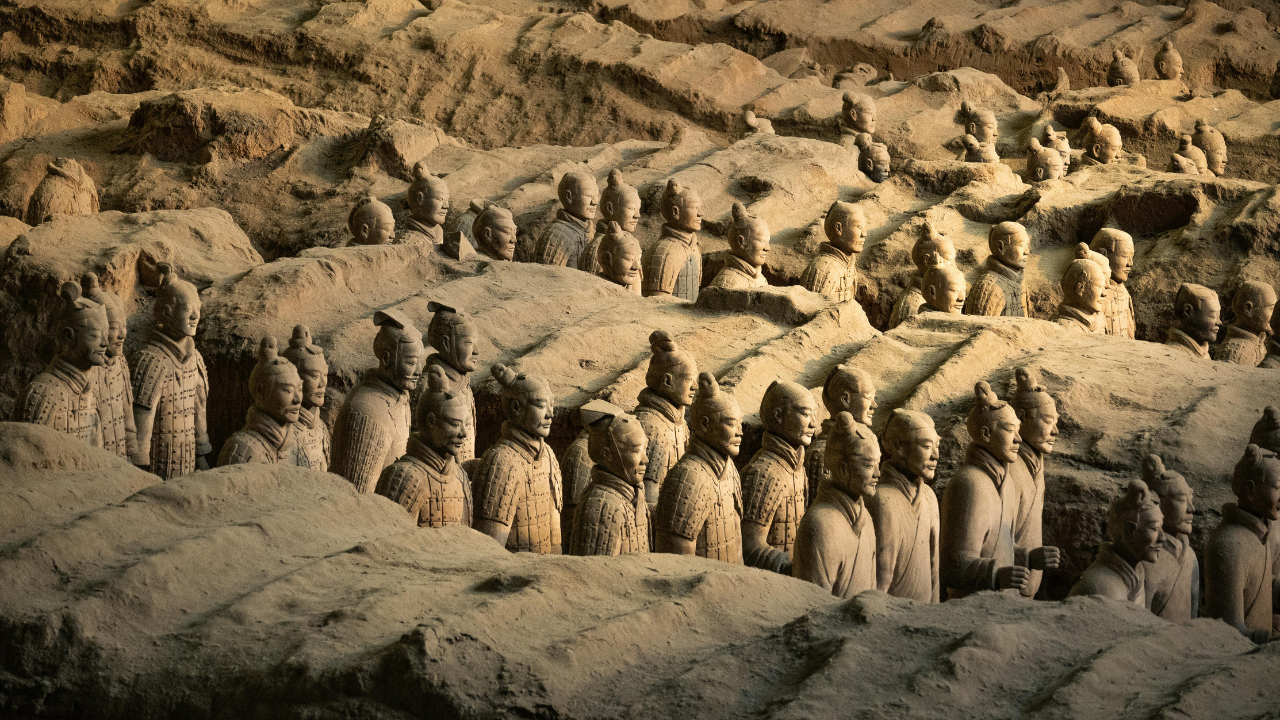
Image credit: Canva
Modern science supports these claims. A 2020 study published in the journal Nature found unusually high levels of mercury in the soil around the tomb mound, far exceeding normal concentrations. Ground-penetrating radar revealed vast chambers and cavities beneath the 76-meter-high pyramid-shaped hill, suggesting the complex “underground palace” described by Sima Qian. While some doubt that the traps are still working after 2,200 years, mercury alone poses a volatilization risk; If disturbed, they can quickly evaporate, poisoning the air.
Archaeologist Duan Qingbo, head of the team at the Shaanxi Provincial Archaeological Institute, confirmed the high density of mercury coming from the shrine itself during geological surveys. “We found through a survey that the density of mercury in the Qinshihuang Cemetery area is exceptionally higher than that in the area on the ocean,” Duan told China Daily in 2006. These results explain why experts are cautious. Opening a grave can unleash dangers that we cannot fully predict.
Preservation risks when opening the emperor’s tomb
The Terracotta Army offers a stark warning. When first exposed to the air in the 1970s, the warriors’ once vibrant colors faded in minutes. “When the Terracotta Army was uncovered in the 1970s, its bright pigments faded within minutes after coming into contact with air,” reports about the challenges of excavating the site. Within the enclosed central chamber, artefacts may be perfectly preserved in their ancient balance, but sunlight, oxygen, and moisture can instantly destroy them.Zhang Bai, deputy director of China’s State Administration for Cultural Heritage (SACH), emphasized this at the 15th ICOMOS Assembly in Xi’an in 2005. “These cultural relics have been buried for more than 2,000 years in the grave and have achieved a state of balance. If they are excavated incorrectly… they will quickly turn into disrepair,” Zhang said, citing an example where unearthed ivory turned into powder in just two hours.
SACH policy strictly limits excavations to cases of natural threats, thefts or national needs, and rejects even nearby cemeteries to avoid damaging the main site.Duan Qingbo echoes this warning: “This is not the time to open the tomb at the moment, as many things are still unknown.” Modern non-invasive technology such as remote sensing has revealed symmetrical staircases and wooden structures that were never mentioned in the records, proving that we still lack a complete understanding.
Rushing in without foolproof protection technology would be tantamount to archaeological vandalism.
The official position on the unopened tomb of the Chinese Emperor
As the World Intellectual Property Organization suggests, China’s cultural heritage laws prioritize “protection first.” The Cultural Heritage Protection Law of the People’s Republic of China only allows excavation under difficult circumstances, a principle that SACH upholds for Qin Shi Huang’s Mausoleum. Even proposals made in the 1990s regarding tourism or earthquake safety were rejected.Michael Petzet, then president of the International Council on Monuments and Sites (ICOMOS), supported this at the same Xi’an Assembly: “Let Qinxihuang and his underground palace continue their deep sleep.” Political and moral layers add weight. Qin Shi Huang unified China, but through brutal means and discomfort he could create cultural controversy. The site’s status on the World Heritage List since 1987 requires global standards of care.Today, the focus remains on the outer pits: more than 8,000 unique soldiers and chariots, and even a possible royal tomb of Prince Gao, were recently discovered. These yield insights without risking substance. As Duane notes, the tomb’s ancient drainage system kept its contents intact for thousands of years. Why gamble now?In the end, refusing to open this 2,200-year-old wonder is not cowardice; It is wisdom. By leaving Qin Shi Huang’s tomb sealed, archaeologists are honoring his legacy while waiting for technology that can truly safely uncover his secrets. Future generations may enter one day, but for now, the Emperor’s eternal guards stand guard, and their secret lives on.
