The National Council of Educational Research and Training (NCERT) has reduced the English syllabus for Class IX, reducing the number of textbooks from two to one, and the number of texts from 29 to 16.

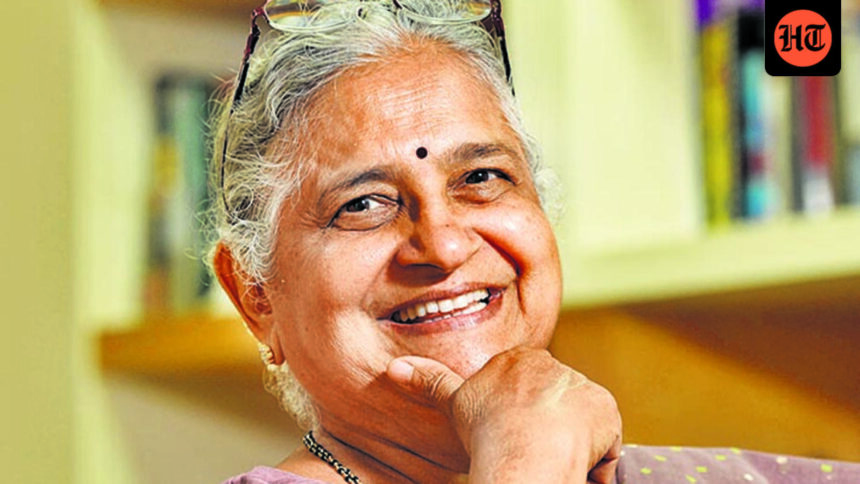
The new English book for Class 9 begins with a story taken from the 2004 book titled How I Taught My Grandmother to Read and Other Stories by Rajya Sabha MP and author Sudha Murty.
It also includes texts by famous Indian writers such as Subramanya Bharati and Rabindranath Tagore, and lesser-known foreign poets such as Brianna T. Perkins, Irene Chua, and Robert Langley. Of the 29 texts in the previous two textbooks, 28 texts have been replaced in the new book.
Only O’Henry’s short story “The Last Leaf” appears in the new book.
In the opening story of the new textbook – seen by HT, which was released on Monday – titled ‘Kaveri’, narrator Murty recalls living with her grandparents in a village in north Karnataka when she was 12, where poor transport meant the morning newspaper arrived only in the afternoon.
She tells how her grandmother decided to learn to read and write late in life. Determined to read on her own, the grandmother told Murty, according to the book: “I have decided that I want to learn the Kannada alphabet from tomorrow onwards… On that day I should be able to read a novel on my own. I want to be independent.”
Reflecting on that moment, the narrator says she was deeply moved by her grandmother’s determination and understood “the meaning of independence and self-respect” in a new way. The story ends on an emotional note when the grandmother, having learned to read, bows to her granddaughter and says she is touching the feet of “a teacher who taught me well.”
The story depicts “the inspiring journey of a grandmother who overcomes age and circumstance to learn to read and write, with the guidance of her granddaughter. It highlights how learning can lead to independence and self-worth at any stage of life,” according to the About the Book section.
The new textbook, which is available on online shopping platforms, has been developed in line with the National Education Policy (NEP) 2020 and the National Curriculum Framework for School Education (NCF-SE) 2023. The book titled ‘Kaveri’ will be introduced for Class IX from the academic year 2026-27, replacing the previous ‘Beehive’ and ‘Moments’ textbooks.
“The book has been made available on online shopping platforms like Amazon where students can order the book. However, the PDF format of the new book has not yet been uploaded on the books section of the NCERT website,” a person familiar with the development told HT.
In the previous textbooks – which were taught in schools between 2006-07 to 2025-26 academic sessions – 15 out of 29 texts were written by international authors.
Famous foreign works include “The Fun They Had” by Isaac Asimov, “The Road Not Taken” by Robert Frost, and “The Happy Prince” by Oscar Wilde. Meanwhile, Indian sounds included tracks like “My Childhood” by APJ Abdul Kalam, “The Snake and the Mirror” by Vaikum Muhammad Bashir, “A Truly Beautiful Mind” by RK Laxman, and “Lost Child” by Malik Raj Anand.
The new Class 9 textbook ‘Elements of Indian Knowledge Systems (IKS)’ contains 16 texts – eight by Indian authors, including Subramanya Bharati, Sudha Murty, Thimsula Ao, Mitra Phukan and Rabindranath Tagore, and six by foreign writers such as David Roth, Charles Swain, Brianna T Perkins, Robert Langley, Maya Antony and Irene Chua.
The new textbook for Class IX, which also contains ‘Elements of Indian Knowledge Systems (IKS)’, contains 16 texts – eight by Indian authors, including Tamil nationalist poet Subramanya Bharati, author and Rajya Sabha MP Sudha Murty, Naga poet and writer Thimsula Ao, Assamese novelist Mitra Phukan, and Nobel Prize-winning poet Rabindranath Tagore. Six texts by foreign writers such as American poet David Roth, English poet Charles Swain, American children’s writer Brianna T. Perkins, poet Robert Langley, writer Maya Anthony, and Singapore-based author Erin Chua.
The book also includes an anonymous poem titled “Gifts of Grace: Honoring Our Callings,” and an interview-based essay titled “The World of Limitless Possibilities,” including an interview with Paralympic athlete Deepa Malik.
Aside from Murti’s story, the new English textbook includes “The Pot Maker” by Temsola Ao, which focuses on traditional handicrafts and the dignity of skilled labour. It also includes the book “Vitamin M” by the Indian author Asha Nehemiah, who wrote a children’s book, which highlights the emotional value of relationships, and the book “Follow This Dream” by the Singaporean writer Erin Chua, which encourages perseverance and ambition.
Subramanya Bharati’s ‘Bharat Our Land’ pays tribute to the country’s heritage and unity, while Rabindranath Tagore’s ‘I Can’t Remember My Mother’ reflects the emotion and loss of a mother. Other poems include David Roth’s “Nine Gold Medals,” which celebrates sportsmanship and compassion, Charles Swain’s “Words” on the power of language, and Robert Langley’s “Believe in Yourself,” which emphasizes confidence and determination.
In the introduction to the textbook, Dinesh Prasad Saklani, Director, NCERT, said: “The content of the book has been chosen to engage learners with concerns about society, environment, ethics, science, technology, aspirations and human relations. This will encourage learners to think critically and affirmatively about the world in which they live.”
Shweta Kumari, an English teacher at St. Marks Higher Secondary School in Delhi’s Harsh Vihar, said the lower content load allows more time for classroom activities. “It is good that the content load has been reduced as we have more time to enable students to learn through the practical activities mentioned in the book,” she said.