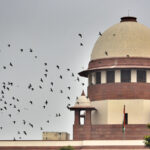
The Supreme Court on Monday issued orders asking high courts across the country to set strict timelines for early completion of acid attack trials, even as it directed states and union territories to come up with policies that ensure preference is given to victims of such crimes in government jobs.

The guidance came in a public interest litigation brought by an acid attack survivor, whose case had been on trial since 2009. In December, the Supreme Court asked all high courts to provide information on continuing acid attack trials within their jurisdiction.
A bench of Chief Justice of India Surya Kant and Justice Joymalia Bagchi said on Sunday: “We request the high courts to fix a schedule for the lower courts.”
The court, reviewing reports submitted by various high courts, said it was “disappointed” at the nearly 160 cases pending in West Bengal as stated by the Calcutta High Court. Moreover, a large number of pending trials have also been reported in Uttar Pradesh.
Most of the High Courts have informed the Supreme Court that circulars have been issued to all their respective trial courts for speedy disposal of acid attack cases. The ICJ-led body also said: “Let the portfolio judge or administrative judge carefully monitor the extent to which the lower courts comply with these circulars.” High Courts were requested to submit reports updating the steps taken for the speedy conclusion of trials.
The court also directed all states and union territories to provide information about welfare schemes available to victims of acid attacks. “All states and union territories will show why no rehabilitation scheme through employment in government or government-controlled sectors should be directed to the victims of acid attacks by them,” the order said.
If the States/Union Territories face logical problems in extending such preference to acid attack victims, the court directed them to submit a proposal for payment of fees in the form of subsistence allowance to such victims.
Following publication of the matter the following month, the court sought the assistance of a senior advocate from the Supreme Court Legal Services Commission (SCLSC) to compile data from each State/UT’s reports regarding total incidents, compliance with the victim compensation scheme and existence of rehabilitation plans for acid attack victims.