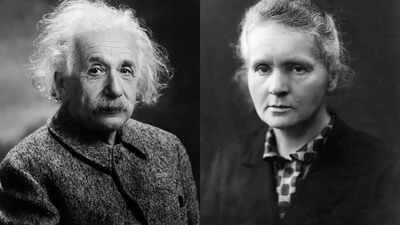
Albert Einstein’s letter to Marie Curie
History often remembers great scientists only for what they discovered. But sometimes, when they are alone together, they show a completely different side of the scientific world. One of these stories is about two of the most famous scientists of the twentieth century: Albert Einstein and Marie Curie. In 1911, Curie was at the center of a major public controversy in France.
At the same time, she was also preparing to receive her second Nobel Prize. Amid intense criticism and media attention, Einstein wrote her a personal letter. According to academic biographies, the thesis was not related to physics or scientific theory. Instead, it was a message of support and admiration. The letter has since become an interesting part of scientific history because it shows how one scientist stood up for another during a difficult time.
The story behind this letter explains how scientists sometimes had to deal with stress outside the lab and how respect for each other helped them form long-lasting friendships.
When Marie Curie was facing public controversy
Marie Curie was already one of the world’s most respected scientists by 1911. She and her husband, Pierre Curie, as well as physicist Henri Becquerel, won the Nobel Prize in Physics in 1903 for their research into radioactivity. However, academic biographies say that Curie was harshly criticized in public life despite her scientific success.
French newspapers began writing about her relationship with physicist Paul Langevin that year. Langevin was married but not living with his wife, and the case quickly became a big story in the news.When the newspapers obtained private letters between Curie and Langevin, things got even worse. People talked more about her personal life than her scientific work. Meanwhile, Curie had just lost a close vote to join the French Academy of Sciences, which had never allowed a woman to join before.
An unexpected letter of support from Albert Einstein to Marie Curie
In November 1911, Albert Einstein wrote a special letter to Marie Curie during this difficult time. At that time, Einstein had just met Curie at a scientific meeting in Brussels and expressed great appreciation for her work and personality.Einstein began the letter by expressing his admiration for Curie’s intelligence, determination, and honesty. He wrote that he felt lucky to have met her in person.He also strongly criticized the way she was treated by the public and the media.
In the letter, Einstein described the sensationalist coverage as unfair and advised Curie not to pay attention to it. According to the translation of the letter, he suggested that if the public continued to spread rumours, they should simply ignore them rather than read them.The message was supportive and direct. It showed that Einstein believed that public gossip should not detract from Curie’s scientific work.
Here is the message:
Prague, November 23, 1911Dear Ms. Currie,Don’t laugh at me because I write to you without having anything sensible to say. But I’m so angry at the bastard [niederträchige] The way the rabble [Pöbel] Nowadays I dare to treat you that I must definitely give vent to this feeling. But I’m sure you despise this rabble, both when he pretends to be in love and when he uses you to quench his thirst for excitement! I must tell you how much I have become a fan of your spirit [Geist]Your creativity and honesty. I consider myself lucky to have known you personally in Brussels. Surely no one other than these reptiles is happy, now as before, to have such eminent persons as yourself, as well as Langevin, among us—real people. [wirkliche Menschen] With whom one feels proud to associate. If the mob continues to bother you, simply don’t read this message. Rather, leave it to the reptile for whom it was created.Best regards to you, Langevin [Jean] Beren,really really yours,A. EinsteinNote: I have defined the statistical law for [rotational] Movement of a diatomic molecule in a Planck radiation field by means of a funny joke [lustigen Witz]Of course assuming that the movement of the structure obeys the laws of ordinary mechanics. But I do not have much hope that this law will be valid on the ground.”
The scientific meeting that began their friendship
Einstein and Curie first interacted closely during the 1911 Solvay Conference in Brussels.
This event brought together many of the leading scientists of the time to discuss new ideas in physics.The conference included figures who later shaped modern physics, including Einstein, Curie, and other pioneers studying radiation, atomic structure, and energy.Although they had only just met, Einstein soon developed a deep respect for Curie’s work and her personality. According to academic biographies, historians of science believe that the letter he wrote during the scandal helped cement a long-standing friendship between the two scientists.Their professional relationship continued for many years afterward.
Marie Curie’s second Nobel Prize during the controversy
The controversy surrounding Curie’s personal life occurred at the same time she was about to receive another major scientific honor.In 1911, she received the Nobel Prize in Chemistry for her research on the discovery of the elements polonium and radium and for her research on radioactivity.Some people even said that she should not go to the Nobel Prize ceremony because of the public scandal.
Corrie chose to go to the ceremony and accept the award herself anyway, even though there was a lot of pressure on her.She was the first person ever to win two Nobel Prizes in two different fields of science.
What Einstein wrote at the end of the letter
Historians have often pointed to one part of the letter because it shows what kind of scientist Einstein was.Einstein wrote a short note at the end about a new scientific idea he was working on, after providing him with support and encouragement.
Talk about a statistical law related to how particles move in a radiation field.The brief scientific note seemed like an afterthought after the emotional letter. This little thing shows how scientists often talked about personal and scientific things in the same conversation.
Why does the message still attract attention today?
Historians and readers remain interested in the letter between Einstein and Curie for a number of reasons.First, it shows the human side of two important worlds.
Most people remember Einstein and Curie for their important theories and discoveries. But this conversation shows how they treat each other and how much they respect each other.Second, this episode shows how difficult it was for scientists in the early twentieth century, especially women who worked in fields that were mostly male.Finally, the letter shows how the scientific community has sometimes stood by each other when they have been publicly criticized.